Forging Pistons for 1000+ HP Applications: Material Grades and Ring Land Design
You need forged pistons for 1000+ HP because they handle over 1,500 psi cylinder pressure that shatters cast units. Use 2618 alloy-it delivers 60,000 psi tensile strength and resists thermal fatigue in forced-induction builds. Ring lands should be 2.0–2.5 mm thick to survive 2,000+ psi loads without cracking. Undercut or keystone grooves improve sealing and reduce ring flutter. Proper clearance, typically 0.004–0.006 in, manages expansion. There’s more to optimizing durability under extreme load.
Notable Insights
- Forged pistons made from 2618 alloy are ideal for 1000+ HP engines due to high tensile and fatigue strength.
- 2618’s superior strength at high temperatures makes it preferred over 4032 in forced-induction and high-stress applications.
- Ring lands in high-horsepower pistons are designed 2.0–2.5 mm thick to withstand cylinder pressures over 2,000 psi.
- Undercut and keystone ring grooves improve sealing, reduce flutter, and enhance durability under extreme pressure and RPM.
- Proper piston-to-wall clearance (0.004–0.006 in) and thermal coatings manage expansion and prevent skirt damage in forged pistons.
Why Forged Pistons Win in 1000+ HP Engines
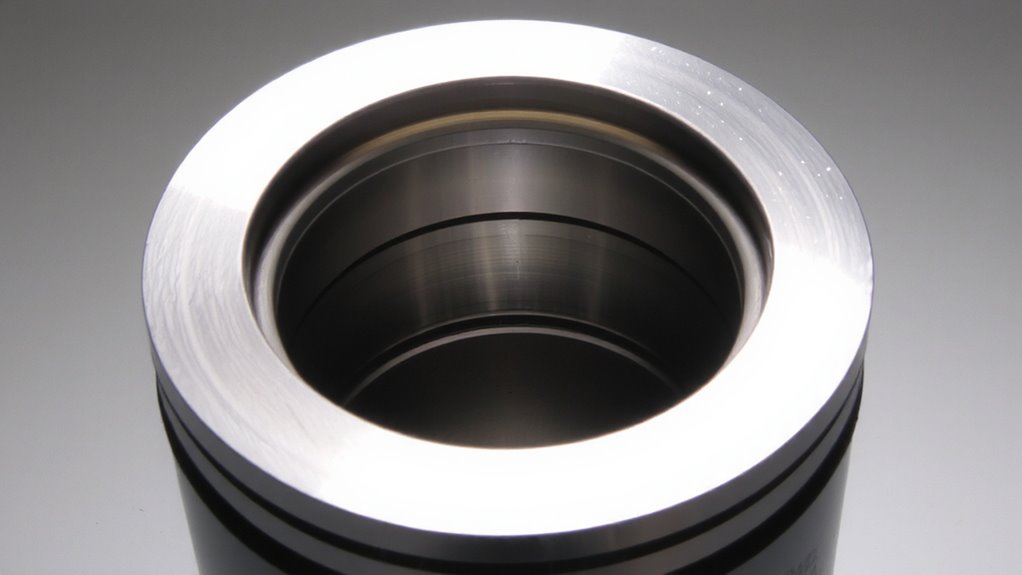
Strength. Forged pistons deliver the structural integrity needed in 1000+ HP engines. You’re dealing with extreme cylinder pressures-often exceeding 1,500 psi-where cast pistons fail. Forged aluminum alloys offer superior fatigue resistance, enduring repeated stress cycles without cracking. This is critical under sustained high-RPM operation. You’ll see better performance and reliability, especially when combined with a durable piston coating. The coating reduces friction, improves heat dissipation, and protects against micro-welding in high-load scenarios. Forged pistons are denser, with tighter grain flow alignment that resists deformation. They maintain dimensional stability under thermal expansion, keeping piston-to-wall clearance in check. Compared to cast units, they’re 20–30% stronger in tensile strength. You’re not just adding power-you’re ensuring survival. In high-output builds, failure isn’t an option. Forged pistons, with proper piston coating and inherent fatigue resistance, are your best defense against catastrophic engine failure.
Choose Forged 2618 or 4032 Aluminum Wisely
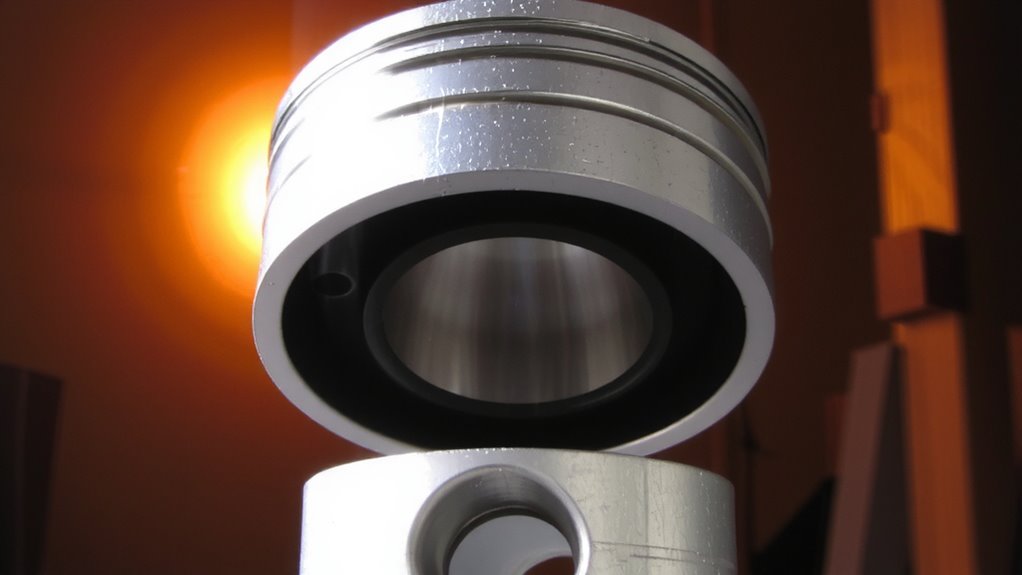
You’ve seen why forged pistons dominate in engines making over 1000 horsepower-now it’s time to pick the right alloy for your build. Your material selection between 2618 and 4032 aluminum直接影响 durability and performance. 2618 offers superior strength at high temperatures, with a tensile strength of 60,000 psi and yield strength of 45,000 psi, making it ideal for forced-induction applications. It handles extreme cylinder pressures but expands more due to lower thermal conductivity-about 120 W/mK. 4032 has 12–14% silicon content, improving thermal conductivity to approximately 160 W/mK, reducing expansion and offering tighter piston-to-wall clearances. That means quicker warm-up and less noise. However, it’s slightly more brittle under extreme stress. Choose 2618 for maximum power and abuse tolerance. Pick 4032 for naturally aspirated or moderate boost builds where thermal response matters most.
How Strong Ring Lands Resist High Cylinder Pressure
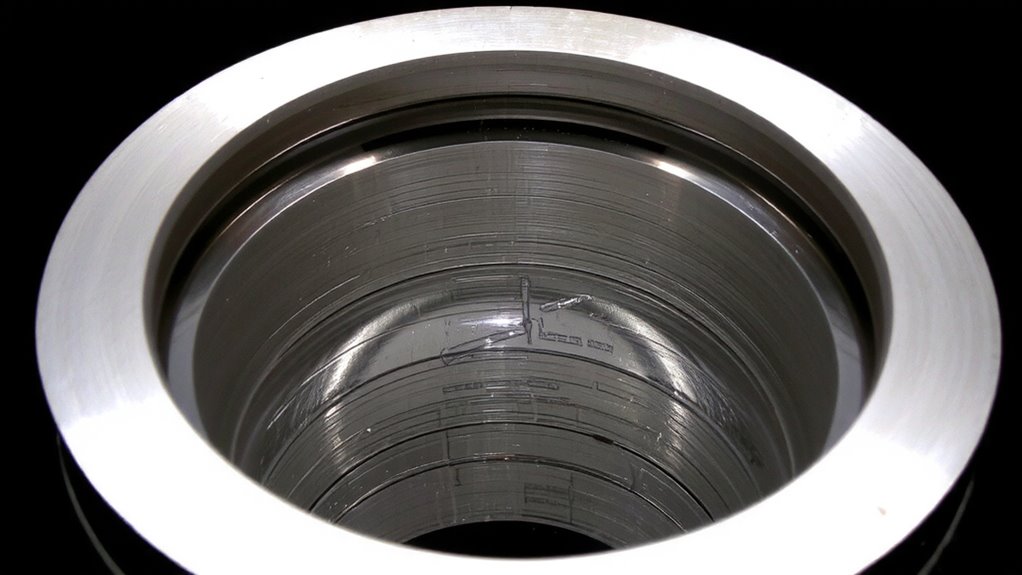
A well-designed ring land is critical for withstanding cylinder pressures that can exceed 2,000 psi in high-performance engines. You need ring rigidity to prevent deformation under extreme loads. Without it, the top ring land can flex, breaking the seal and increasing blow-by. Ring rigidity depends heavily on land thickness-typically 2.0 to 2.5 mm in forged pistons built for 1000+ HP. Thicker lands add strength but must be balanced against weight and thermal expansion. The material, like 2618 alloy, must also resist thermal fatigue. A rigid ring land maintains piston-to-cylinder integrity, ensuring consistent compression. It transfers combustion forces evenly to the ring groove, reducing stress peaks. You can’t rely on coatings or ring design alone-if the land flexes, the system fails. Proper land thickness and structural support are non-negotiable in high-boost or high-RPM applications where durability is paramount.
Use Undercut & Keystone Grooves for Durability
Ring land rigidity sets the foundation for piston integrity, but groove geometry fine-tunes durability under extreme combustion forces. You get improved ring control and reduced flutter using undercut and keystone top ring grooves. These designs allow better conformability under high pressure, minimizing blow-by and boosting efficiency. An undercut groove raises the ring’s contact edge, increasing seal quality. A keystone-shaped groove resists ring rotation and improves heat transfer. Both styles work well with modern piston coating to reduce friction and thermal load. They also interact safely with valve relief areas, avoiding stress concentrations.
| Groove Type | Shape | Best For |
|---|---|---|
| Undercut | Tapered inner | High-boost applications |
| Keystone | Trapezoidal | High-RPM endurance |
| Standard | Square | Mild performance |
Set Piston Clearance for Thermal Expansion
When designing high-performance pistons, accounting for thermal expansion is critical to avoiding seizure or excessive noise during operation. You must set piston-to-wall clearance precisely based on alloy type, bore size, and expected operating temperature. For forged aluminum pistons, typical clearance ranges from 0.004 to 0.006 inches in steel sleeves, but tighter tolerances apply with a piston coating. The coating acts as thermal insulation, reducing heat transfer to the piston skirt and allowing slightly reduced clearance. Thermal insulation also minimizes bore distortion and stabilizes operating temperatures. Always follow manufacturer specs, as over-tight clearance causes scuffing, while excessive clearance increases piston slap. A molybdenum-disulfide or ceramic-based piston coating improves durability and controls expansion. Clearance is not guesswork-it’s a calculated value ensuring ideal performance under extreme loads.
Match Forged Piston Design to Turbo, Supercharger, or Nitrous
Because forced induction and power adders drastically alter combustion dynamics, you can’t treat piston design as one-size-fits-all. Turbocharged engines demand forged pistons with reduced compression heights to accommodate higher effective compression ratios. You’ll need thicker ring lands-often 1.5–2.0 mm-to resist detonation. Piston coatings, like thermal barrier coatings on the crown, are essential; they reduce heat transfer to the piston, lowering crown temperatures by up to 200°F. Supercharged applications generate immediate cylinder pressure, so robust thrust face design is critical-look for asymmetrical forgings with added material on the major thrust side. Nitrous setups introduce massive, sudden pressure spikes; here, use pistons with conservative dome shapes and hardened wrist pins. Always pair your build with low-friction moly disulfide piston coatings and guarantee the thrust face design matches your engine’s dominant load direction.
On a final note
You need forged pistons for 1000+ hp engines. They handle extreme cylinder pressure and thermal loads better than cast alternatives. Use 2618 aluminum for high strength and ductility or 4032 for tighter clearances and reduced noise. Ring lands must be thick-minimum 2.5 mm-at the top to resist cracking. Undercut and keystone ring grooves improve sealing and ring life. Maintain piston-to-wall clearance between 0.0035 and 0.005 inches per inch of piston diameter for thermal expansion.