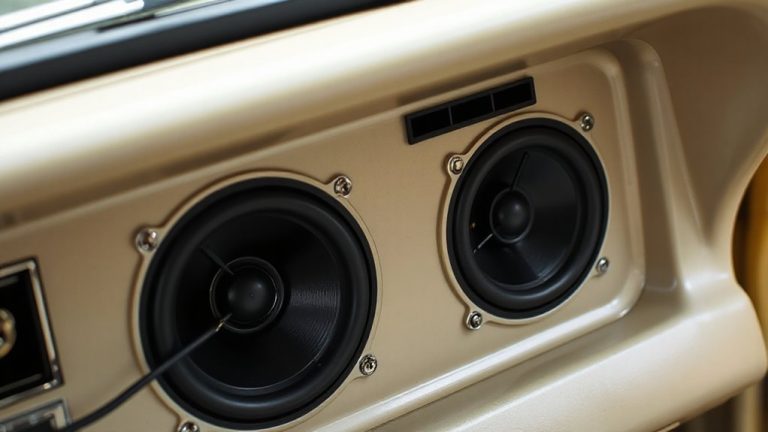
Why Dual-Voice Coil Drivers Offer Wiring Flexibility
You get more wiring options with dual-voice coil (DVC) drivers because they have two identical voice coils-typically 4Ω or 2Ω each-on one former. Wiring them in series doubles the impedance, while parallel halves it. This lets you fine-tune the final load to match your amplifier’s stable range, like 1Ω, 2Ω, or 4Ω. You can combine multiple DVC subs to optimize power delivery and heat management. Smart wiring maximizes efficiency, prevents clipping, and activates your system’s full potential.
Notable Insights
- Dual-voice coil drivers have two identical coils on one former, enabling multiple wiring configurations.
- Each coil has matching impedance, allowing symmetrical and balanced circuit designs.
- Parallel wiring combines coils to halve total impedance, increasing amplifier power output.
- Series wiring links coils to double impedance, reducing current and improving thermal safety.
- Multiple DVC subwoofers can be wired to achieve 1Ω, 2Ω, or 4Ω loads for amplifier compatibility.
What Is a Dual-Voice Coil Driver?
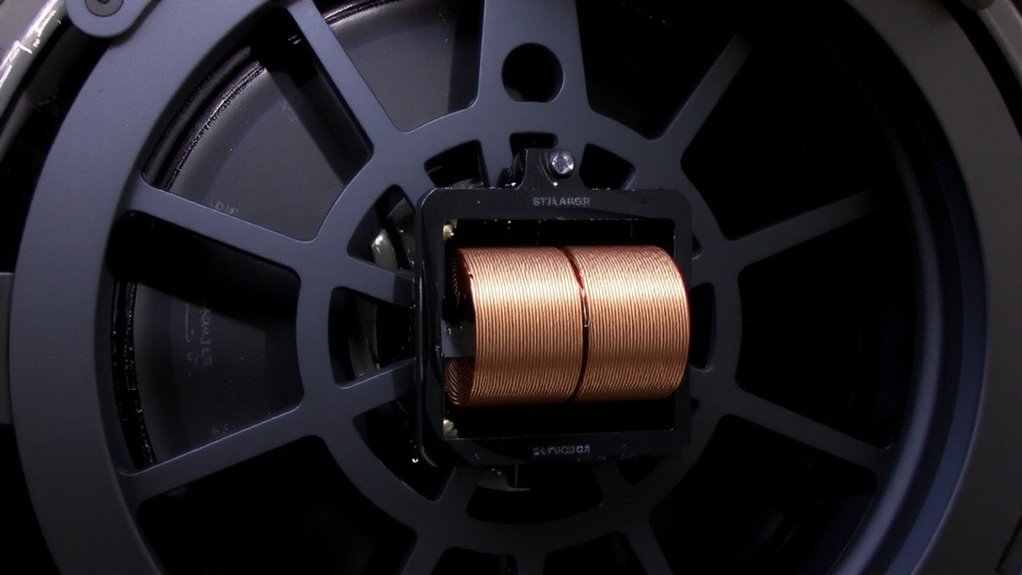
Picture having two voices instead of one-each capable of handling sound independently-within a single speaker. A dual-voice coil driver does exactly that, featuring two separate voice coils wound around a common former. Each coil interacts with the same magnetic gap, allowing independent or combined signal control. This design enhances voice coil symmetry, ensuring even movement and reduced distortion. Precise magnetic flux balance is maintained across the pole pieces, improving efficiency and thermal management. Dual-coil systems typically have identical electrical characteristics-same impedance, winding turns, and coil length-for matched performance. You’ll find these drivers in 4Ω or 8Ω dual configurations, often used in subwoofers. Their symmetrical layout promotes linear excursion and tighter bass response. Unlike single-coil units, they distribute power more evenly, minimizing heat buildup. Voice coil symmetry and magnetic flux balance together deliver greater mechanical control. That means accuracy, power handling, and longevity improve without added complexity.
Why Two Voice Coils Mean More Wiring Options

Because you have two independent voice coils on a single former, wiring configurations become far more flexible than with single-coil drivers. You can optimize impedance matching to suit different amplifier outputs, whether you’re running 2-ohm, 4-ohm, or higher loads. Each coil typically has the same nominal impedance-like 4 ohms-giving you options. Wire them in parallel, and the total impedance drops; wire in series, and it increases. This adaptability simplifies integration into complex audio systems. Power distribution also improves, as the dual coils split amplifier output across two windings, reducing heat buildup and mechanical stress. Balanced power delivery enhances thermal handling and increases reliability under high drive levels. You gain precise control over how electrical energy converts to sound, improving overall efficiency. With dual voice coils, you’re not locked into one setup-you can tailor the driver’s electrical behavior to your system’s demands, ensuring peak performance and longevity.
Series vs. Parallel Wiring Explained
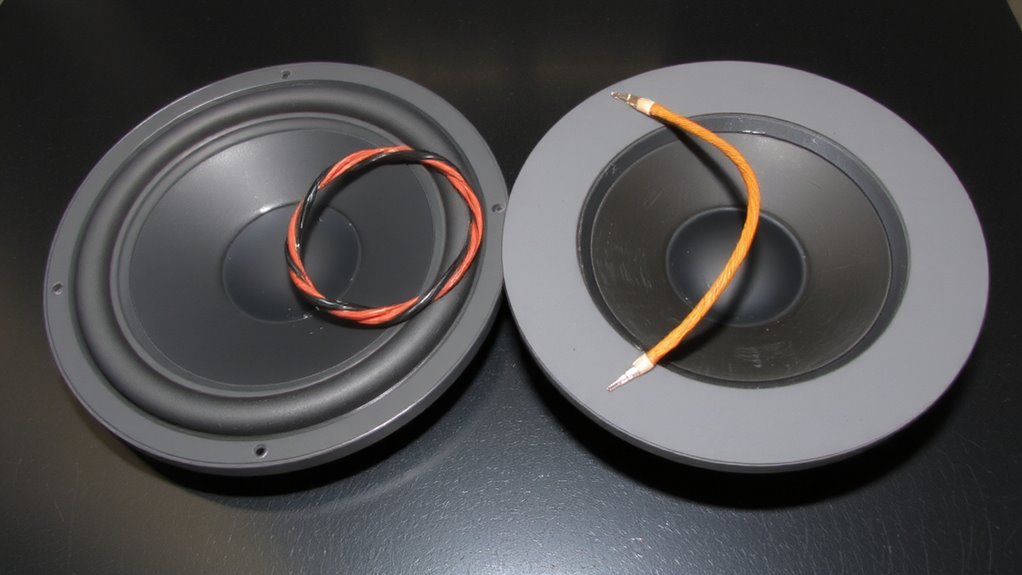
How do you get the most out of a dual-voice coil subwoofer? You choose the right wiring configuration-series or parallel. In series wiring, you connect the positive of one coil to the negative of the other, increasing total impedance. This reduces current draw and improves heat dissipation, protecting your amplifier during long sessions. Parallel wiring connects both positives and both negatives together, lowering impedance and increasing power output. However, lower impedance can lead to signal degradation if your amp isn’t stable at that load. Series wiring typically doubles the coil impedance (e.g., two 2-ohm coils yield 4 ohms). Parallel halves it (e.g., two 4-ohm coils yield 2 ohms). Each method affects how efficiently power transfers and how well the system manages thermal stress. Choose based on your amp’s specs and thermal limits.
How to Match DVCs to Your Amp’s Ohm Load
Impedance matching sits at the heart of a stable, efficient car audio system. When using dual-voice coil (DVC) subwoofers, you can adjust wiring to meet your amp’s minimum ohm load. Each DVC driver has two voice coils-typically 2-ohm or 4-ohm per coil. Wiring them in series adds the impedance; parallel divides it. For example, a 4-ohm DVC wired in series presents 8 ohms, while parallel yields 2 ohms. You need to align this final impedance with your amplifier’s stable load-most commonly 2, 4, or 1 ohm. Proper impedance matching prevents amp shutdowns and overheating. It also enables power optimization, letting your amp deliver maximum rated wattage safely. Mismatched loads risk underperformance or damage. Always check your amp’s specs and use DVC wiring configurations that meet its ideal ohm output. This precision guarantees clean, reliable bass.
Wiring Multiple DVC Subwoofers for Maximum Power
When you’re stacking multiple dual-voice coil (DVC) subwoofers, how you wire them determines whether you tap your amplifier’s full power or leave watts on the table. Wiring in parallel lowers impedance, allowing more current flow and higher power output. A 2-ohm final load is often ideal for monoblock amplifiers, accessing peak power handling safely. Series wiring increases impedance, reducing amplifier strain and aiding thermal management. For two 4-ohm DVC subs, parallel the coils per sub, then parallel both subs-this yields a 1-ohm load, suited for stable, high-current amps. Matching the final impedance to your amp’s rated output guarantees efficiency. Proper wiring maximizes heat dissipation and prevents clipping. Optimize connections with 12-gauge wire and secure terminals. You’re not just routing wires-you’re engineering performance.
When Does DVC Wiring Really Make a Difference?
Why would you choose dual-voice coil (DVC) subwoofers over single-voice coil (SVC) models? When impedance matching and amplifier compatibility matter, DVCs give you more options. You can wire two 4-ohm DVC subs to present a 1-ohm, 2-ohm, or 4-ohm load, letting your amp run efficiently at its stable output range. This flexibility enhances thermal stability by preventing overheating under heavy loads. With single voice coils, your wiring choices are limited. DVCs also improve phase alignment-both coils receive identical signals, reducing timing errors and distortion. When you’re pushing high wattage, even minor misalignment affects sound quality. Dual coils distribute power evenly across the motor structure, reducing mechanical stress and voice coil wear. This balanced load increases longevity and maintains output consistency. For precision-tuned systems where performance matters, DVC wiring isn’t just convenient-it’s critical.
On a final note
You gain precise impedance control with dual-voice coil (DVC) drivers. Each coil typically measures 2 or 4 ohms, letting you wire in series or parallel. Series wiring adds resistance-useful for matching 8-ohm stability. Parallel wiring halves impedance, ideal for 1-ohm amp compatibility. This flexibility optimizes power delivery from your amplifier. You maximize efficiency and avoid overheating. DVCs adapt where single-coil subs can’t. Think of it as having multiple tools in one speaker.