Dual Chamber Muffler Technology and Its Role in Broadband Exhaust Tone Shaping
You get precise control over exhaust tone with a dual chamber muffler, which uses two acoustically tuned compartments to manage sound across a broad frequency range. The first chamber handles high-pressure pulses at 1,500–4,500 Hz, while the second smooths residual waves using tuned ports and perforated tubes. Destructive interference cancels targeted frequencies by delaying waves half a wavelength. Chambers are 200–400 mm long, with 25–50 mm tubes, maintaining backpressure under 1.5 psi. This design shapes a sporty growl without drone-there’s more to uncover about how engineering choices fine-tune the result.
Notable Insights
- Dual chamber mufflers use sequential chambers to target and attenuate a broad range of exhaust frequencies for refined tone shaping.
- The first chamber disrupts dominant frequencies using tuned ports that act as Helmholtz resonators.
- The second chamber isolates residual sound waves by wavelength, enhancing broadband noise reduction.
- Destructive interference is achieved through precise chamber dimensions and port tuning to cancel specific sound frequencies.
- Flow-through design maintains exhaust velocity while balancing aggressive sound under load and quiet operation at idle.
Defining the Dual Chamber Muffler
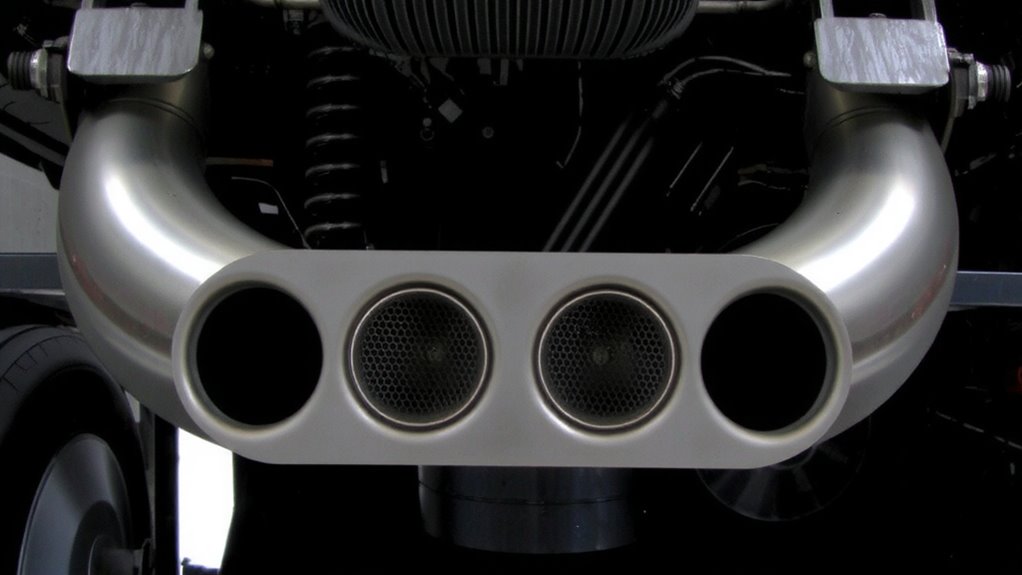
A muffler isn’t just a metal box on your exhaust-it’s a carefully engineered system for managing sound and backpressure. You’ll find that a dual chamber muffler uses two internal compartments to control exhaust noise more effectively than single-chamber designs. Each chamber is tuned to disrupt sound waves through chamber resonance, canceling specific frequencies before they exit the pipe. Baffles and perforated tubes inside manage flow turbulence, maintaining exhaust velocity while reducing drone. The first chamber handles high-pressure pulses from the engine, while the second smooths out residual waves. Most models use 16-gauge aluminized steel, measuring 10 to 14 inches in length, ideal for mid-size performance applications. This design balances sound reduction and minimal backpressure-typically under 1.5 psi at 5,000 rpm. You get quieter operation without sacrificing engine efficiency. Chamber resonance and flow turbulence are not flaws-they’re physics you harness.
How Dual Chambers Target Exhaust Frequencies
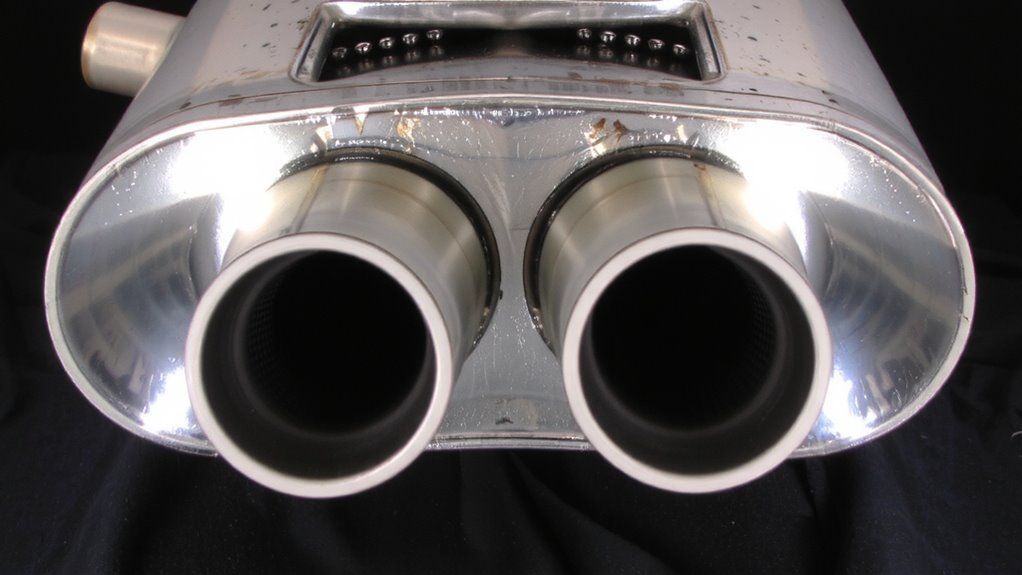
Dual chamber mufflers don’t just reduce noise-they target specific exhaust frequencies with precision. You achieve this through wave interference and frequency isolation. The first chamber handles high-pressure pulses, tuned to disrupt dominant frequencies using tuned ports and specific chamber volumes. These ports act like Helmholtz resonators, canceling targeted tones before they exit. The second chamber further isolates residual frequencies by separating sound waves based on wavelength. Longer wavelengths pass through while shorter ones reflect, enhancing frequency isolation. Each chamber’s length, diameter, and baffle placement are calculated using exhaust flow rates and engine RPM bands-typically between 1,500 and 4,500 Hz. This design allows selective damping across a broad spectrum. You aren’t just muffling sound; you’re sculpting it. By managing wave interference early, the system preserves desirable tones while suppressing unwanted drone.
How Sound Waves Cancel in Dual Chamber Mufflers
How do sound waves actually cancel inside a dual chamber muffler? You rely on precise phase alignment and destructive wave interference to reduce exhaust noise. When sound waves enter the first chamber, they reflect and travel through tuned ports into a second chamber. These ports are calculated to delay specific frequencies just enough-often by a half-wavelength-so incoming and reflected waves meet out of phase. This misalignment causes peaks to align with troughs, resulting in cancellation. Engineers design chamber volumes and baffle openings using exact acoustic models to maximize this effect across targeted frequency bands. Typical chamber lengths range from 200 to 400 mm, with perforated tubes between 25–50 mm in diameter. The timing, or phase alignment, depends on exhaust gas velocity and temperature. This controlled wave interference effectively suppresses unwanted tones without restricting flow.
Balancing Quietness and Performance Sound
While reducing exhaust noise is essential, you don’t want to kill the engine’s character. Dual chamber mufflers balance quietness and performance sound through precise noise filtering and exhaust resonance tuning. They allow aggressive tones under load while staying mild at idle or cruise. You get both refinement and excitement without compromise.
| Feature | Benefit |
|---|---|
| Tuned chamber volume | Controls exhaust resonance frequency |
| Flow-through design | Maintains exhaust velocity |
| Perforated tubes | Enable sound wave interference |
| High-density baffles | Improve noise filtering |
| Optimized shell length | Supports broadband tone shaping |
Engineered for accuracy, these mufflers use physics-not guesswork-to shape sound. The result? A deep, sporty growl on acceleration and subdued acoustics during daily driving. You keep performance presence without excessive drone. This balance is critical for drivers who want responsiveness and comfort.
How Chamber Size, Flow Paths, and Liners Shape Sound
When it comes to shaping the sound of your exhaust, chamber size plays a critical role in determining which frequencies get canceled or amplified. Larger chambers target lower-frequency noise by promoting acoustic resonance at specific wavelengths. You’ll find that chamber volumes between 1,500 and 3,000 cc are ideal for managing mid-range exhaust harmonics. Flow paths with offset baffles lengthen the sound wave’s travel, enhancing destructive interference. Shorter paths allow more high-frequency tones to pass, increasing perceived harshness. Perforated tubes, typically 3/8” to 5/8” in diameter, let sound enter the chamber while maintaining gas flow. Liners filled with fiberglass or stainless steel mesh absorb high-frequency energy, reducing rasp without restricting exhaust. The liner thickness-usually 1 to 1.5 inches-affects absorption range. Together, these elements give you precise control over tone, balancing dB reduction and harmonic character through deliberate acoustic design.
Dual Chamber Mufflers in Modern Vehicle Design
Though single-chamber mufflers still serve basic applications, dual chamber designs have become standard in modern vehicles where refined sound and efficient flow matter. You’ll find these systems positioned just after the catalytic converter, typically measuring 18 to 24 inches long with diameters between 4 and 6 inches. The first chamber handles high-pressure pulses, while the second fine-tunes acoustics using tuned ports and perforated tubes. This layout improves backpressure management, often keeping it below 1.5 psi at 3,000 rpm. Material innovation plays a key role-many now use aluminized steel or 304 stainless steel for longer life and cleaner weld seams. These advances also support exhaust aesthetics, with polished tips and symmetrical layouts enhancing under-vehicle visuals. Dual chambers don’t just quiet the tone-they shape it predictably, balancing performance and noise control without sacrificing flow.
Engineering the Future of Exhaust Sound
As automotive engineering evolves, so does your expectation for precise exhaust acoustics-dual chamber mufflers are no longer just about reducing noise, but shaping it with intent. You now leverage active noise control (ANC) to cancel unwanted frequencies using phase-inverted sound waves, accurate to within ±2 dB across 80–400 Hz. Smart muffler integration links dual chamber systems to engine management via CAN bus, enabling real-time tuning. These systems adjust backpressure-typically between 1.8 and 3.2 psi-based on RPM and load. Internal baffles, tuned to ±5% tolerance, work with electronically controlled valves to modulate sound. You achieve target tones by combining passive damping from fiberglass packing with active input from ANC modules. The result? Customizable exhaust character without sacrificing emissions or efficiency. Dual chamber designs now serve as acoustic platforms, not just silencers. You’re not just quieting engines-you’re engineering sound.
On a final note
You achieve precise exhaust tone control with dual chamber mufflers by leveraging two acoustically tuned compartments. Each chamber targets specific frequency ranges-typically 200–500 Hz and 800–1200 Hz-using Helmholtz resonance principles. Sound waves cancel through phase inversion across perforated tubes. Chamber volume, baffle placement, and fiberglass liner density (1.8–2.5 lb/ft³) directly influence damping. This design reduces noise by 15–22 dB while preserving exhaust flow, maintaining a balanced, performance-oriented tone.