How to Choose Lightweight Wheels for Improved Acceleration and Braking
You want lightweight wheels to cut rotational mass and boost acceleration and braking. Each pound saved on the wheels acts like 2–3 pounds off the chassis. Forged aluminum wheels (18–22 lbs) offer strength and balance, while carbon fiber can be 30–40% lighter, often under 117 lbs. Less inertia means quicker launches and shorter stops. Match weight to use-track and drag demand lighter builds. Precision engineering guarantees safety without sacrificing performance. Explore further to match material, weight, and fitment to your driving goals.
Notable Insights
- Prioritize reducing rotational mass, as lighter wheels improve acceleration and braking more than equivalent chassis weight savings.
- Choose forged aluminum or carbon fiber wheels for the best strength-to-weight ratio and reduced inertia.
- Select wheel weights appropriate for your use-under 15 lb for drag, 15–18 lb for track, and 18–22 lb for street.
- Ensure proper fitment with correct bolt pattern, offset, and width to maintain handling and avoid clearance issues.
- Verify wheel strength through certifications like JWL or VIA, especially when reducing weight for performance gains.
Why Lightweight Wheels Boost Acceleration and Braking
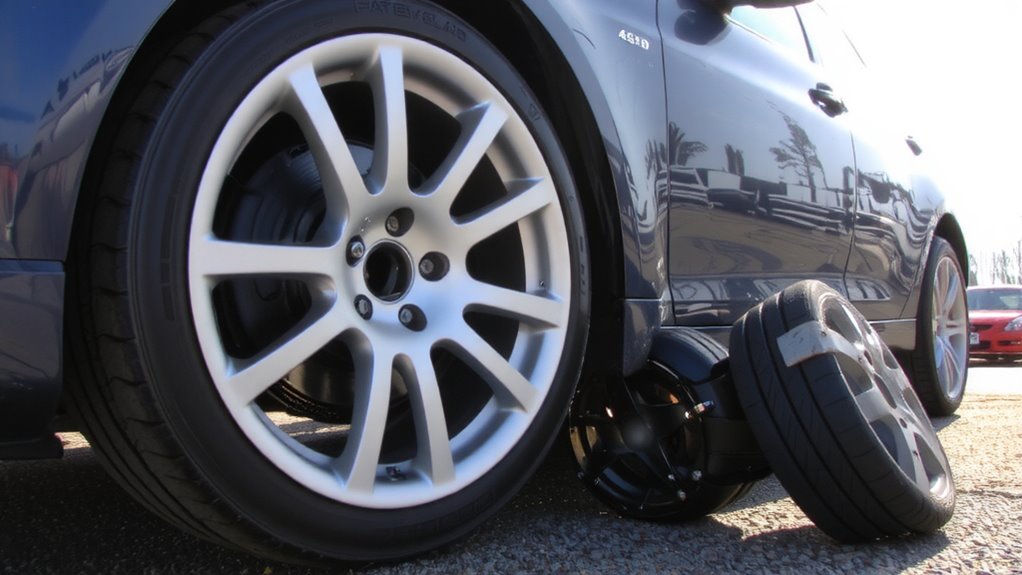
While reducing overall vehicle mass helps performance, cutting rotational weight at the wheels has an even greater impact on how quickly your car accelerates and stops. Lower rotational mass means less inertia to overcome, so your engine’s power transfers to the road more effectively. Each pound shaved from the wheels acts like several pounds removed from the chassis. Lightweight wheels require less torque to spin, improving off-the-line acceleration. During braking, reduced rotational mass decreases kinetic energy stored in the wheels, allowing calipers and rotors to halt the car faster. This boosts energy efficiency by minimizing wasted effort. For example, a 15-pound wheel instead of an 18-pound unit can cut unsprung weight considerably. The result? Sharper throttle response, shorter stopping distances, and reduced strain on drivetrain components. You’ll notice gains in both straight-line performance and daily driving economy. Every detail counts-lighter wheels make a measurable difference.
Forged Aluminum vs. Carbon Fiber: Which Is Lighter and Stronger?
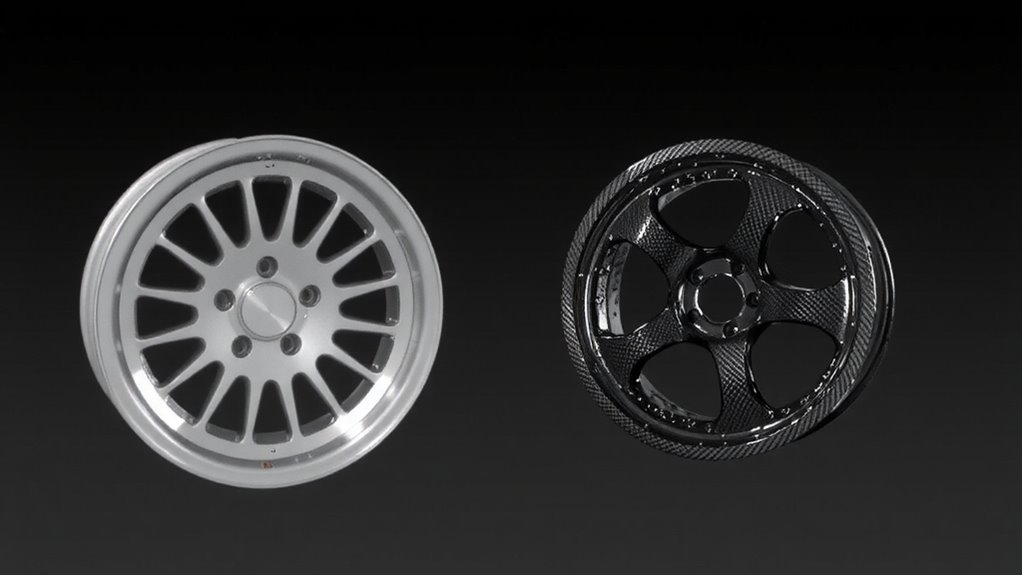
Every ounce counts when you’re deciding between forged aluminum and carbon fiber wheels, and your choice directly impacts both weight and strength. Forged aluminum wheels typically weigh 18–22 pounds, with high tensile strength from heat-treated 6061 or 7075 alloys. Their material composition offers excellent durability and resistance to impact damage. Carbon fiber wheels, however, are 30–40% lighter, often under 17 pounds, due to layered carbon strands cured in resin. This construction enhances structural integrity while reducing rotational mass. Carbon’s anisotropic properties allow engineers to align fibers for optimized load distribution, much like reinforced concrete. Though carbon fiber resists fatigue better, it can fail catastrophically under sharp impacts. Forged aluminum provides predictable deformation and easier repair. Both materials deliver high performance, but carbon fiber leads in weight savings and stiffness when structural integrity under dynamic loads is critical.
Choose the Right Wheel Weight for Street, Track, or Drag
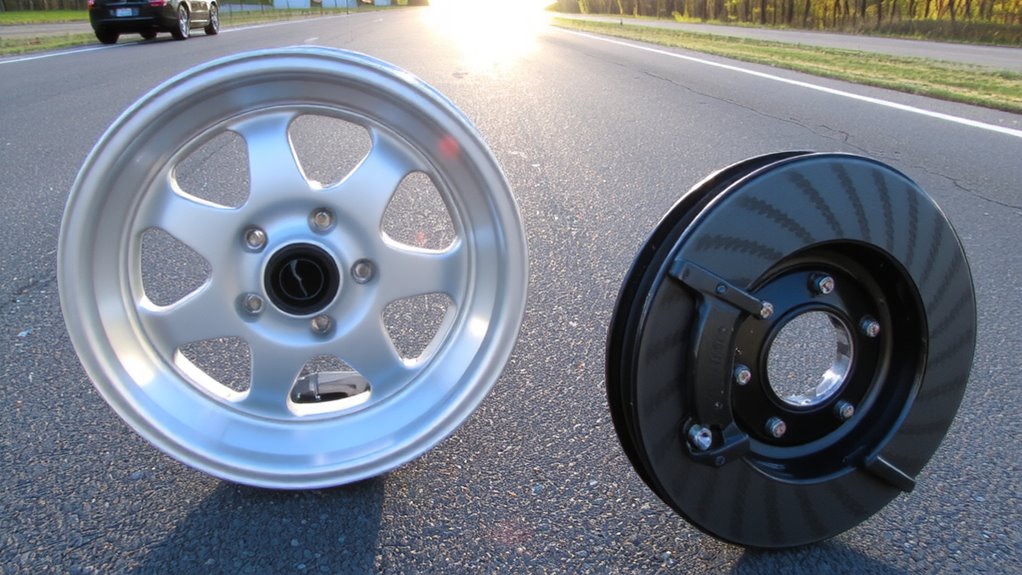
You’ve seen how forged aluminum and carbon fiber compare in strength and weight-now it’s time to match that knowledge to your driving needs. For street driving, wheels between 18 and 22 lbs offer the best compromise, ensuring smooth wheel balance and daily comfort. Track use demands lighter 15–18 lb wheels to reduce rotating mass and enhance cornering precision. These improve brake heat dissipation by minimizing thermal buildup during repeated hard stops. Drag racing prioritizes minimal inertia, so wheels under 15 lbs maximize launch response. Carbon fiber excels here, though forged aluminum remains a cost-effective option. Lighter wheels reduce unsprung mass, improving tire contact and suspension response. Proper wheel balance is critical at high speeds to prevent vibration and tire wear. Choose weight based on your primary use-each environment demands specific performance trade-offs for ideal acceleration, braking, and control.
How Lightweight Wheels Stay Strong and Safe
Strength isn’t sacrificed for lightness-it’s engineered. You get both performance and safety when wheels use advanced alloys like forged aluminum or flow-formed steel. These materials boost material durability, resisting stress from daily driving and track abuse. Impact resistance is critical-lightweight wheels must survive potholes and curbs without cracking. Forged wheels, for example, have grain structures aligned under high pressure, making them up to 30% stronger than cast counterparts. Flow-formed rims undergo radial pressure during manufacturing, enhancing density and toughness. Testing standards like JWL and VIA guarantee each wheel handles load limits exceeding 1,500 pounds. Finite element analysis optimizes spoke design, distributing forces evenly. Proper heat treatment further increases resilience. You’re not just reducing unsprung weight-you’re gaining structural integrity. Safety isn’t an add-on; it’s built in through precise metallurgy, strict tolerances, and real-world validation.
Get the Perfect Fit: Offset, Width, and Bolt Pattern
While lighter wheels improve acceleration and handling, getting the right fit matters just as much as reducing weight. You must match the bolt pattern-like 5×114.3 or 5×120-to your vehicle’s hub for secure mounting. Incorrect offset changes handling; too much causes rubbing, too little strains suspension. Ideal offset keeps the tire centered in the fender. Wheel width, typically 7 to 10 inches, affects tire clearance and grip. Wider wheels support broader tires for better traction but require checking for inner liner and suspension contact. Always verify clearance when steering and over bumps. Choose a wheel finish-matte, gloss, or machined-that won’t compromise material strength. A proper fit guarantees peak performance, safety, and prevents premature wear. Measure precisely. Fitment isn’t just about looks-it’s critical to how your car handles, brakes, and drives. Installing high-quality wheel spacers can further optimize fitment by adjusting the effective offset without changing wheel width.
On a final note
You improve acceleration and braking by reducing unsprung mass. Lightweight wheels demand less energy to rotate, enhancing throttle response and stopping power. Forged aluminum wheels weigh 18–22 lbs, offering strength and savings. Carbon fiber drops to 13–17 lbs but costs more. Match weight to use: street, track, or drag. Guarantee correct offset, width, and bolt pattern. Proper fit avoids clearance and handling issues.