Preventing Brake Dust Accumulation on Alloy Wheels
You can reduce brake dust on alloy wheels by driving smoothly and avoiding aggressive stops, which cut dust production by up to 40%. Use ceramic brake pads-they produce 70% less dust and contain copper instead of iron, reducing magnetic attraction to wheels. Clean wheels every 10–14 days with a pH-balanced cleaner to prevent iron bonding. Apply a ceramic coating with 9H hardness and hydrophobic properties for long-term protection. A well-maintained wheel surface stays cleaner longer. There’s more to optimizing your setup effectively.
Notable Insights
- Use ceramic brake pads to significantly reduce brake dust due to lower iron content and finer particle production.
- Practice smooth, gradual braking to minimize friction heat and decrease brake dust generation by up to 40%.
- Clean wheels every 10–14 days with a pH-balanced cleaner to prevent iron particles from bonding and causing corrosion.
- Apply ceramic coatings or nano sealants to create a dust-repellent, durable barrier on alloy wheels.
- Choose low-dust brake pads with stable friction performance to reduce buildup by up to 70% over time.
Understand What Causes Brake Dust
Brake dust starts with friction. When you press the pedal, your brake pads clamp down on the rotors, creating friction heat that can exceed 500°F during normal driving. This heat breaks down the brake composition-typically a mix of metallic fibers, resins, and fillers-releasing microscopic particles into the air. These particles, primarily iron from the rotor and degraded pad material, settle on your alloy wheels as brake dust. The high iron content makes the dust magnetic and prone to bonding with hot wheel surfaces. Different brake compositions produce varying dust levels; semi-metallic pads generate more dust than ceramic ones due to higher metal content. Friction heat accelerates this process, increasing particle emission rates. Understanding how brake composition and friction heat interact helps you choose parts that reduce dust at the source. You can’t eliminate it entirely, but you can minimize it through informed component selection.
Drive Smoothly to Minimize Brake Dust
While you can’t stop brake dust completely, how you drive has a direct impact on how much accumulates on your alloy wheels. Aggressive driving increases brake friction, raising dust production by up to 40%. Gentle acceleration reduces the need for hard braking, minimizing pad wear. Steady deceleration allows gradual heat dissipation, lowering metallic particle shedding. Maintaining speeds between 30–50 mph in city driving reduces brake engagement frequency by nearly 30%. Engine braking on downhill stretches cuts reliance on friction brakes. Smooth inputs extend pad and rotor life by up to 25%. Each abrupt stop generates peak temperatures over 600°F, accelerating dust formation. In contrast, controlled slowing keeps temps under 400°F. Driving style directly influences thermal cycles and particulate emission. You can’t eliminate dust, but your foot controls how much stains your wheels. Practicing restraint delivers cleaner alloy appearance over time.
Choose Low-Dust Brake Pads for Cleaner Wheels
Many modern brake pads generate excess dust, but selecting the right type can cut buildup by up to 70%. You should choose low-dust brake pads designed with optimized material composition. These pads often use ceramic or semi-metallic compounds that produce finer, lighter dust. Ceramic pads, for example, have stable friction efficiency across temperatures, reducing particle shedding. Their material composition includes copper fibers instead of iron, which minimizes magnetic attraction to wheels. Friction efficiency remains high-typically between 0.35 and 0.45 μ-ensuring reliable stopping without excess wear. Unlike softer organic pads, they last longer and create less residue. Low-dust pads also maintain performance under repeated use, unlike some budget options that degrade quickly. You’ll notice cleaner alloy wheels after just a few driving cycles. Selecting the correct pad isn’t just about appearance-it’s about balancing material composition, friction efficiency, and long-term wheel maintenance.
Wash Wheels Frequently to Stop Brake Dust Buildup
Regularly washing your wheels isn’t just about looks-it’s a critical step in preventing brake dust buildup. Frequent wheel cleaning removes corrosive iron particles before they bond to the alloy surface. Brake dust contains metallic fragments that, when heated, etch into clear coats and cause pitting. You should clean wheels every 10–14 days using a pH-balanced, non-acidic cleaner. Apply the solution with a soft-bristle brush to avoid micro-scratches. Rinse thoroughly with low-pressure water to prevent trapped moisture. For maximum dust prevention, inspect wheels weekly and address grime early. Use dedicated cleaning tools to avoid cross-contamination with chassis debris. Regular maintenance preserves finish integrity and enhances braking efficiency. Think of wheel cleaning as routine maintenance, like oil changes-neglect reduces longevity. Consistent care guarantees alloys resist oxidation and maintain structural performance under thermal cycling.
Coat Wheels for Lasting Brake Dust Protection
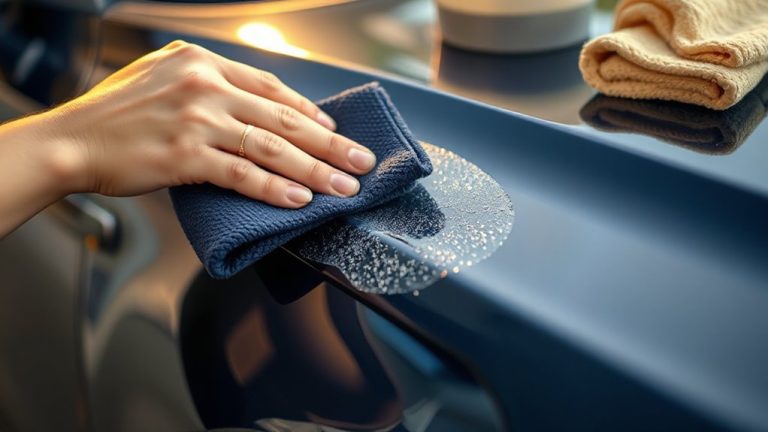
Treating your alloy wheels with a protective coating creates a barrier that minimizes brake dust adhesion and simplifies cleaning. Ceramic coatings form a hard, transparent layer bonded at the molecular level, offering durability up to three years. These coatings have a shore hardness of 9H, resisting swirl marks and chemical etching from brake dust. They’re typically 1–2 microns thick, creating a smooth surface that repels grime. You’ll notice brake dust slides off more easily during washes. Nano sealants, while less durable than ceramic options, last six to twelve months and fill microscopic pores in the wheel’s finish. Their hydrophobic properties reduce water spotting and dust buildup. Applied in thin, even layers, they cure quickly under UV light or ambient conditions. Both products require clean, decontaminated surfaces for ideal adhesion. Use isopropyl alcohol wipes before application. Coating your wheels cuts cleaning time and protects finish integrity long term.
On a final note
You can effectively minimize brake dust on alloy wheels with the right approach. Smooth driving reduces friction, cutting dust at the source. Low-dust ceramic brake pads produce up to 70% less particulate versus semi-metallic types. Frequent washing removes iron-laden debris before corrosion sets in. Apply a ceramic coating with a 9H hardness rating to create a hydrophobic barrier, repelling contaminants. These proven steps deliver cleaner, longer-lasting wheels.