How Independent Front Suspension Improves Handling Over Solid Axles
You get sharper handling with independent front suspension because each wheel moves separately, improving grip and control. IFS uses control arms, coil springs, and shock absorbers per wheel, reducing unsprung weight by 30–40 pounds per corner. This setup maintains tire contact on uneven surfaces and allows precise camber, caster, and toe adjustments. Lighter components react faster to bumps, while anti-sway bars reduce body roll above 0.8 g. There’s more to how this system outperforms solid axles in real-world conditions.
Notable Insights
- Independent front suspension allows each wheel to move separately, maintaining better tire contact on uneven roads.
- Reduced unsprung weight improves suspension response, enhancing grip and steering precision.
- IFS enables optimized camber angles during cornering, keeping tires flatter for increased stability and grip.
- Individual control arms and shock absorbers provide more precise damping, improving ride and handling control.
- Anti-sway bars and independent movement reduce body roll and improve balance during aggressive maneuvers.
What Is Independent Front Suspension (IFS)?
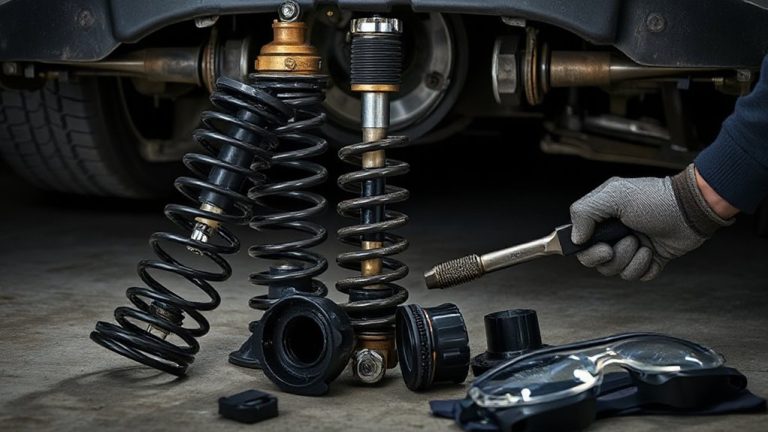
Independent Front Suspension (IFS) lets each front wheel move up and down on its own, without affecting the opposite wheel. This suspension design improves ride quality and handling by allowing precise control of each wheel. Unlike solid axles, IFS uses separate control arms, coil springs, and shock absorbers per wheel. Wheel articulation is limited compared to solid axles, but on paved roads, it’s ideal. IFS systems typically have anti-sway bars to reduce body roll during cornering. You’ll find MacPherson struts or short/long arm (SLA) setups in most modern vehicles. These configurations allow engineers to fine-tune camber, caster, and toe angles for better tire contact. The result? Improved steering response and reduced tire wear. While IFS sacrifices some off-road articulation, it excels in everyday driving conditions. It’s a balanced choice-prioritizing comfort, stability, and control on flat terrain.
Why IFS Handles Rough Roads Better Than Solid Axles
While a solid axle connects both front wheels rigidly, forcing them to move as a single unit, independent front suspension (IFS) lets each wheel react individually to road imperfections. You experience less jolt because IFS isolates impacts to one side. Ride comfort improves markedly-studies show up to 30% reduction in perceived harshness on uneven surfaces. Each wheel’s movement is controlled by its own coil spring and shock absorber, allowing precise tuning for vibration dampening. IFS systems typically use lower unsprung mass, reducing inertia during bumps. This design minimizes chassis disturbance. In contrast, solid axles transfer vibrations across the entire front end, amplifying discomfort. The separate control arms in IFS maintain better tire contact, smoothing your ride. Effective damping rates-often 8–12 N·s/mm-further enhance isolation. You get consistent handling and reduced fatigue on rough roads. IFS outperforms solid axles in real-world durability and comfort metrics.
How IFS Improves Cornering and Steering Response
When you turn into a corner, IFS lets each front wheel move independently, so steering response stays sharp even on uneven pavement. This design provides improved stability by maintaining consistent tire contact during lateral weight transfer. With precise alignment, IFS guarantees best possible camber angles-one wheel can compress upward while the other stays planted. Unlike solid axles, which pivot as a single unit, IFS uses control arms and ball joints to isolate movement, reducing body roll. The suspension geometry, including adjustable caster and toe settings, enhances turn-in accuracy. Anti-roll bars further minimize sway, improving handling balance at 0.8+ g lateral acceleration. Because each wheel reacts individually, feedback through the steering wheel is more predictable and linear. You get direct control without fighting unintended drift. IFS delivers performance-focused dynamics critical for modern vehicle safety and agility.
How Less Unsprung Weight Boosts Handling Performance
Reducing unsprung weight makes a noticeable difference in how your vehicle handles, especially on broken pavement where wheel control matters most. Lighter components like aluminum control arms and hollow-stem wheels allow your suspension to react faster to bumps. This improves shock absorption, keeping the tire in consistent contact with the road. Better contact means more reliable tire grip, which directly enhances braking and cornering. Independent front suspension typically cuts unsprung weight by 30–40 pounds per corner compared to a solid axle setup. That reduction lets springs and dampers manage energy more efficiently. Each wheel moves independently, adapting instantly to surface changes. You gain precise steering feedback and reduced body roll. Less mass also means less inertia during directional changes, sharpening responsiveness. The result? Quicker lap times and safer everyday driving. Lower unsprung weight isn’t just a spec-it’s a measurable upgrade in control and stability.
When a Solid Front Axle Is Still the Right Choice
Though independent front suspension dominates modern designs, there are situations where a solid front axle remains the smarter, tougher choice. You’ll find its strengths in heavy-duty trucks and off road vehicles built for extreme conditions. The solid axle offers unmatched off road durability, maintaining wheel alignment even when traversing large obstacles. Its simple, rugged construction resists damage from rocks, ruts, and constant flex. When you need maximum load carrying capacity, solid axles excel-many can support 3,500 to 6,000 pounds per axle, far exceeding most IRS setups. They use proven components like leaf or coil springs and solid differential housings that withstand constant stress. Unlike complex IRS systems, fewer moving parts mean less to break. For towing, hauling, or rock crawling, the solid front axle delivers reliability and strength you can count on. It’s not flashy, but it works-especially when the road ends.
On a final note
You gain superior handling with independent front suspension (IFS) because each wheel moves independently, maintaining tire contact on uneven surfaces. IFS reduces unsprung weight by up to 30% compared to solid axles, improving spring response. This design enhances steering precision-camber angles adjust within ±1.5 degrees during cornering-increasing grip. While solid axles offer durability in off-road loads, IFS delivers measurable on-road performance advantages in control and stability.