Exhaust Rust from Road Salt: Warning Signs & When to Replace
Winter road salt attracts moisture and lowers water’s electrical resistance by up to 90%, accelerating electrochemical corrosion on your exhaust. Rust starts as reddish-brown discoloration, especially on parts under 1.5 mm thick. Check mufflers, heat shields, and pipe joints-common weak points. Chloride exposure leads to rapid oxidation, even at low concentrations. Structural integrity drops when wall thickness erodes below 0.05 inches. Severe corrosion at hanger mounts or over 30% penetration in 16-gauge manifolds demands action. You’ll soon see how timely intervention prevents costly failure.
Notable Insights
- Road salt attracts moisture and increases ion flow, accelerating electrochemical rust on exhaust system metals.
- Reddish-brown discoloration and metallic odors signal early-stage salt-induced corrosion on exhaust surfaces.
- Mufflers, catalytic converters, and heat shields are high-risk areas due to trapped salt and moisture.
- Bubbling paint or pinholes on heat shields and rust at pipe joints indicate advanced salt-related damage.
- Exhaust components with wall thickness below 0.05 inches or rust penetrating over 30% of manifold depth need replacement.
How Road Salt Causes Exhaust Rust
While winter roads may seem harmless once the snow clears, the salt used to melt ice can quietly accelerate rust on your exhaust system. Road salt attracts and holds moisture, creating a persistent damp environment on undercarriage metals. This moisture combines with oxygen and salt to trigger a chemical reaction that speeds up corrosion. Specifically, sodium chloride lowers the electrical resistance of water, enhancing ion flow and promoting electrochemical oxidation of iron in steel. This process leads directly to metal degradation, especially in exhaust components like manifolds, pipes, and mufflers, which cycle between hot and cool temperatures. Thermal cycling causes expansion and contraction, cracking protective coatings and exposing bare metal. Once exposed, the metal is vulnerable to chloride-induced corrosion, even at low salt concentrations. Over time, structural integrity weakens, risking exhaust failure.
Common Early Signs of Salt-Related Exhaust Rust
You can spot salt-related exhaust rust early if you know what to look for. Exhaust discoloration is one of the first visible indicators, often appearing as reddish-brown spots or streaks along metal surfaces. This oxidation begins when road salt accelerates corrosion on vulnerable steel components. The rust typically starts in thin layers but spreads quickly under repeated exposure. Unusual smells-especially a sharp, metallic or rotten-egg odor-suggest internal corrosion or leaks in the exhaust system. These odors often mean hydrogen sulfide from fuel impurities is escaping due to compromised seals or cracks. Early-stage rust may not affect performance yet, but it weakens structural integrity, particularly on pipes and mufflers with wall thicknesses under 1.5 mm. Detecting these signs promptly allows for intervention before costly damage occurs.
Key Spots to Check for Exhaust Rust
Since road salt lingers in hidden areas long after winter ends, it’s critical to inspect the most vulnerable parts of your exhaust system. Begin with the muffler and catalytic converter, where moisture and salt accumulate. Check heat shields closely-these thin metal covers trap salt against hot surfaces, accelerating corrosion. Inspect heat shields for bubbling paint or pinholes, signs of advanced rust. Mounting brackets are also high-risk; they secure components and retain moisture due to tight bends. Look for pitting or fractures, especially where rubber hangers attach. The exhaust manifold, exposed to extreme thermal cycling, often shows early flaking. Examine pipe joints and weld seams-common corrosion entry points. Use a flashlight and mirror to view undercarriage sections. Focus on steel thickness: anything below 1.2 mm indicates structural compromise. These targeted checks reveal hidden decay before failure.
How to Keep Road Salt From Ruining Your Exhaust
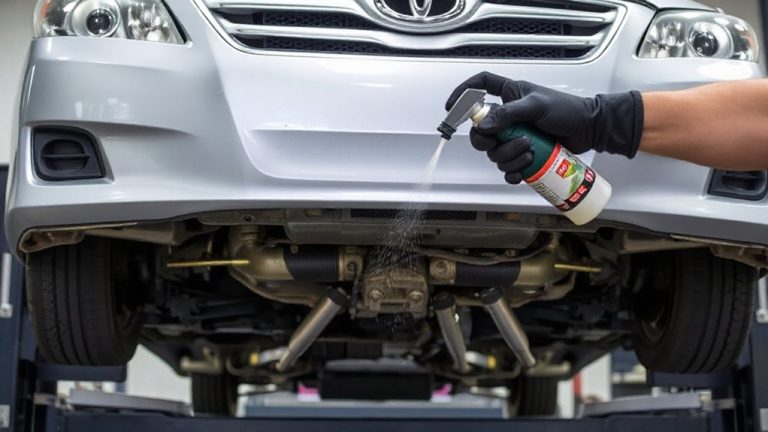
Regular inspections help catch rust early, but preventing road salt damage in the first place keeps your exhaust system lasting longer. Applying exhaust coatings creates a durable barrier against moisture and corrosive salts. High-temperature ceramic coatings withstand temperatures up to 1,200°F, shielding metal surfaces from thermal cycling and oxidation. These coatings bond at the molecular level, offering longer protection than paint or plating. Complement them with protective sprays containing wax or oil-based formulations. Products like fluid film or lanolin-based sprays penetrate tight seams and seams, displacing water. Apply every 3–4 months during winter. A 16-ounce spray typically covers one full exhaust system. Use a pressure washer to clean underneath first, then dry thoroughly. Consistent maintenance with these methods reduces chloride ion penetration by up to 75%, markedly slowing corrosion. For stubborn salt buildup, using a dedicated undercarriage cleaner can enhance the effectiveness of your protection routine.
When Rust Means You Need a New Exhaust
While surface rust on exhaust components is common and often manageable, penetrating corrosion that compromises structural integrity signals the need for replacement. You must consider exhaust replacement when rust severity exceeds superficial oxidation. If holes or cracks form in the muffler, catalytic converter, or pipes-especially where wall thickness drops below 0.05 inches-exhaust gases can leak, reducing efficiency and increasing emissions. Severe rust at hanger mounts or flange connections affects alignment and can cause excessive vibration. Rust that penetrates through more than 30% of the material depth on a 16-gauge (0.06-inch) steel manifold calls for immediate action. Ignoring advanced corrosion risks failure during operation. Unlike minor rust, which may only affect appearance, critical rust impairs function. Have your system inspected annually in high-salt regions. Early detection prevents costly repairs and maintains ideal backpressure and flow rates.
On a final note
You must act early to protect your exhaust from salt damage. Winter road salts accelerate corrosion, especially on steel components with thin protective coatings. Inspect your muffler, catalytic converter, and tailpipe every 3,000 miles. Look for surface pitting deeper than 0.5 mm or flaking on chrome finishes. Use dielectric grease on hangers and wash undercarriage monthly. Replace sections with wall loss exceeding 20%. Prevention extends system life by 2–4 years.