Weak Car Battery in Cold? Check for 12.4V or Lower
Cold weather can cut your battery’s power by up to 60% at 0°F due to slowed chemical reactions. Check voltage with a multimeter: 12.6V means full charge; 12.4V or lower indicates weakness. Clean corroded terminals with a baking soda solution and wire brush. Use 6-gauge, 400-amp jumper cables if starting fails. After a jump, drive 30+ minutes or use a smart charger to fully recharge. Weak performance may mean it’s time to replace.
Notable Insights
- Test battery voltage at rest with a multimeter: 12.6V indicates full charge, while 12.4V or lower suggests a weak battery.
- Check engine cranking power, as cold weather can reduce battery output by up to 60% at 0°F.
- Inspect for corrosion on terminals and clean with a baking soda solution to ensure proper electrical contact.
- Measure voltage while the engine runs; 13.7–14.7V confirms the charging system is functioning correctly.
- After jump-starting, drive over 30 minutes or use a smart charger to fully recharge a depleted battery.
Why Cold Weather Kills Car Batteries
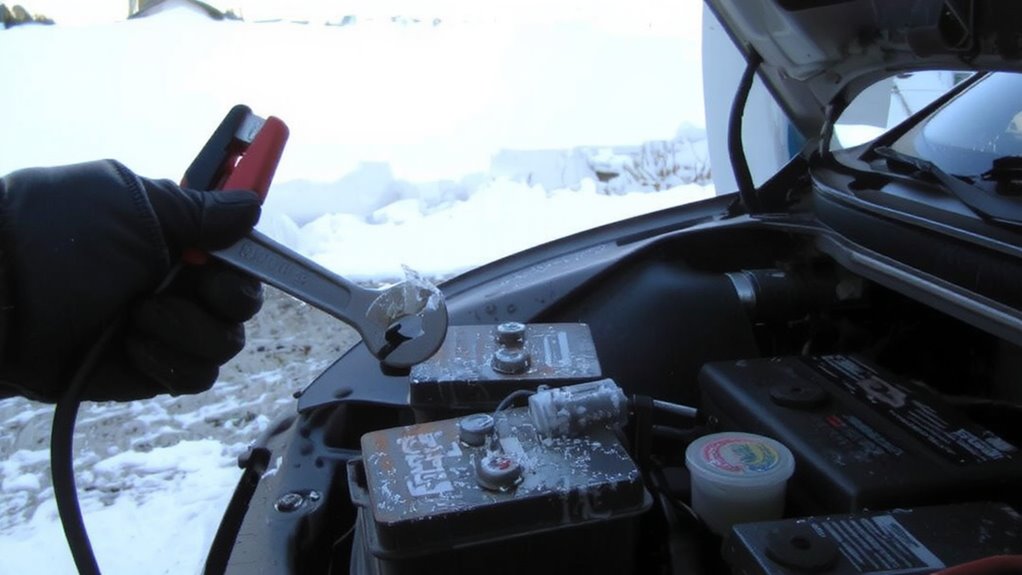
When temperatures drop, your car battery’s ability to produce power decreases markedly-often by as much as 30% at 32°F and up to 60% at 0°F. This loss stems from chemical slowdown within the battery’s electrolyte solution, reducing ion flow between lead plates. Cold temperatures thicken engine oil, demanding more cranking power just as your battery delivers less. Simultaneously, increased resistance in battery terminals and cables impedes current flow, further limiting available amps. A healthy battery at 70°F may output 600 cold-cranking amps (CCA), but that drops substantially in freezing conditions. Even fully charged batteries suffer because electrochemical reactions slow by roughly 30% per 20°F decline. You might not notice weak performance in summer, but winter exposes aging cells. Corroded connections worsen increased resistance, compounding the problem. Ultimately, cold weather doesn’t usually kill batteries-it reveals existing weaknesses amplified by chemical slowdown and electrical inefficiencies. Upgrading to a battery with higher cold-weather performance can significantly improve reliability in freezing temperatures.
Jump-Start Your Car in Cold Weather
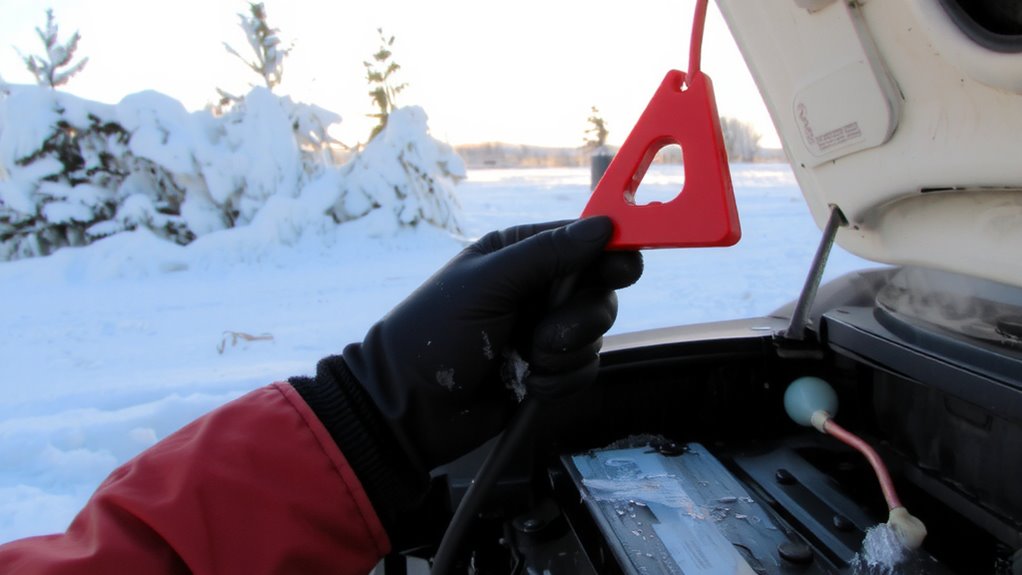
Though cold weather exposes battery weaknesses, you can get your vehicle running with a proper jump-start using the right technique and equipment. Always follow battery safety protocols-wear insulated gloves and eye protection. Cold precautions include ensuring both vehicles are off and park securely. Use jumper cables with at least 6-gauge wire and 400-amp rating for reliable current transfer. Connect red to the dead battery’s positive terminal, then to the good battery’s positive. Attach the black cable to the good battery’s negative, then to an unpainted metal surface on the dead car’s engine block. This minimizes spark risk near the battery. Start the working vehicle, let it run two minutes, then attempt to start the stalled car. If it cranks slowly, wait five more minutes before retrying. Successful jumps typically require 5–10 minutes of connection time in sub-freezing conditions.
Test Battery Voltage With a Multimeter
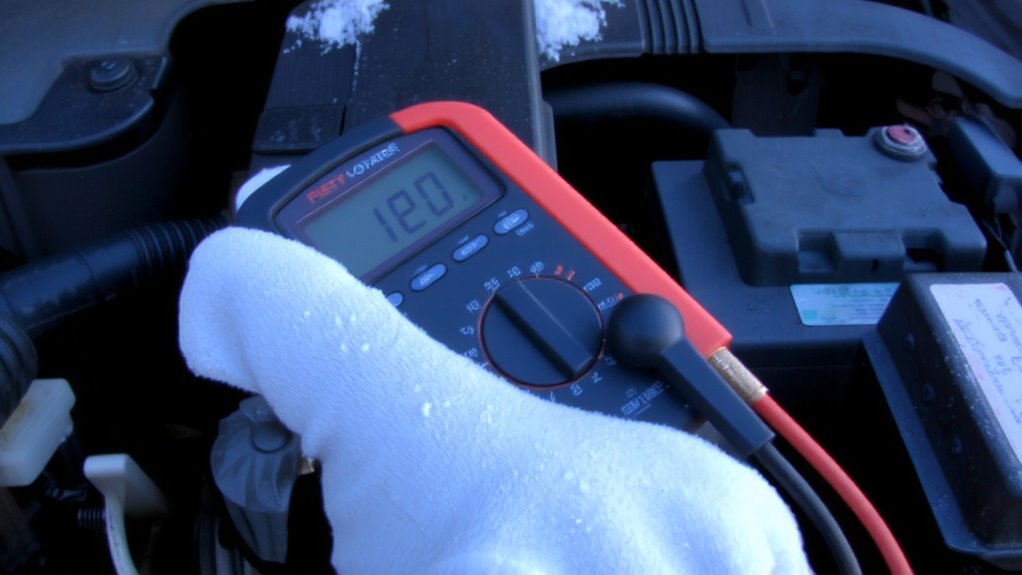
You can quickly check your car battery’s health by measuring its voltage with a digital multimeter-this simple test reveals whether the battery holds a sufficient charge to start the engine. Set your multimeter to DC voltage, typically the 20V range. Touch the red probe to the positive terminal and the black probe to the negative. A fully charged battery should read around 12.6 volts at rest. If it shows 12.4 volts or lower, the charge is weak. Start the engine and check voltage again. A healthy system reads between 13.7 and 14.7 volts. A significant voltage drop suggests charging issues. Poor connection resistance from dirty or loose terminals can distort readings. Guarantee clean, tight connections before testing. Voltage drop caused by high resistance may mimic battery failure. Accurate measurement requires direct contact with terminal metal. For more precise diagnostics, consider using a dedicated battery tester that can assess both charge level and overall battery health.
Clean Corroded Battery Terminals Fast
Corrosion on battery terminals can sabotage even a strong battery, especially in cold weather when electrical demands rise. Battery corrosion increases electrical resistance, reducing current flow and preventing reliable starts. Terminal cleaning is a fast, effective fix. Use a wire brush or battery terminal cleaner tool to scrape off buildup. A solution of baking soda and water (1 tablespoon per cup) neutralizes acid and stops further damage. Always disconnect the negative terminal first, then the positive, to avoid shorts.
| Step | Tool/Material | Purpose |
|---|---|---|
| 1 | Safety gloves & goggles | Protect against acid exposure |
| 2 | Wrench | Loosen terminal clamps |
| 3 | Baking soda solution | Dissolve corrosion |
| 4 | Wire brush | Complete terminal cleaning |
Rinse with distilled water and dry thoroughly. Reconnect positive then negative. Clean terminals guarantee maximum conductivity. For optimal results, consider using a dedicated battery terminal cleaner product designed to remove stubborn corrosion and protect against future buildup.
Recharge Your Battery After a Jump
A jump-start gets you moving, but it doesn’t fix the underlying charge deficit. Your car’s alternator isn’t designed for full battery charging-it’s meant to maintain a healthy battery, not revive a depleted one. After a jump, drive for at least 30 minutes at highway speeds to allow partial charging, but don’t assume the battery is fully restored. Use a smart battery charger set to 2–10 amps for 4–12 hours, depending on state of charge. This guarantees a complete, controlled recharge without overloading the system. Always follow jump precautions: turn off electronics before disconnecting jumper cables, remove negative first, then positive. Never short the terminals. Proper battery charging restores cranking amps (CA) and cold cranking amps (CCA), critical in cold weather. A fully charged 12-volt battery should read 12.6–12.8 volts at rest.
Replace Your Battery Before Winter
Cold temperatures reduce a battery’s ability to deliver the power needed to start an engine, and even a recently recharged battery may struggle if it’s nearing the end of its service life. Most car batteries last three to five years, so knowing your battery lifespan helps determine if replacement is due. A battery weakened by age may hold a charge in warm weather but fail in cold conditions due to reduced chemical activity. For reliable winter preparation, test your battery’s cold cranking amps (CCA) - it should meet or exceed the manufacturer’s rating, typically 600–800 CCA for standard vehicles. Guarantee reserve capacity (RC) is sufficient, ideally 120 minutes or more. Replacing your battery early avoids breakdowns. A new, fully charged battery with proper CCA and RC ratings restores peak starting power, giving you consistent performance when temperatures drop.
On a final note
Your car battery weakens in cold weather because low temperatures slow chemical reactions inside the 12-volt lead-acid unit. A fully charged battery should read 12.6 volts or higher on a multimeter. Below 12.2 volts, it struggles to start your engine. Corrosion on terminals increases resistance, reducing current flow. After a jump-start, recharge the battery with a 4-8 amp charger for 4–6 hours. Replace batteries older than 3–5 years before winter.