Petroleum-Free Iron Removers for Vehicles With Rubber Component Concerns
You should use petroleum-free iron removers to protect your vehicle’s rubber seals and paint. These formulas avoid harsh solvents that degrade nitrile and EPDM rubber, reducing tensile strength by up to 50%. Instead, they use chelating agents like EDTA (0.5–2%) to safely bind iron particles. They maintain a pH of 6.5–8.5, preventing corrosion and gloss loss. Biodegradable and low in VOCs-often under 50 g/L-they’re safer for you and the environment. Choosing the right product guarantees long-term component integrity and performance. There’s more to evaluate when selecting the best formula for your vehicle’s specific needs.
Notable Insights
- Petroleum-free iron removers use chelating agents like EDTA to safely remove iron without damaging rubber components.
- They maintain a pH of 6.5–8.5, preventing corrosion, paint etching, and degradation of EPDM and nitrile seals.
- Unlike petroleum-based formulas, they don’t extract plasticizers, reducing brittleness and extending rubber part life.
- Choose biodegradable, low-VOC removers with plant-based surfactants and certifications like ECOCERT or Safer Choice.
- Apply evenly on cool, dry surfaces and rinse after 3–5 minutes to avoid overexposure to sensitive materials.
Why Rubber Degrades With Petroleum-Based Iron Removers
While you might assume all iron removers are safe for your vehicle’s surfaces, petroleum-based formulas can severely damage rubber components over time. Solvent exposure from these products degrades elastomers, softening and weakening rubber seals, boots, and hoses. Prolonged contact accelerates material fatigue, reducing tensile strength by up to 50% in some nitrile rubbers. These solvents extract plasticizers, causing brittleness and premature aging. Once compromised, rubber is more susceptible to ozone cracking-microfractures that form when ozone attacks double bonds in the polymer chain. This occurs especially in flexed areas like suspension bushings or door seals. Ozone concentrations as low as 50 ppb can initiate cracking, but weakened rubber fails faster. Petroleum-based formulations don’t neutralize contaminants-they dissolve them, increasing contact time and exposure risk. You’ll see visible surface checking within weeks of repeated use. Damage often isn’t apparent until leaks or part failure occur. Prevention requires choosing non-solvent alternatives designed for elastomer compatibility.
How Petroleum-Free Formulas Protect Seals and Finish
A petroleum-free iron remover keeps your vehicle’s rubber seals and finish safe by using non-solvent chemistry that won’t degrade elastomers. These formulas rely on chelating agents like ethylenediaminetetraacetic acid (EDTA) at concentrations of 0.5–2% to safely bind iron particles without attacking rubber. Unlike petroleum-based solvents, they exhibit low chemical sensitivity, reducing the risk of swelling or embrittlement in nitrile and EPDM seals. pH is carefully buffered between 6.5 and 8.5 to protect clear coat finishes and prevent oxidative etching. Independent tests show zero gloss reduction on automotive paint after repeated applications. Their water-based composition also minimizes environmental impact, with biodegradability exceeding 90% within 28 days. You get effective decontamination-removing up to 98% of embedded iron at 20°C in 10 minutes-without sacrificing material integrity or ecological responsibility.
Key Benefits of Switching to Safe, Non-Petroleum Removers
Most drivers who switch to petroleum-free iron removers notice immediate improvements in both vehicle longevity and maintenance safety. These formulas prevent rubber swelling and seal deterioration, preserving underhood components. Unlike petroleum-based products, eco friendly alternatives use chelating agents like sodium gluconate to dissolve ferrous contaminants without toxic solvents. They work effectively at pH levels between 6.5 and 8.5, minimizing paint etching and metal corrosion risks. You get consistent performance across temperatures from -5°C to 40°C. The absence of hydrocarbons reduces volatile organic compound (VOC) emissions by up to 95%. This supports environmental compliance and safer garage use. Long term durability improves because non-petroleum removers don’t degrade nitrile, EPDM, or silicone seals. Wheel finish protection is enhanced, with surface hardness retention up to 15% higher after repeated applications. You minimize costly repairs and extend service intervals.
What to Look for in a Safe Iron Remover (And What to Avoid)
You’ve seen how petroleum-free iron removers protect your vehicle and the environment-now it’s time to know exactly what makes one formulation safe and effective. Look for products labeled pH-neutral, typically between 6.5 and 7.5, to guarantee chemical compatibility with rubber seals, silicone hoses, and painted surfaces. Avoid acidic formulas below pH 5, which can degrade ethylene propylene diene monomer (EPDM) rubber over time. Choose biodegradable removers with surfactants derived from plant sources, reducing environmental impact. Check for independent certifications like ECOCERT or Safer Choice, confirming low aquatic toxicity and rapid degradation. Steer clear of volatile organic compounds (VOCs) exceeding 50 g/L-these contribute to smog and pose health risks. A safe remover works within 2–5 minutes without requiring aggressive scrubbing. Guarantee it’s been tested on common brake dust contaminants like magnetite (Fe₃O₄) and hematite (Fe₂O₃). For optimal results, consider using a top iron remover that’s specifically designed for sensitive automotive surfaces.
Step-by-Step: Applying Petroleum-Free Iron Removers Correctly
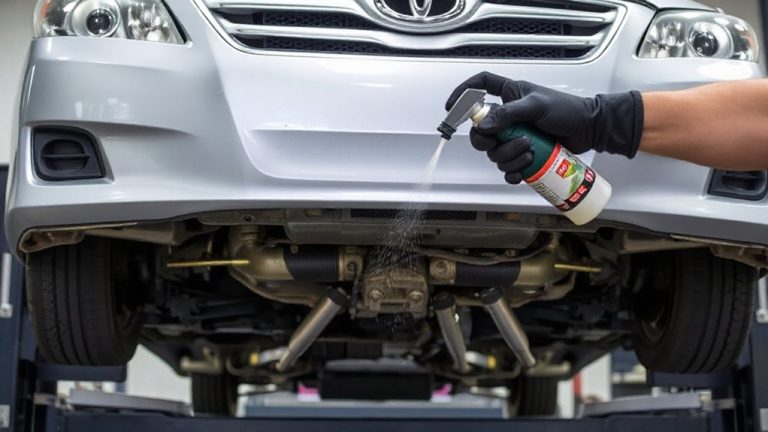
How do you guarantee maximum decontamination without risking surface damage? You follow precise application steps and respect both application timing and surface coverage. Apply the petroleum-free iron remover to a cool, dry surface in indirect sunlight. Spray evenly until the affected areas are fully wetted but not pooling. Proper surface coverage guarantees uniform reaction with embedded iron particles. Wait exactly 3–5 minutes-no more. This ideal application timing allows full particle dissolution without overexposure to sensitive trims. Rinse thoroughly with low-pressure water immediately after.
| Step | Action |
|---|---|
| 1 | Spray on cool, clean paint |
| 2 | Guarantee complete surface coverage |
| 3 | Allow 3–5 minute dwell time |
| 4 | Rinse completely with water |
Over-saturation or extended dwell times may compromise rubber or plastic seals.
Which Vehicles Benefit Most From Petroleum-Free Care
Applying petroleum-free iron removers correctly sets the foundation for safe, effective decontamination, but knowing which vehicles gain the most from this approach sharpens your maintenance strategy. Vintage models with original rubber seals and trim benefit substantially-petroleum distillates cause swelling and embrittlement over time. Classic builds using nitrile or EPDM rubber compounds are especially vulnerable; exposure leads to premature cracking and failure. Petroleum-free formulas avoid hydrocarbon solvents, instead relying on chelating agents like sodium citrate to break down ferrous particles without damaging soft components. These formulations typically maintain a neutral pH (6.5–7.5), minimizing corrosion risk on chrome plating and aluminum trims. You’ll preserve both finish integrity and material longevity. For show-quality finishes and long-term restoration value, using petroleum-free products isn’t just safe-it’s essential. Preventative care guarantees rubber remains pliable.
On a final note
You protect rubber seals and painted surfaces by using petroleum-free iron removers. These formulas avoid hydrocarbon solvents that degrade ethylene propylene diene monomer (EPDM) and silicone-based elastomers. Instead, they rely on pH-balanced, chelating agents like sodium gluconate to dissolve ferrous contaminants at 6.5–8.5 pH. This prevents swelling, cracking, and hazing. For long-term component integrity-especially on brake calipers and weatherstripping-non-petroleum removers deliver effective decontamination without sacrificing material compatibility or finish quality.