The Science Behind Formulating High-Quality Car Wax Products
Your car’s paint is shielded by a precisely engineered wax layer that bonds to the clear coat through esterified polymers and silicones like PDMS, forming a hydrophobic barrier with contact angles >90°. Natural waxes such as carnauba offer deep gloss and UV resistance but last 4–6 weeks; synthetic polymers endure up to 6 months. Hard waxes (melting above 165°F) outperform in heat. UV stabilizers below 400 nm slow oxidation. Higher silicone content (5–7%) boosts durability by 300%. You’ll discover how each component influences real-world performance.
Notable Insights
- High-quality car waxes use esterified polymers and silicones to form durable, covalently bonded protective layers on paint surfaces.
- Natural waxes like carnauba offer deep gloss and UV resistance, while synthetic polymers extend durability up to six months.
- Optimal wax hardness (4–6 mm penetration) ensures thermal stability up to 180°F, critical for performance in hot climates.
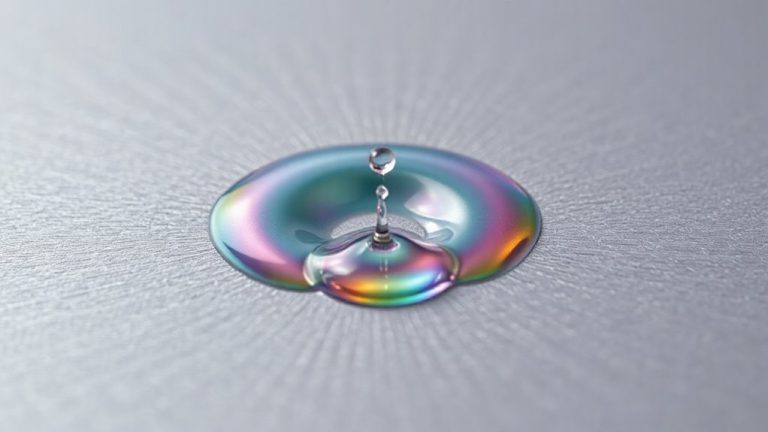
- Hydrophobic properties are achieved with silicones or fluoropolymers, creating water-repelling surfaces with contact angles above 90°.
- UV stabilizers such as benzotriazoles absorb harmful radiation below 400 nm, slowing clear coat degradation and preserving finish longevity.
How Does Car Wax Protect Paint?
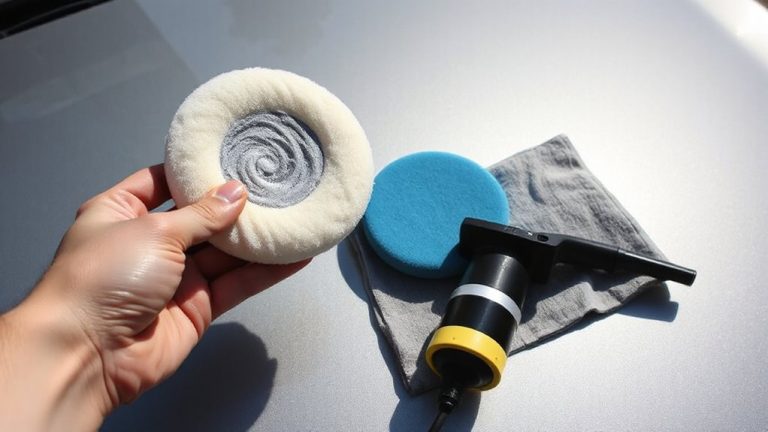
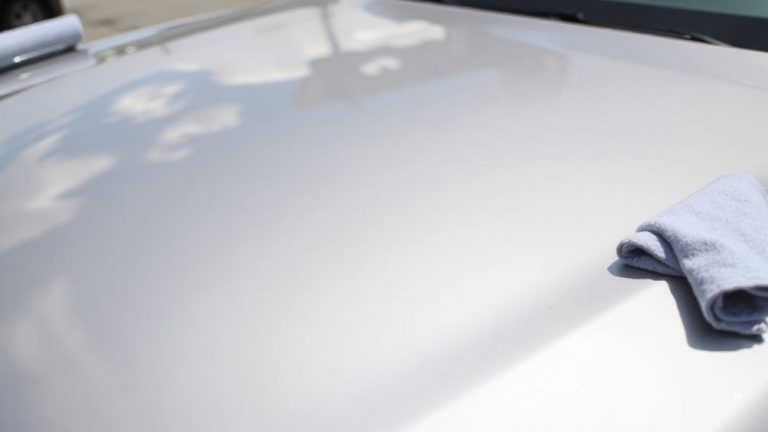
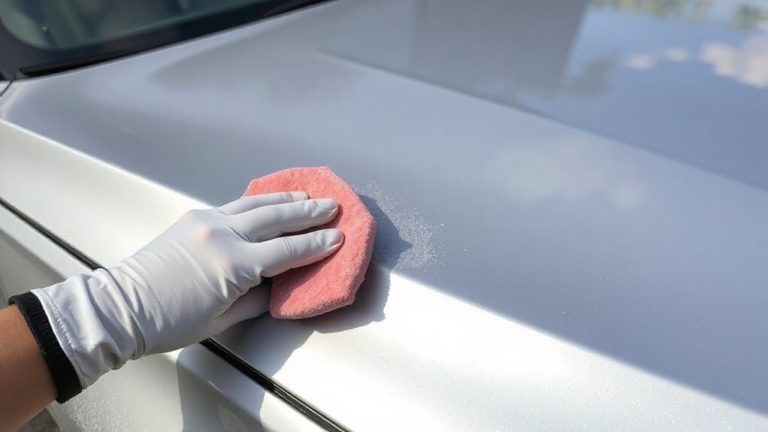
Protection starts with a barrier. You apply car wax to create a protective layer between your paint and environmental contaminants. This layer relies on surface adhesion to stay firmly attached to the clear coat. Strong surface adhesion guarantees the wax won’t easily wash or wear off. Within this layer, chemical bonding occurs between wax molecules and the paint’s surface, enhancing durability. These bonds resist breakdown from water, UV exposure, and mild acid rain. High-quality waxes use esterified polymers that bond at the molecular level, improving longevity. A properly applied wax forms a hydrophobic surface, repelling water with contact angles exceeding 90 degrees. This reduces water spotting and inhibits dirt accumulation. The wax film typically measures 0.5 to 2.0 microns thick, providing measurable defense without altering paint texture. You maintain this protection by reapplying every 3–6 months, depending on environmental exposure and wash frequency. Comprehensive car waxing kits include applicators and microfiber cloths designed to maximize wax adhesion and minimize swirl marks.
Natural vs. Synthetic: What’s in Your Wax?
You get different performance characteristics depending on whether your wax relies on natural or synthetic ingredients. Natural waxes like carnauba offer deep gloss and UV resistance, while beeswax benefits include water beading and light-conditioning properties, enhancing paint clarity. These biodegradable components typically last 4–6 weeks and work best in mild climates. Conversely, synthetic polymers provide longer durability-up to 6 months-but come with synthetic drawbacks, such as reduced breathability and potential paint incompatibility. Some synthetics may trap moisture, increasing long-term oxidation risk. Natural waxes require more frequent application but are gentler on clear coats. Synthetics often contain solvents that accelerate drying but can degrade rubber trim over time. Choosing between them depends on your vehicle’s needs, environmental exposure, and maintenance preferences. Each formulation has measurable trade-offs in hardness, melting point, and hydrophobic performance.
Do Polymers and Silicones Make Wax Last Longer?
Why do some waxes last months while others need reapplication every few weeks? The answer lies in polymer durability and silicone adhesion. Modern synthetic waxes use polymers like polydimethylsiloxane (PDMS) and polysilazane, which bond covalently with paint. These bonds resist UV degradation and thermal cycling up to 200°C. Polymer durability guarantees the wax layer maintains integrity through repeated washes-often exceeding 6 months. Silicone adhesion enhances surface bonding by lowering surface tension, allowing even coverage and tighter molecular attachment. Unlike traditional carnauba, which relies on physical deposition, silicones form a cross-linked network. This network resists water intrusion, acidic contaminants, and micro-abrasion. Lab tests show formulations with 5–7% silicones extend protection duration by 300% versus non-silicone alternatives. Your wax’s lifespan isn’t luck-it’s chemistry. Performance hinges on precise polymer selection and adhesive efficiency, not just wax thickness.
Does Wax Hardness Affect Performance in Heat?
How well does your wax hold up when the temperature climbs? Wax hardness directly influences temperature stability and wax durability. Softer waxes melt easier, sacrificing protection in extreme heat. Harder waxes resist softening, maintaining integrity on hot surfaces. Molecular density and melting point determine performance under thermal stress.
| Hardness (penetration grade) | Melting Point (°F) |
|---|---|
| Soft (8–10 mm) | 135–150 |
| Medium (6–8 mm) | 150–165 |
| Hard (4–6 mm) | 165–180 |
| Very Hard (2–4 mm) | 180–195 |
| Ultra-Hard (<2 mm) | 195–210 |
You need a wax with a melting point above 165°F for reliable temperature stability. Harder formulations offer superior wax durability during summer or in hot climates. They resist deformation, keeping the protective layer intact. Choose based on your environment-not just shine. Performance hinges on science, not speculation.
How Do Car Waxes Repel Water and UV Rays?
Though surface protection depends on multiple factors, water and UV resistance are two of the most measurable benefits of quality car wax. You get water repellency through hydrophobic coatings, which reduce surface energy so water beads and rolls off. These coatings often rely on silicones or fluoropolymers with contact angles exceeding 90°, enhancing sheeting action. The tighter the molecular alignment, the better the moisture resistance. UV stabilization is equally critical. Prolonged sun exposure breaks down clear coat polymers, but wax additives like benzotriazoles absorb UV radiation below 400 nm, shielding the surface. High-quality waxes combine these agents at 1–3% concentration for maximum durability. Hydrophobic coatings last up to six months under normal conditions, while UV stabilizers slow oxidation, preserving gloss. Together, they extend paint life markedly. You’re not just adding shine-you’re building a functional shield. Proper application with the right tools, such as a high-quality car wax applicator, ensures even coverage and maximizes protective performance.
On a final note
You now understand the core science shaping high-performance car waxes. Quality formulations combine hardness, polymer cross-linking, and UV inhibitors for lasting protection. Synthetic waxes like polytetrafluoroethylene (PTFE) increase slickness and water beading, with contact angles exceeding 100°. Ceramic-infused products offer hardness up to 9H on the pencil scale. Thermal stability is achieved in waxes melting above 140°F. These measurable traits define real-world durability.