Sealing Ring-and-Pinion Housings Against Leaks During Hard Cornering Episodes
You prevent ring-and-pinion housing leaks during hard cornering by combining precision machining with high-performance seals. Machine flanges to within 0.002 inches flatness and use FKM or expanded PTFE gaskets at 0.040–0.060” thickness. Install labyrinth seals with 0.008–0.012 inch clearances to trap oil without drag. Align axle seals properly using a driver tool, lubricate the lip, and torque bolts to 8–10 ft-lbs. Pressure test at 3–5 psi and validate under lateral loads-there’s more beneath the surface.
Notable Insights
- Use labyrinth seals to prevent leaks during hard cornering with non-contacting grooves that redirect oil under high lateral loads.
- Select FKM or expanded PTFE gaskets for superior heat, chemical resistance, and stability under extreme cornering forces.
- Ensure flange flatness within 0.002 inches and precision-machined surfaces to maintain seal integrity under stress.
- Lubricate axle seal lips and install with proper tools to prevent misalignment and leakage during aggressive driving.
- Set oil level below the lowest seal point to avoid pressure buildup and pooling during sustained high-G maneuvers.
Stop Cornering Oil Leaks: Design Tips
While oil leaks might seem inevitable in high-pressure gear systems, they’re usually the result of preventable design flaws. You must account for thermal expansion when sealing ring-and-pinion housings. As temperatures rise during operation, metal components expand, potentially distorting flange geometry and breaking the seal. Use precision-machined flanges with flatness tolerances within 0.002 inches to maintain contact under stress. Match your gasket material to the oil viscosity; thicker oils need softer gaskets to achieve proper conformability. High viscosity oils resist leakage but increase shear forces, placing added stress on seals. Design breathers to accommodate pressure differentials caused by thermal expansion, preventing oil from being forced past seals. Position fill levels below the differential’s lowest seal point to avoid pooling during hard cornering. Integrate check plugs to verify correct oil levels under operational conditions. These steps minimize leaks without relying on aftermarket fixes.
Upgrade to Labyrinth Seals for Track Use
Because standard lip seals often fail under extreme track conditions, upgrading to labyrinth seals is a proven solution for maintaining gear housing integrity. The labyrinth design uses a series of non-contacting grooves to trap and redirect oil, eliminating wear from friction. Unlike traditional seals, it doesn’t rely on physical contact to block fluid flow. This drastically improves seal dynamics under high RPM and lateral load. You’ll see zero drag increase, even during sustained cornering. Manufactured from anodized aluminum or stainless steel, these seals withstand temperatures up to 300°F and resist corrosion. Typical clearances are held to 0.008–0.012 inch, balancing oil retention with thermal expansion. There’s no elastomer to degrade, so lifespan exceeds 50,000 track miles. Fluid shear forces are disrupted by the maze-like path, preventing pressurized oil migration. You maintain lubricant where it’s needed, without leakage. This design is common in motorsports and high-performance differentials.
Choose High-Performance Gasket Materials
Durability starts with the right gasket material. Material selection directly impacts seal integrity under high stress and temperature swings. You need a gasket that won’t compress prematurely or degrade from gear oil exposure. Opt for FKM (Viton®) or expanded PTFE-they offer superior chemical resistance to synthetic lubricants and extreme heat. FKM handles continuous temperatures up to 400°F (204°C), while PTFE resists nearly all automotive fluids. Unlike standard rubber or cork gaskets, these materials won’t swell or embrittle over time. Die-cut precision guarantees uniform thickness-typically 0.040” to 0.060”-for consistent clamping force. A high-performance gasket maintains torque load without creep, critical when lateral G-forces shift oil during hard cornering. Your differential housing joint stays sealed because the gasket holds its form and function. Choose wisely-long-term leak prevention starts here.
Install Axle Seals the Right Way
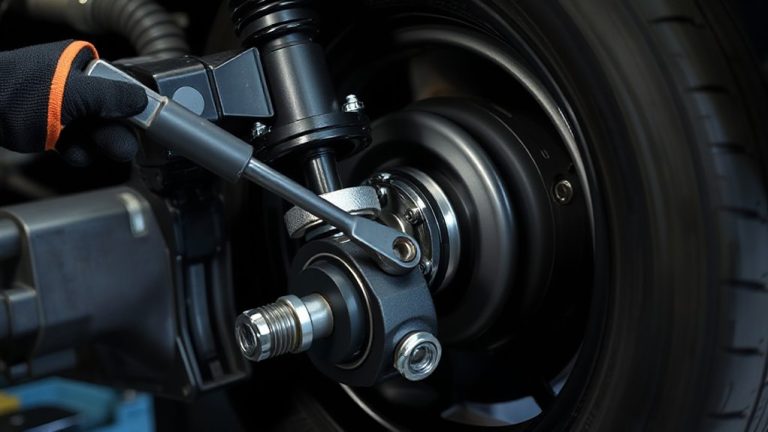
You’ve sealed the ring-and-pinion housing with a high-performance gasket, but the job isn’t complete until the axle seals are properly installed. Proper alignment during installation prevents seal distortion and premature failure. Misaligned seals create gaps, allowing gear oil to escape under lateral loads. Always use a seal driver tool matched to the seal’s outer diameter-typically 2.75 to 3.1 inches, depending on the axle model. Tap the seal evenly until it’s flush with the housing bore. Do not hammer directly on the seal. Apply a light coat of gear oil to the sealing lip before assembly. Tighten the retaining bolts gradually in a crisscross pattern. Adhere strictly to factory torque specifications-usually 8–10 ft-lbs-to avoid housing warpage or seal deformation. Correct installation guarantees leak-free operation, even during aggressive cornering.
Machining the Case for a Perfect Seal
While surface imperfections may seem minor, they can compromise the integrity of the ring-and-pinion housing seal. You need a flat, smooth mating surface to guarantee proper gasket compression and prevent leaks. Surface finish matters-aim for 63 to 125 microinches RA; anything rougher risks seepage under pressure. You’re not just smoothing metal-you’re creating a precision interface. Case alignment is equally critical. Misaligned housing halves, even by 0.002 inches, distort the seal path and create weak points. Use alignment pins or a torque sequence that draws the case evenly. A warped or improperly mated case won’t hold a seal, no matter the gasket quality. Always inspect and machine both halves on a surface plate first. Think of it like engine head work-consistency and flatness are non-negotiable. Proper machining guarantees long-term integrity under stress.
Fix Leaking Differentials Under High G-Loads
High g-forces during aggressive cornering or hard acceleration can overwhelm even well-machined differential housings, exposing flaws in the sealing system. Fluid dynamics inside the housing shift under load, creating pressure differentials that force gear oil past weak seals. You need to address both ventilation and seal integrity to stop leaks. Proper breathers equalize pressure, but their placement affects efficiency. Use ribbed seals with nitrile lips rated for 180°F and 50 psi to resist deformation. Consider spiral groove designs that channel oil back during rotation.
| Solution | Function | Pressure Handling |
|---|---|---|
| High-flow breather | Equalizes pressure | 0.5–2 psi differential |
| Ribbed shaft seal | Blocks reverse flow | 50 psi static |
| Spiral groove seal | Returns oil under centrifugal force | 3,500 RPM effective |
| Vent relocation | Prevents pooling at seals | Optimized for lateral Gs |
Test Your Differential After Sealing
How do you know the fix held? You pressure test the differential housing. Seal integrity under real-world stress demands verification beyond visual inspection. Pressure testing exposes leaks by forcing air into the housing at 3–5 psi, simulating internal vapor pressure during high-speed operation. Attach a regulated pressure gauge to the fill port; hold pressure for 15 minutes. Any drop indicates failure. Fluid dynamics dictate that even microscopic gaps channel differential fluid outward during hard cornering, due to centrifugal force and oil flow turbulence. Proper sealing halts this migration. Recheck after a test drive involving aggressive lateral loads. Confirm no seepage at the pinion seal, carrier seam, or cover gasket. A successful test means stable internal pressure and contained lubrication. Your differential now resists the fluid dynamics of extreme maneuvers. Pass this stage, and you’ve achieved reliable, leak-free performance.
On a final note
You’ve sealed your differential correctly when no oil escapes under 1.5+ G cornering loads. Labyrinth seals outperform lip seals, handling up to 5,000 RPM without heat buildup. Use FKM (Viton) gaskets-they resist oil degradation up to 400°F. Precision machining guarantees housing surfaces are flat within 0.002 inches. Properly torqued axle seals, installed with 1/32-inch even bead sealant, prevent micro-movement leaks.