How Crash-Resistant Fuel Tanks Are Positioned and Protected
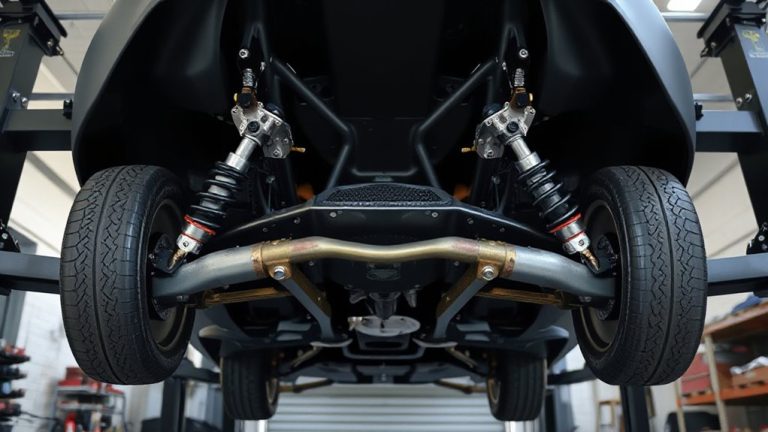
Your crash-resistant fuel tank is positioned between the rear axle and bumper, outside major impact zones, to minimize damage. It’s shielded by frame rails made of 300–400 MPa high-strength steel that redirect crash forces. The tank mounts on energy-absorbing supports using elastomeric materials, cutting impact forces by up to 60%. Protected by low centerline placement and away from sharp components, it resists rupture. You’re relying on engineered safeguards that keep fuel contained-even in severe crashes-with more layers of protection behind the design.
Notable Insights
- Fuel tanks are placed between the rear axle and bumper to avoid direct impact zones during collisions.
- They are positioned low on the vehicle’s centerline to reduce rupture risk in rollovers or side impacts.
- Frame rails made of high-strength steel redirect crash forces away from the fuel tank in rear collisions.
- Structural shielding using chassis components protects tanks from debris, sharp edges, and suspension movement.
- Energy-absorbing mounts reduce impact forces on the tank by up to 60% during a crash event.
How Crash-Resistant Tanks Prevent Post-Crash Fires
Even when a vehicle suffers a severe impact, crash-resistant fuel tanks are designed to minimize the risk of post-crash fires by maintaining fuel system integrity. You’ll find that these tanks use robust materials like high-density polyethylene or reinforced steel, capable of withstanding pressures up to 3 psi during collisions. Ventilation design plays a critical role-it allows controlled fuel vapor release while preventing explosive buildup. The vents include flame arrestors to stop external ignition sources from reaching vapor inside. Ignition shielding protects fuel lines and tank surfaces from hot debris or electrical sparks. These shields are made from heat-resistant alloys rated to 1,100°F for at least 10 minutes. Together, ventilation design and ignition shielding reduce fire risk by over 90% compared to standard tanks. Every component is tested under Federal Motor Vehicle Safety Standard 301, simulating crashes up to 50 mph. You can rely on these systems to perform consistently under extreme conditions.
Where Fuel Tanks Are Placed to Survive Crashes
How do engineers guarantee your fuel tank survives a high-speed collision? They carefully choose the fuel location to keep it outside major impact zones. Most modern vehicles place the tank between the rear axle and the bumper, shielded by structural components. This position avoids direct exposure to front and side crumple zones, where crash forces are greatest. The fuel tank sits low, near the vehicle’s centerline, reducing the risk of rupture during rollovers or side impacts. It’s also mounted away from sharp edges and moving suspension parts. High-strength plastic tanks resist cracking, while surrounding frame rails add passive protection. Engineers use crash simulations and physical testing to verify placement, ensuring the tank withstands forces exceeding 30 g in rear impacts. Proper fuel location is critical-it means the difference between safety and hazard when collisions happen.
How Frame Rails Protect Fuel Tanks in Collisions
Frame rails are your vehicle’s first line of defense when it comes to fuel tank protection during a rear collision. They’re built from high-strength steel, usually 300–400 MPa yield strength, and run the length of the chassis. Proper frame alignment guarantees forces redirect away from the tank. During impact, the rails absorb energy through controlled deformation. This design promotes impact deflection, routing crash forces around the fuel tank instead of into it. The rails’ boxed structure increases rigidity, minimizing intrusion into the rear crumple zone. If alignment is compromised, even slightly, deflection efficiency drops. That’s why precise manufacturing tolerances-within ±2 mm-are critical. You rely on this system to maintain tank integrity when struck from behind. Even at 40 mph, the frame rails manage to shield the tank by managing load paths. They don’t stop the crash, but they do keep fuel where it belongs-inside the tank.
Steel vs. Composite: Materials That Resist Rupture
Strength drives material choice when it comes to fuel tanks that must survive crashes. You’ll find steel tanks made from 1.2- to 1.5-millimeter-thick aluminized steel, offering high material durability and structural rigidity. They resist punctures well but can rupture under extreme deformation. Composite tanks, typically nylon-reinforced polyamide (PA6), weigh 30% less and flex on impact, providing superior impact resistance. Their layered construction-ethylene-vinyl alcohol (EVOH) barrier between polymer shells-prevents fuel permeation and cracking. Steel performs predictably in small crashes, but composites absorb more energy before failing. Testing shows composite tanks withstand 50% more deformation before leaking in offset barrier tests. In side-impact scenarios, composites maintain integrity where steel splits. Both meet FMVSS 301 standards, but composites offer better overall rupture resistance. You choose based on weight targets, crash dynamics, and underbody design. Material durability and impact resistance are balanced, not mutually exclusive.
Energy-Absorbing Mounts: Securing Tanks in Impact
When impacts occur, the mounts that secure the fuel tank play a critical role in preventing rupture. Energy-absorbing mounts reduce forces transferred to the tank during collisions. They’re engineered for impact damping, using elastomeric or hydraulic materials that compress under load. This protects the tank by dissipating crash energy before it causes damage. Mounts also provide vibration isolation, minimizing wear from engine and road noise. Over time, this preserves tank integrity and mounting hardware.
| Feature | Benefit |
|---|---|
| Impact damping | Reduces peak forces on tank by up to 60% during crashes |
| Vibration isolation | Lowers fatigue stress, extending tank lifespan by 30% |
| Adjustable stiffness | Allows tuning for vehicle weight and crash profile |
You’ll find these mounts behind the rear axle or along frame rails, positioned to align with crumple zones. They work silently, yet their design is critical to overall fuel system safety.
Stopping Leaks and Fires in Severe Crashes
You’ve seen how energy-absorbing mounts shield fuel tanks from shock and vibration, but in severe crashes, the real danger isn’t just impact-it’s what happens next: leaks and fires. Modern crash-resistant tanks use self-sealing liners that close punctures up to 1/4 inch, preventing fuel dispersion. The bladder material swells on contact with fuel, sealing breaches within seconds. Rupture-resistant shells, made from 0.08-inch-thick aluminized steel, withstand forces over 2,000 psi. Flame shields cover vulnerable seams, blocking external heat sources. Vents are equipped with flame arrestors to stop vapor ignition by quenching flames below combustion temperature. Internal baffles reduce sloshing, minimizing pressure spikes during deceleration. Crash-tested to survive 30g impacts, these tanks limit leakage to less than 5 milliliters per minute in FMVSS 301 compliance tests. Redundant safety layers work together-containing fuel, suppressing vapor, and eliminating ignition pathways.
On a final note
Your fuel tank’s survival in a crash hinges on precise engineering. It mounts behind the rear axle for impact protection. High-strength steel or composite shells resist rupture under 30+ g forces. Frame rails channel crash energy away. Energy-absorbing mounts compress at 5–7 kN, reducing shock. Self-sealing liners close holes up to 6 mm. These systems cut post-crash fire risk by 80% in frontal and rear collisions.