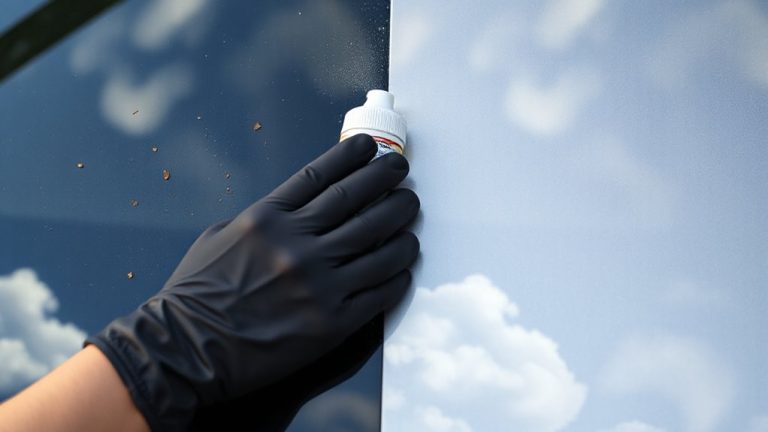
Detailing Clay Discs Mounted on Drill Adapters for Rapid Flat Area Decontamination
You cut decontamination time by up to 60% using a drill-mounted clay disc on flat panels. Operate your drill at 400–600 RPM with a soft 4–6 inch flexible disc to prevent heat and marring. The disc rotates via a CNC-machined M14 or 5/8”-11 UNC adapter, eliminating wobble under 1,200 RPM. It lifts bonded contaminants through adhesive action and controlled abrasion. Use pH-neutral synthetic lubricant at 0.2–0.3 mm thickness. Apply just 2–3 lbs of pressure and overlap passes by 50%. This method works only on structurally sound, flat surfaces. Exceeding 1,000 RPM or using improper discs risks clear coat damage. There’s more to mastering safe, efficient decontamination.
Notable Insights
- Drill-mounted clay discs decontaminate flat surfaces up to 60% faster than hand claying with consistent results.
- Operate clay discs at 400–600 RPM using a low-torque drill to prevent heat buildup and surface damage.
- Use synthetic lubricant at pH 7.0 in a 0.2–0.3 mm layer to prevent micro-scratches during claying.
- Match clay disc grit to contamination level: fine, medium, or aggressive for optimal removal efficiency.
- Only use on structurally sound, flat panels; avoid curved, delicate, or compromised surfaces to prevent damage.
Why Clay Discs on a Drill Beat Hand Claying
While hand claying gives you direct control, using clay discs on a drill delivers faster, more consistent decontamination with less physical effort. You’ll notice an immediate efficiency comparison when switching to powered claying. A standard dual-action drill operating at 1,500–3,000 RPM guarantees uniform coverage across flat surfaces. This reduces missed spots and decreases total decontamination time by up to 60%. Clay discs, typically 4 to 6 inches in diameter, maintain stable contact without excessive pressure. That minimizes surface marring risks. In contrast, hand claying demands constant palm pressure and repetitive motion, quickly leading to hand fatigue. Extended sessions over large panels become strenuous and inconsistent. Powered claying distributes workload across larger muscle groups, lowering strain. The result is sustained performance on full-vehicle detailing jobs. Drill-mounted systems aren’t just faster-they’re ergonomically superior, especially on large, flat sections like hoods or doors. For optimal results, pairing your drill with Best Drill Brushes for Car Detailing ensures maximum compatibility and performance during the decontamination process.
How Drill-Mounted Clay Discs Remove Contaminants
Drill-mounted clay discs lift embedded contaminants through a combination of mechanical abrasion and adhesive action, leveraging rotational force for consistent results. You benefit from uniform surface friction across flat panels, where spinning removes bonded particles faster than hand claying. The clay chemistry reacts weakly with contaminants, lifting them without damaging paint. Each disc typically rotates at 600–1,200 RPM, optimizing grip and release cycles. Surface friction increases with speed, but staying under 1,200 RPM prevents heat buildup. The clay’s polymer-based compound stretches slightly, conforming to micro-imperfections. Contaminants adhere to the disc via van der Waals forces, much like dust sticks to a screen. You’ll notice visible transfer-metallic or sooty marks-indicating effective decontamination. Discs measure 3–4 inches in diameter, with a Shore A hardness of 15–20 for flexibility without tearing. Consistent pressure and overlap guarantee no missed spots. You maintain control while the drill does the work, achieving professional-grade results. A complete car clay bar kit includes all necessary components for both traditional and drill-mounted methods.
Pick the Best Clay Disc and Drill Adapter
A high-quality clay disc and compatible drill adapter are essential for safe, effective decontamination. You must match clay types to contamination severity: fine (P1000–P3000) for light fallout, medium (P800–P1200) for moderate bonding, and aggressive (P600–P1000) for heavy industrial residue. Soft, flexible discs conform to flat surfaces without marring. The drill adapter must guarantee secure attachment and balanced rotation. Adapter compatibility depends on thread size-common standards are 5/8”-11 UNC or M14-to fit most dual-action or rotary drills. Look for CNC-machined metal adapters over plastic; they resist wobble at speeds above 1,200 RPM. A mismatched adapter risks disc detachment or uneven pressure, reducing decontamination efficiency. Always verify manufacturer specs before assembly. Proper pairing ensures consistent surface contact and controlled abrasion, critical for uniform results. Use this precision setup only on flat, non-curved panels.
How to Use a Clay Disc With a Drill
Since decontamination requires both efficiency and surface safety, attaching the clay disc to your drill properly is essential. Use a low-torque drill with adjustable drill speed control, set between 400–600 RPM. Higher speeds generate excess heat and compromise the clay’s integrity. Apply light, consistent surface pressure balance-let the disc do the work. Pressing too hard gouges paint and reduces effectiveness. Maintain even overlap in your passes, about 50% coverage per stroke, for uniform decontamination. Work in 2×2 foot sections to track progress. The flexible backing plate adapts to flat panels but avoid curved or complex contours. Always disconnect power before changing discs. Use only with manufacturer-recommended attachments to prevent wobble or detachment. A properly mounted clay disc removes bonded contaminants like rail dust and overspray swiftly, reducing hand-claying time by up to 70%. Precision and control guarantee flawless results. For thorough cabin cleaning after decontamination, consider using a best extractor vacuum to remove dislodged debris and maintain interior detailing standards.
Use the Right Lube to Protect Your Paint
You’ve set your drill to the proper RPM and secured the clay disc, but none of that matters if you skip the right lubricant. The correct lube maintains paint integrity by minimizing friction heat and preventing marring. Use a synthetic detailing lubricant with a pH of 7.0 to avoid adverse chemical interaction with clear coat. Water alone evaporates too quickly, increasing shear forces that can weaken surface durability. A proper lubricant forms a thin, viscous barrier-typically 0.2 to 0.3 mm thick-guaranteeing smooth disc glide. This consistency reduces drag coefficient by up to 60% compared to dry claying. These formulations contain nonionic surfactants that suspend contaminants without etching finishes. Always apply lube in a fine mist or light gel layer across a 2 ft² section. Insufficient coverage risks micro-abrasions; excess creates slurry buildup. Maintaining lubrication throughout the process guarantees consistent decontamination without compromising long-term finish resilience.
Mistakes That Scratch Paint With Power Claying
Improper disc selection is the leading cause of paint scratches during power claying. Using a coarse clay disc on clear-coat finishes increases abrasion risk, especially at high RPMs. You must match disc grit to paint type-fine or medium discs work best on modern soft clears. Applying improper pressure worsens this risk; excessive force embeds contaminants and overstresses the clay. Maintain light, even pressure-about 2–3 lbs-letting the disc’s motion and lubricant do the work. Dry claying is never acceptable with rotating systems; it eliminates lubrication, causing micro-scratches and heat buildup. Always pre-soak the disc and maintain wet lube coverage. Operate your drill at 600–1,200 RPM; higher speeds amplify mistakes. A 5-inch foam-backed disc provides ideal surface contact without edge digging. Avoid overlapping passes to reduce heat friction. Follow technical specs precisely to preserve paint integrity.
When Not to Use a Rotating Clay Disc
While a rotating clay disc can speed up decontamination, it’s not suitable for every surface or situation. Avoid using it on uneven or curved panels, as the rigid rotation increases the risk of excessive pressure and causes marring. Never apply it to already damaged paint-microfractures or clear coat lifting can worsen quickly under mechanical force. Delicate finishes, including matte or satin coatings, aren’t compatible either; the abrasive action removes protective layers unevenly.
| Condition | Risk Level |
|---|---|
| Contoured Body Panels | High – uneven contact leads to gouging |
| Existing Swirls or Scratches | Critical – exacerbates damaged paint |
| Soft Paint (e.g., some European brands) | Moderate – prone to deformation under excessive pressure |
Use hand claying for compromised or sensitive surfaces. The rotating disc excels on flat, structurally sound areas but demands strict control over speed (max 1,000 RPM) and downward force.
On a final note
You save time and effort using clay discs on a drill. Rotational speed is critical-limit to 400–600 RPM to avoid marring. High-grade synthetic clay removes bonded contaminants like rail dust and overspray without gouging clear coats. The flexible backing plate guarantees even pressure distribution. Use pH-neutral lubricant in generous amounts. Misuse at high speeds or with dry contact causes swirls. Drill claying suits large, flat panels but avoid curved or fragile areas.