Preventing CV Joint Damage When Lowering Vehicles With Extreme Coilover Drops
Lowering your car beyond 1.5 inches increases CV joint angles past their 20–22-degree limit, risking premature failure. For drops over 3 inches, install extended CV axles with 1.5–3.0 inches of added length to restore proper geometry. Pair them with adjustable control arms to maintain alignment and reduce joint stress. Inspect boots every 15,000 miles for cracks or grease leaks. Use high-temperature CV grease when servicing. A well-maintained setup handles extreme drops safely-further optimization depends on your specific suspension configuration.
Notable Insights
- Use extended CV axles to maintain proper joint angles and prevent binding during extreme coilover drops.
- Install adjustable control arms to correct alignment and reduce stress on CV joints after lowering.
- Limit suspension drop to 1–2 inches for safety, as deeper drops increase CV joint angles beyond 20 degrees.
- Inspect CV boots regularly for damage and repack with high-temperature grease to ensure joint lubrication.
- Avoid drops over 3 inches without modifications, as factory axles may exceed 30-degree angle limits and fail.
Why Lowering Your Car Stresses CV Joints
While lowering your car can improve handling and give it a sleek look, it also changes the factory alignment of critical drivetrain components-especially the CV (constant velocity) joints. You alter the suspension geometry, which directly affects the axle angle. A steeper axle angle increases the joint’s operating range beyond design limits. Most OEM CV joints handle angles up to 20–22 degrees under normal conditions. When you lower the vehicle more than 1.5 inches, the angle can exceed 30 degrees, accelerating wear. Uneven wear in the CV joint’s inner and outer cages leads to clicking noises and eventual failure. Modified suspension geometry reduces lubrication efficiency inside the joint. The grease pools away from high-friction zones, increasing heat and metal-on-metal contact. This degradation is gradual but unavoidable with extreme drops. You’re forcing factory parts to operate outside intended tolerances. The result? Premature CV joint failure, costly repairs, and compromised drivability.
Pick a Ride Height That Protects CV Joints
You can minimize CV joint wear by selecting a ride height that keeps suspension geometry within design limits. Most manufacturers design suspension systems to operate within a specific range, typically allowing 1–2 inches of drop safely. Exceeding this increases CV joint angles, accelerating wear. Staying within factory-specified alignment tolerances preserves joint life. You’ll also maintain better ride comfort, as over-lowered cars transmit more road shock to the chassis. Proper ground clearance-ideally 4 to 6 inches on paved roads-prevents scraping and protects axles. Dropping too low forces CV joints to operate beyond 20 degrees, which exceeds their intended range and risks binding. Even small reductions in ride height can double the stress on the joint. Balance aesthetics with function: a moderate drop keeps the drivetrain operating efficiently. You won’t sacrifice handling, ride comfort, or ground clearance-while extending CV axle life markedly.
Install Extended CV Axles for Extreme Drops
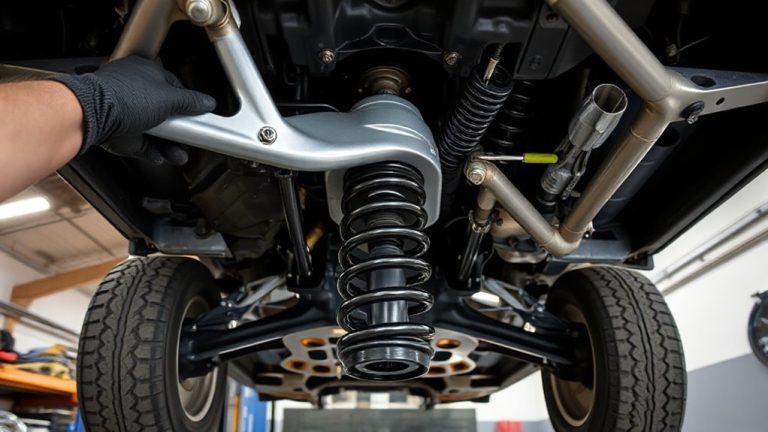
When lowering your vehicle beyond the factory’s recommended range, standard CV axles can’t maintain proper joint angles, leading to premature failure. You need extended axles to restore correct geometry and prevent binding. These axles are designed for extreme drops, typically between 3 to 6 inches, and handle increased articulation without compromising integrity. Extended axles reduce strain on CV joints by maintaining ideal operating angles.
For severe modifications, custom fabrication guarantees a precise fit, especially when stock dimensions won’t suffice.
| Drop Range (in) | Axle Extension Needed (in) | Max Joint Angle (deg) |
|---|---|---|
| 3–4 | 1.5–2.0 | 22 |
| 4–5 | 2.0–2.5 | 25 |
| 5–6 | 2.5–3.0 | 28 |
Extended axles paired with custom fabrication deliver reliability and longevity in extreme drop setups.
Fix Alignment With Adjustable Control Arms
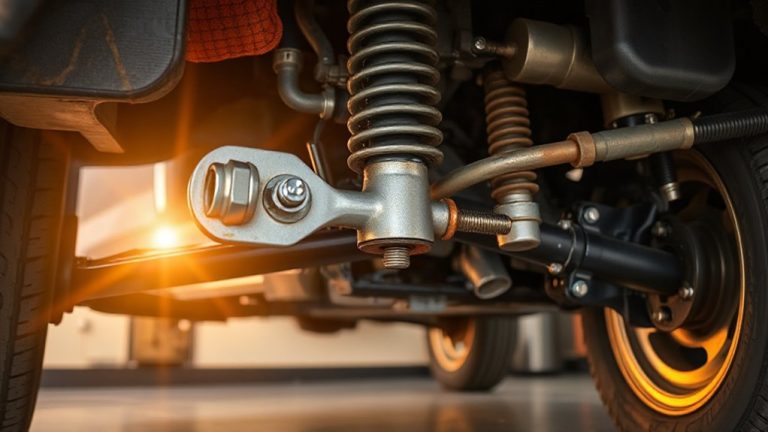
Why risk uneven tire wear or unstable handling after modifying your suspension? Lowering your car drastically alters suspension geometry, affecting camber, toe, and track alignment. Without correction, you’ll sacrifice grip, accelerate tire wear, and compromise safety. Adjustable control arms let you restore proper alignment by fine-tuning control arm length, compensating for the new ride height. They maintain correct caster and camber angles, critical for steering response and stability. Unlike stock arms, adjustable units offer threaded ends or heim joints for precise on-the-fly adjustments. You gain consistent tire clearance, preventing rub even with aggressive wheel fitment. Misaligned geometry increases stress on axles and joints-adjustable arms reduce that strain. Precision-altered suspension geometry guarantees even load distribution across tires. For extreme coilover drops, these arms aren’t optional-they’re essential for safety, performance, and maximizing component life.
Inspect CV Joints Regularly to Prevent Failure
Regularly inspecting CV joints is essential to catching early signs of wear before failure occurs. You should check them every 15,000 miles or after any extreme drop modification. Focus on boot seal integrity-cracks, tears, or collapsed boots mean contaminants are entering. A compromised seal leads to rapid loss of CV joint lubrication, which accelerates wear. Grease escaping from the boot is a clear red flag. Use a flashlight and mirrors to examine the full circumference. If the boot is intact, squeeze it gently; swollen or brittle areas suggest degradation. Proper lubrication reduces internal friction and heat, extending joint life. Angles exceeding 28 degrees from extreme lowering increase stress. Catching issues early prevents catastrophic joint failure, which can leave you stranded. Replace damaged boots immediately and repack with high-temperature CV grease to maintain performance and safety.
On a final note
You must prioritize CV joint protection when lowering your vehicle. Extreme coilover drops increase axle angle beyond factory specs, accelerating wear. Install extended CV axles-typically 1.5 to 3 inches longer than stock-to restore proper alignment and reduce strain. Pair them with adjustable control arms to maintain correct camber and toe. Regular inspections every 6,000 miles prevent failure. These steps guarantee drivetrain longevity and safe operation.