Fog Light Wiring Harness Inspection for Ground Faults in Wet Environments
You should inspect your fog light wiring harness monthly in wet environments to catch ground faults early. Check connectors for greenish corrosion and test resistance between the socket ground and chassis-over 5 ohms indicates a poor connection. Use a multimeter to measure voltage drop under load;超过 0.2 volts means excessive resistance. Replace damaged sections with 18-gauge stranded copper wire and adhesive-lined heat-shrink connectors rated for 105°C. Apply dielectric grease and use IP67-sealed connectors to prevent moisture ingress. Ensuring proper grounding and insulation now leads to discovering more effective long-term fixes.
Notable Insights
- Inspect connectors monthly for greenish residue indicating copper oxidation caused by moisture exposure.
- Use a multimeter in continuity mode to verify ground resistance below 5 ohms for reliable grounding.
- Check for cracked insulation or soft spots near drain holes where water may pool and damage wiring.
- Apply dielectric grease to metal contacts and use IP67-rated sealed connectors to prevent moisture ingress.
- Replace damaged sections with 18-gauge stranded wire and adhesive-lined heat-shrink connectors for watertight repairs.
Spot Fog Light Wiring Problems Early
Why wait until your fog lights fail during a heavy downpour? Spot fog light wiring problems early to prevent reduced visibility in poor weather. Corros rồi detection is critical-inspect connectors and wires monthly. Look for greenish residue on copper terminals, a sign of oxidation. Even minor corrosion increases resistance, leading to a voltage drop. Use a digital multimeter: place probes at the battery and fog light connector while powered. A drop exceeding 0.2 volts indicates excessive resistance. Check wiring harnesses for cracked insulation or loose crimps. Damaged sheathing exposes conductors to moisture, accelerating corrosion. Replace any compromised connectors with dielectric grease-filled versions. Maintain a 14-gauge wire standard to support 15-amp circuits. Address issues proactively-don’t wait for complete failure. Early detection guarantees peak light output and system longevity.
Test for Ground Faults With a Multimeter
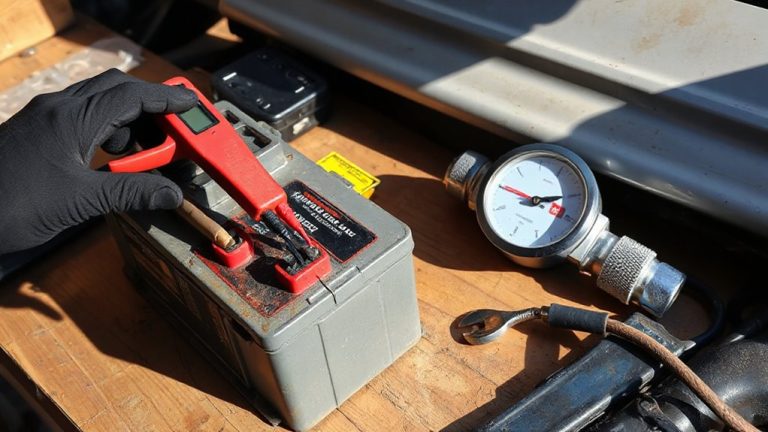
A ground fault can silently undermine your fog light system, so testing for one is a critical step in diagnostics. Set your multimeter to measure resistance or use continuity mode to verify circuit continuity. Disconnect the fog light from the power source and remove the bulb. Touch one probe to the ground terminal in the socket and the other to a known good ground on the chassis. A reading near 0 ohms or an audible beep confirms proper grounding. If resistance exceeds 5 ohms, corrosion or a broken ground path likely exists. Check for voltage drop by reconnecting power and measuring between the ground terminal and chassis while the light is on. More than 0.2 volts indicates poor grounding. This small voltage drop can severely impact light output. Accurate multimeter use reveals hidden faults before they worsen. For reliable results, use one of the top-rated multimeters recommended for automotive diagnostics.
Fix Water-Damaged Wiring in Your Fog Lights
If water’s gotten into your fog light wiring, you’re risking corrosion, short circuits, and eventual system failure. Cut out any damaged sections showing cracked or swollen wire insulation. Moisture compromises insulation integrity, increasing conductivity where it shouldn’t exist. Replace affected segments with 18-gauge stranded copper wire rated for 600 volts and 105°C. Use heat-shrink butt connectors with adhesive lining to seal splices-this guarantees corrosion resistance and maintains circuit continuity. Wrap connections with vinyl electrical tape before applying split loom tubing for extra protection. Always route wires away from standing water and secure them with waterproof clamps. Silicone-coated wire insulation offers superior moisture and abrasion resistance compared to standard PVC. Test continuity post-repair with a multimeter. Properly sealed and insulated wiring resists degradation for years, even in high-humidity environments.
Stop Moisture From Causing Electrical Faults
Though moisture intrusion often starts small, it can quickly lead to major electrical faults if you don’t take preventive steps. Maintaining insulation integrity is essential-check all wires for cracks, brittleness, or soft spots that compromise protection. Even minor damage allows humidity to seep in, creating conductive paths that disrupt circuits. For effective corrosion prevention, apply dielectric grease to all metal contacts and connectors. This blocks moisture without interfering with conductivity. Use only sealed, rubber-grommeted connectors rated IP67 or higher to keep water out. Inspect harnesses regularly, especially near drain holes or mounting points where pooling occurs. Replace damaged conduit immediately; split loom tubing with UV resistance restores protection. Never rely on electrical tape long-term-it dries out and loses adhesion. Preserving insulation integrity and prioritizing corrosion prevention guarantees reliable fog light operation, even in sustained wet conditions.
Weatherproof Your Fog Light Wiring Harness
Since fog lights operate in exposed, high-moisture environments, sealing every connection in the wiring harness is critical to long-term performance. You need reliable corrosion prevention and insulation reinforcement to avoid ground faults. Use heat-shrink butt connectors with adhesive lining for watertight seals. Wrap splices with self-amalgamating tape for added protection. Route wires through UV-resistant conduit to shield against abrasion and moisture ingress.
| Component | Material | Operating Temp Range |
|---|---|---|
| Heat-Shrink Tubing | Polyolefin with adhesive | -40°C to 125°C |
| Wire Seal Connectors | Rubber-sealed nylon | -45°C to 105°C |
| Harness Conduit | Cross-linked polyolefin | -55°C to 135°C |
These materials guarantee durability and sustained electrical integrity. Proper installation guarantees insulation reinforcement and effective corrosion prevention under real-world driving conditions.
On a final note
You’ve inspected for ground faults and sealed moisture entry points. A multimeter confirmed continuity below 0.5 ohms and isolation above 1 megohm. Replace frayed 16-gauge wires with UV-resistant, cross-linked polyethylene (XLPE) insulation. Use dielectric grease in connectors rated IP67 or higher. Properly routed, sealed harnesses prevent voltage drop exceeding 3% at 12 volts. This guarantees fog lights operate at 100% rated lumens. Prevent failure-maintain electrical integrity.