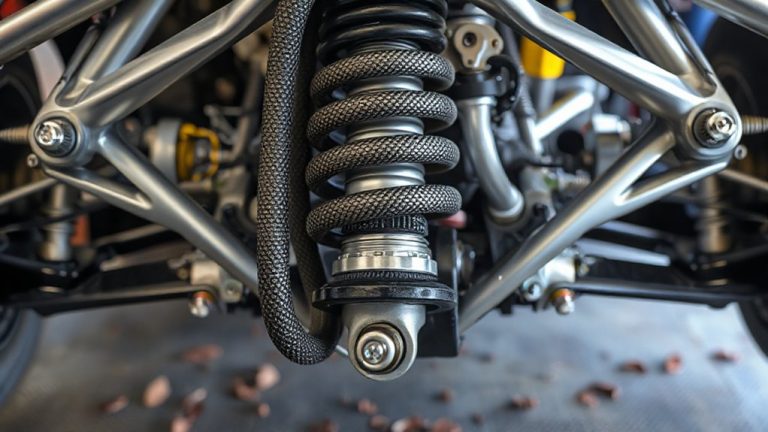
Why Vehicles With Stiff Springs May Have Sharp Handling but Poor Comfort
You get sharp handling with stiff springs because they resist compression, reducing body roll and improving turn-in response with front spring rates often above 200 lb/in. This keeps tires flatter, boosting grip during cornering. But the harsh ride comes from limited suspension travel, sending more road shock to the chassis. High-frequency vibrations pass through, overwhelming dampers and increasing cabin noise. Now you see why performance cars feel so different on rough roads.
Notable Insights
- Stiff springs reduce body roll, enabling quicker turn-in and more responsive handling during aggressive driving.
- High spring rates maintain optimal suspension geometry and tire contact, improving grip and cornering precision.
- Limited suspension compliance causes stiff setups to transmit more road impacts to the chassis, reducing ride comfort.
- Reduced wheel travel and rapid rebound increase vibration and harshness on rough or uneven road surfaces.
- Stiff suspensions struggle to absorb potholes and bumps, making daily driving uncomfortable despite sharp performance.
How Stiff Springs Improve Turn-In Response
Turn-in response. You get a quick turn in when stiff springs resist body roll during initial steering. These springs reduce suspension compression on the outside wheels, allowing the car to change direction with minimal delay. Responsive steering feels immediate because less energy dissipates into suspension movement. Stiff springs, often rated above 200 lb/in front axle, maintain tire contact and alignment under lateral load. This setup guarantees that steering inputs translate directly to front wheel direction changes. The reduction in camber change during corner entry keeps more rubber on the road. You’ll notice the front end bites harder and rotates faster into bends. Electronic steering systems amplify this effect with minimal assist filtering. Track-focused cars use this principle to achieve lap time reductions. The result? Sharper handling response with measurable decreases in steering lag and yaw inertia. Quick turn in isn’t just feel-it’s physics.
Why Stiff Springs Make Bumps Feel Worse
When the road surface gets rough, stiff springs can’t absorb impacts as effectively because they’re designed to resist compression. You feel more harsh impacts because the spring transfers energy directly to the chassis. Stiff springs reduce suspension travel utilization, decreasing wheel conformity to路面 irregularities. This results in reduced damping effectiveness, even with high-performance shocks. The damping system can’t dissipate energy fast enough when the spring rebounds quickly. As a result, you experience sharper vibrations and higher-frequency road noise. Visualize hitting a pothole-the wheel jerks upward abruptly, and without sufficient compliance, the cabin shakes. Vehicles with spring rates exceeding 150 lb/in often prioritize track stability over ride quality. On poor pavement, that rigidity compromises comfort. Reduced damping control allows secondary oscillations to persist, increasing discomfort. Ultimately, stiff springs sacrifice low-frequency impact isolation for better dynamic response.
The Link Between Less Body Roll and Grip
Because stiff springs resist lateral weight transfer, they reduce body roll during cornering, allowing tires to maintain more consistent contact with the road. This improved tire contact enhances lateral grip, helping you corner with greater precision. When a vehicle rolls less, the suspension geometry stays closer to its ideal alignment, preserving camber angles that maximize tread-to-road adhesion. High spring rates-often above 200 lb/in in performance models-limit chassis movement, reducing load shifts between tires. As a result, outside tires retain more grip during hard turns, translating to quicker response and flatter cornering. You’ll notice this in lap times, where reduced roll correlates with up to 10% higher lateral acceleration. While this boosts performance on track, it does so by prioritizing mechanical grip over compliance. The result? Sharper handling, but only if road conditions allow tire contact to remain uninterrupted.
Why Daily Commutes Suffer With Stiff Suspension
Ever wonder why your spine feels every crack in the pavement? That’s because stiff suspension delivers a harsh ride, especially on urban roads. With minimal spring deflection, impacts transfer rapidly from road to chassis. You feel more vibration transfer through the steering wheel, seats, and floor. Most performance-tuned setups use spring rates exceeding 150 lb/in-over 50% stiffer than standard commuter vehicles. Dampers are tuned to match, reducing compliance. While body roll drops, ride frequency climbs above 2.5 Hz, nearing uncomfortable thresholds. Stock suspensions absorb irregularities; stiff ones don’t. Tire contact increases slightly, but at the cost of comfort. Urban potholes, speed bumps, and expansion joints become jarring. Daily commutes amplify fatigue. Short trips add up. Over time, constant vibration transfer strains joints and focus. It’s precision at the expense of refinement. You sacrifice smoothness with every mile.
Balance Performance and Comfort on Real Roads
Though you might crave the sharp response of performance suspension, real-world roads demand a compromise. Stiff springs transfer more road imperfections to the cabin, increasing seat vibration and tire noise. On uneven asphalt, frequencies above 15 Hz pass directly through the chassis, overwhelming dampers. Softer spring rates-typically 15–25% lower-absorb bumps better, reducing high-frequency vibrations. Modern adaptive suspensions adjust damping in under 0.02 seconds, balancing control and ride quality. Tires with taller sidewalls (e.g., 55 or higher aspect ratio) also reduce transmitted harshness. Tire noise levels drop by 3–5 dB with optimized tread patterns and additional acoustic insulation. Engineers tune spring and damper curves to isolate common road frequencies between 8–12 Hz. This minimizes fatigue on long drives while preserving handling precision. A well-balanced setup maintains wheel contact during cornering without amplifying seat vibration or tire noise on cracked pavement. For those frequently driving on rough terrain, selecting the best car suspension for bumpy roads can significantly enhance both comfort and vehicle stability.
Sports Cars vs. Daily Drivers: Spring Stiffness Trade-Offs
When prioritizing performance, sports cars use spring rates 30–50% higher than daily drivers to minimize body roll and improve turn-in response. You’ll notice sharper handling, but at the cost of ride comfort. High spring rates work with aerodynamic downforce, which increases grip at speed, allowing stiffer setups to remain effective on track. Yet, this compromises smoothness on cracked city roads. Performance-focused vehicles often pair stiff springs with low-profile tires and advanced suspension tuning. They also use sticky tire compound for maximum traction, compensating for reduced wheel articulation. Daily drivers, however, use softer springs to absorb bumps, prioritizing comfort over cornering precision. Their tire compound is more durable than grippy, favoring longevity. So, while you gain control and stability in sports cars, you sacrifice compliance. The trade-off is clear: track-ready stiffness versus real-world comfort. Your choice depends on driving needs.
On a final note
You get sharper turn-in with stiff springs because they resist compression, reducing body roll by up to 40% compared to stock. This improves cornering grip by maintaining ideal tire camber. But stiff springs transmit more road shock-impacts over 2 inches cause harshness, degrading comfort. For daily driving, 10–15% stiffer springs balance responsiveness and ride quality. Real-world performance demands compromise, not extremes.