How to Choose Microfiber Materials That Suit Your Specific Needs
Choose microfiber with split fibers under 0.5 denier for precision cleaning on lenses or screens. Use solid fibers above 1.5 denier for heavy-duty upholstery that resists fraying. Opt for a tight 300–400 gsm weave to balance absorbency, strength, and lint-free performance. A 70–90% polyester blend with polyamide guarantees durability and microbial resistance. Wash with mild detergent, no fabric softener, in warm water under 105°F. More details on optimizing performance follow.
Notable Insights
- Select lower denier fibers (0.5–1.0) for delicate surfaces to ensure gentle, lint-free cleaning.
- Choose split microfibers for superior absorbency and trapping of oils, ideal for cleaning and drying tasks.
- Opt for solid fibers in high-stress uses like upholstery, where durability and color retention are critical.
- Match weave density (200–400 gsm) to the task-higher gsm for heavy-duty cleaning, lower for light use.
- Use 70–90% polyester blends with polyamide for durability, and avoid fabric softeners when washing.
Understand Microfiber Basics: What Makes It Work
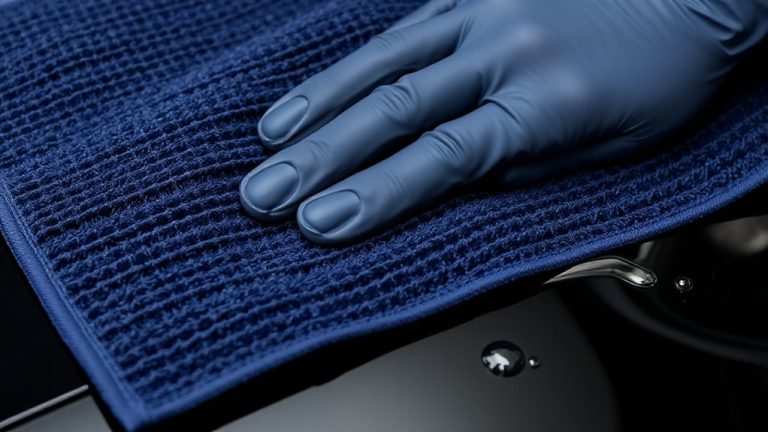
Although microfiber might look and feel like regular fabric, its performance comes from a precisely engineered structure. Each fiber is split into strands finer than silk-typically 0.5 denier or less-creating more surface area for absorption and cleaning efficiency. You benefit from its high capillary action, enabling rapid fluid wicking. Chemical resistance is a key trait, allowing microfiber to withstand exposure to solvents, alcohols, and cleaning agents without degrading. This resistance preserves fiber integrity over time. Durability factors include tensile strength and abrasion resistance, often exceeding 50,000 cycles in testing. The tight weave resists fraying and linting, even after repeated laundering. Most microfiber blends use 70–90% polyester reinforced with polyamide to enhance resilience. Unlike cotton, it doesn’t absorb microbes, making it hygienic. These properties are built in during extrusion and heat-setting, ensuring performance stays consistent. You rely on these engineered traits for long-term effectiveness.
Match Microfiber Denier to Your Use Case
You get the best results when you match microfiber denier to your specific task. Denier measures fiber thickness-lower denier means finer fibers. For delicate surfaces like lenses or screens, use microfiber with 0.5 to 1.0 denier. These ultra-fine fibers increase fiber density, enhancing softness and absorbency. Higher fiber density traps more dust and oils without scratching. For heavy-duty cleaning, like gym equipment or industrial surfaces, choose 1.5 to 2.0 denier. These offer greater durability and scrubbing power. Application matching guarantees peak performance and fabric longevity. A 0.3 denier fiber has nearly 40% more surface area than 0.5 denier, improving oil and moisture pickup. Finer denier isn’t always better-it must suit the job. Using the wrong denier reduces efficiency and can damage surfaces. Match the material to the task, and you get faster, safer, more effective results every time. Top-performing towels for car care often use blended deniers to handle both polishing and drying effectively, with best microfiber towels for car care offering optimized fibers for each step.
Split or Solid Fibers? What Works for Cleaning vs. Upholstery?
Most microfiber products use either split or solid fibers, and choosing the right type depends on whether you’re cleaning or upholstering. Split fibers undergo fiber splitting, creating multi-stranded filaments that increase surface area and boost absorbency. These microfibers can absorb up to seven times their weight in water, making them ideal for cleaning tasks like wiping glass or dusting electronics. The tiny channels formed during fiber splitting lift and trap oils and debris effectively. In contrast, solid fibers skip this process, preserving fiber durability for high-stress applications. Upholstery demands resilience against abrasion and frequent use, which solid fibers provide thanks to their intact, stronger structure. They resist fraying and hold color better over time. For cleaning, select split fibers for superior performance. For upholstery, choose solid fibers to maximize longevity and maintain appearance under wear.
Pick the Best Microfiber Weave for Your Needs
Why do some microfiber cloths feel soft like silk while others remain stiff and rugged? The answer lies in the weave. Weave flexibility determines how pliable or durable the fabric feels. A tight, high-count weave provides structure, ideal for scrubbing tasks, while a looser, soft-knit weave offers superior drape and comfort. Fiber density-measured in grams per square meter (gsm)-also plays a key role. Cloths with 200–400 gsm balance absorbency and strength, while those above 400 gsm suit heavy-duty use. Low-density weaves feel lighter but wear faster. Microfiber used in cleaning often has a twill or plain weave, enhancing lint-free performance. Upholstery favors dobby or sateen weaves for texture and abrasion resistance. Matching weave flexibility to your application guarantees longevity and function. Always check weave type and fiber density specs before buying.
Choose the Right Microfiber Blend
The performance of microfiber begins with its composition. Your choice of blend directly impacts fiber durability and moisture retention. Blends vary by polyamide-to-polyester ratio, altering functionality.
| Blend Ratio (Polyamide:Polyester) | Fiber Durability (Pilling Resistance, ASTM D3887) | Moisture Retention (g H₂O/g fabric) |
|---|---|---|
| 20:80 | 4.8 (Excellent) | 0.12 |
| 40:60 | 4.2 (Very Good) | 0.21 |
| 60:40 | 3.5 (Good) | 0.34 |
Higher polyamide increases moisture retention but reduces fiber durability due to softer filament structure. Polyester-rich blends resist wear but wick less. For heavy-duty cleaning, choose 20:80. For absorbent tasks like glass or mirror wiping, 60:40 works best. Always match the blend to your use case. The wrong ratio leads to premature breakdown or inefficient drying. You need the right balance.
How to Wash Microfiber Without Ruining It
You’ve picked the right microfiber blend for your task-now protect that investment by washing it properly. Always use a mild, bleach-free detergent; harsh chemicals degrade fibers and reduce absorbency. Avoid fabric softeners-they coat strands, diminishing their static charge and cleaning ability. Wash microfiber in warm water, never exceeding 105°F (40°C), to prevent fiber damage. Use a gentle cycle with minimal agitation to maintain structural integrity. For drying techniques, opt for low heat-not above 120°F (49°C)-to avoid melting or shrinking. Air drying is safest and preserves fiber lifespan. Never over-dry; remove while slightly damp to prevent stiffness. Wash microfiber separately from lint-producing fabrics like cotton to maintain effectiveness. Proper detergent selection and drying techniques extend usability up to 500 washes. Treat microfiber like a precision tool-its performance depends on care.
On a final note
Choose microfiber based on denier, weave, and fiber structure. Lower denier (0.5–1.0) offers superior softness and absorbency for cleaning lenses or screens. Higher denier (1.0–3.0) increases durability for car detailing or furniture. Split fibers enhance liquid absorption-ideal for cloths. Solid fibers resist wear-best for upholstery. A tight satin or twill weave improves filtration. Avoid fabric softeners when washing; they clog fibers. Use 30–40°C water for maximum longevity.