Why Some Cars Use Electronically Controlled Suspension for Adaptive Ride
You get a smoother, more controlled ride because electronically controlled suspension adjusts damping force in real time, from 2.5 to 15.8 kN·s/m, using sensors that monitor wheel motion up to 1,000 times per second. Actuators respond within 10 milliseconds, reducing body roll by up to 30% and minimizing jolts. The system integrates with stability controls and adapts to steering, braking, and road inputs. It uses microprocessors, chassis sensors, and sometimes GPS-linked terrain data. Luxury, performance, and off-road vehicles benefit most from this precision. There’s more to discover about how these systems balance comfort and control across driving conditions.
Notable Insights
- Electronically controlled suspensions adjust damping in real time for optimal comfort and handling on varying road surfaces.
- They use sensors to detect road conditions and vehicle dynamics, enabling instant adjustments up to 1,000 times per second.
- These systems reduce body roll, pitch, and bounce, improving stability during cornering and high-speed driving.
- Integration with vehicle dynamics and navigation systems allows predictive adjustments for upcoming road or terrain changes.
- Found in luxury and performance vehicles, they enhance ride quality, control, and passenger comfort despite higher ownership costs.
What Is Electronically Controlled Suspension?
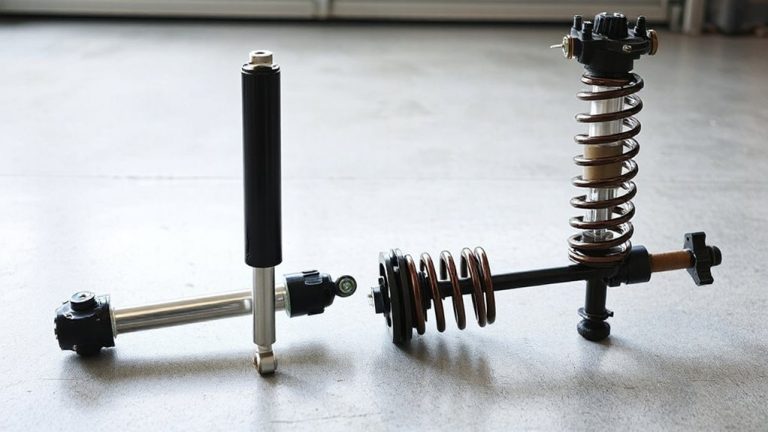
Conceive a suspension system that adapts in real time to road conditions-electronically controlled suspension does exactly that. You get a ride that’s both smooth and stable, no matter the terrain. This system uses servomotors or hydraulic actuators to adjust damping force within milliseconds. On-board computers process inputs from multiple chassis sensors to modify suspension behavior continuously. You rely on precise sensor calibration to guarantee accurate data collection from wheel position, acceleration, and body movement sensors. Without proper calibration, response times degrade by up to 30%. Suspension diagnostics monitor system health, detecting faults in valves, actuators, or communication lines. These diagnostics trigger dashboard alerts and log error codes for service. The damping range typically varies from 2.5 to 15.8 kN·s/m, allowing stiff responses during cornering and soft compliance on potholes. You benefit from improved handling, comfort, and tire contact.
How It Reads the Road in Real Time
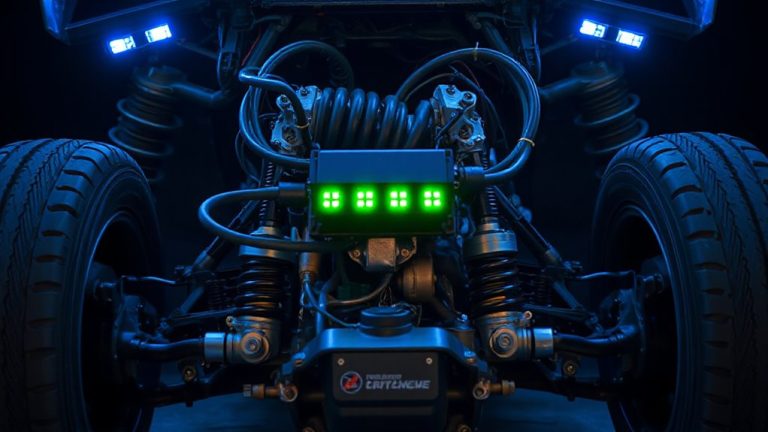
You already know the system adjusts damping force in milliseconds, but how it decides when to stiffen or soften is where the real intelligence lies. Road sensors at each wheel detect surface changes instantly. These sensors measure vertical wheel motion, body acceleration, and suspension position up to 1,000 times per second. Data feeds to the central control module, which processes inputs in real time. The system calculates ideal damping rates based on driving speed, load, and road conditions. Real time adjustments happen continuously, ensuring peak tire contact and stability. Sensors react to cracks, bumps, and dips before you feel them. Each damper operates independently, adapting within 10 milliseconds of input. This precision preserves handling balance. High-end systems use GPS-linked terrain mapping to anticipate changes. The result? Uninterrupted control. No delay. No guesswork. Just responsive, data-driven performance calibrated for safety and efficiency on any surface.
Smoothing Out Bumps: Comfort in City Driving
While city roads may seem smooth at a glance, they’re riddled with potholes, expansion joints, and uneven pavement that challenge ride quality. Your car’s electronically controlled suspension adapts in real time, maintaining ride harmony by adjusting damping forces within milliseconds. Sensors monitor wheel movement up to 500 times per second, feeding data to the control module. This system modifies shock absorber stiffness based on road inputs, ensuring consistent comfort. You experience an effortless urban glide, even over cracked asphalt or sudden dips. The suspension’s response time is typically under 15 milliseconds, minimizing jolts. Dampers operate across a 70% variable range, balancing soft compliance for bumps and firm control for stability. This precision engineering reduces body motion by up to 30%, enhancing passenger comfort. No manual input is needed-adjustments happen continuously, seamlessly. You stay relaxed, insulated from disruptions, while the system preserves tire contact for safety. Ride quality remains ideal, regardless of road imperfections.
Sharper Handling on Highways and Curves
When high-speed stability and precise cornering matter, electronically controlled suspension transforms your driving experience. This system continuously adjusts damping forces in real time, ensuring ideal contact between tires and road. You maintain better control during aggressive maneuvers, especially at speeds exceeding 65 mph. Corner stability improves dramatically, reducing body roll by up to 30% compared to conventional suspensions. Sensors monitor steering angle, lateral acceleration, and road input 1,000 times per second. Based on this data, the suspension stiffens on the outer wheels during turns. This enhances dynamic balance, keeping the vehicle level and responsive. Adaptive dampers react within 10 milliseconds, adjusting firmness to match driving conditions. The result is confident mid-corner grip and minimal post-turn oscillation. On sweeping highways or sharp mountain curves, your car stays planted and predictable. Engineers tune these systems using advanced algorithms that prioritize handling precision without sacrificing ride quality. You get measurable improvements in lateral grip-often exceeding 0.9g on testing tracks.
Customizing Your Ride With Driving Modes
How does your car adapt to different road conditions and driving styles? It uses electronically controlled suspension with selectable driving modes. These systems adjust damping rates in real time, aligning with your driver preferences. Comfort mode softens shocks for city roads, while Sport firms up response for sharper handling. Advanced models offer Individual modes, letting you customize settings. Terrain adaptation kicks in on off-road settings, increasing ride height and suspension travel by up to 2 inches. Sensors monitor wheel position 1,000 times per second, adjusting each shock independently. Some systems integrate GPS data to pre-load settings for known road contours. Response times average 15 milliseconds per adjustment. You get optimized ride quality without sacrificing control. Whether commuting or touring, driving modes guarantee performance matches conditions. This precision tuning enhances both safety and comfort.
Which Cars Gain the Most From Adaptive Suspension?
Why do certain vehicles benefit more from adaptive suspension than others? Because their design priorities demand real-time ride adjustments. Luxury sedans leverage adaptive suspension to enhance comfort and uphold luxury branding, smoothing asphalt imperfections effortlessly. SUVs, especially those engineered for off road capability, rely on it to switch between highway stability and rugged terrain compliance. Performance cars use it to balance cornering stiffness with daily drivability.
| Vehicle Type | Key Benefit | Example Feature |
|---|---|---|
| Luxury Sedan | Enhanced ride refinement | Self-leveling rear suspension |
| Off-Road SUV | Improved terrain adaptation | Height-adjustable air springs |
| Sports Coupe | Sharper handling response | Magnetic damping with 1ms response |
You see measurable gains in body control, wheel articulation, and ride height adjustments, making adaptive suspension especially valuable where versatility and prestige intersect.
Hidden Costs and Maintenance: What Buyers Overlook
What good is a smooth ride if repair bills roughen your wallet? Electronically controlled suspension systems introduce hidden costs through increased repair complexity. Unlike conventional suspensions, these systems rely on multiple electronic sensors and hydraulic controls. When a sensor fails, diagnosis requires specialized software, not just a wrench. Sensor replacement alone can cost $300–$600 per unit, depending on location and integration. Faulty ride-height sensors or accelerometers disrupt damping adjustments, leading to uneven wear or poor handling. The interdependence of components amplifies repair complexity-fixing one module often uncovers faults in another. Labor costs rise due to extended calibration procedures, sometimes requiring realignment of the entire suspension system. Over time, exposure to road debris and moisture degrades electronic connectors. These factors reduce long-term reliability compared to mechanical setups. Buyers often overlook these expenses, focusing only on comfort. But maintenance here isn’t just routine-it’s technical, costly, and unavoidable. Upgrading to a best car suspension for bumpy roads may improve comfort, but systems with advanced electronics often come with higher ownership costs.
On a final note
You get a smarter ride with electronically controlled suspension. It adjusts damping force in milliseconds using sensors and control units. Accelerometers detect body motion at up to 1,000 times per second. The system counters roll, pitch, and bounce with variable valve dampers or air springs. Drivers choose modes-Comfort, Sport, Auto-altering response curves. High-end sedans and performance SUVs benefit most. Maintenance costs rise due to complex electronics and alignment needs.