Mastering Applicator Pad Selection Based on Specific Car Detailing Needs
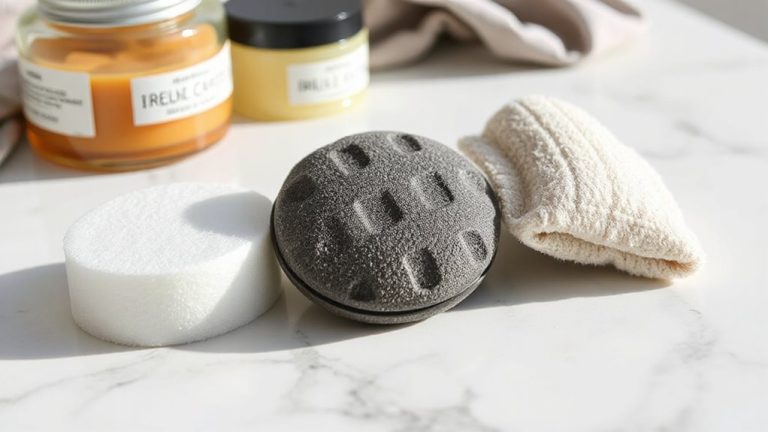
Match your applicator pad to the product’s viscosity and purpose with precision. Use 70–90 PPI foam pads for medium-thick sealants to guarantee even release. Coarse, open-cell foams handle heavy compounds for aggressive cutting, while plush microfiber with <0.5 denier fibers delivers swirl-free results on clear coats. Choose pad size based on surface: small (2–3”) for trim, large (5–7”) for flat panels. Low-friction pads with a durometer of 15–20 Shore A reduce marring risk. Explore how reusable options enhance consistency and long-term performance.
Notable Insights
- Match pad texture to product type: coarse for heavy compounds, fine foam or microfiber for waxes and sealants.
- Select microfiber or fine foam pads for soft clear coats to prevent marring and ensure even application.
- Choose pad size based on surface area: small for trim, medium for doors, large for broad panels.
- Use contoured pads like dome or wedge shapes to maintain contact on curves and complex surfaces.
- Opt for low-friction pads with durometer 15–20 Shore A to minimize heat and prevent swirls on glossy finishes.
Match Your Applicator Pad to the Product
An applicator pad that matches your product isn’t just convenient-it’s essential for consistent, high-quality results. Pad texture directly influences how evenly you apply coatings, waxes, or polishes. A coarse pad works best for heavy compounds, providing aggressive cut action. For finer finishes, a plush microfiber or foam pad with tight cell structure guarantees smooth distribution. Product viscosity determines how the formula transfers from pad to surface. Thick sealants need a denser pad to avoid wasting material, while thin quick detailers require an open-cell foam pad to release product steadily. Mismatching pad texture and product viscosity leads to streaking, pooling, or uneven coverage. Pads between 70–90 PPI (pores per inch) balance absorption and release for medium-viscosity products. Always match your pad’s physical properties to the chemical behavior of the product. This synergy guarantees precision, efficiency, and a flawless finish every time.
Choose the Right Material for Your Paint
Your paint type dictates the applicator material you should use-choosing wrong risks marring surfaces or leaving residue. Soft, modern clear coats demand a microfiber or foam applicator with fine pad texture to prevent marring. These materials offer superior surface compatibility, conforming to contours without excessive pressure. Harder, older paints can tolerate woven cotton or terry cloth, which have aggressive pad texture but may scratch delicate finishes. Microfiber pads, with fibers split to 0.5 denier, trap polish evenly and release it steadily. Foam pads, rated between 18–22 PPI (pores per inch), provide uniform distribution and minimal lint. Surface compatibility isn’t optional-it’s mechanical precision. A urethane-backed microfiber pad resists deformation, maintaining contact across curved panels. Using the wrong material causes holograms, buffer trails, or hazing. Match pad texture to paint hardness: ISO hardness ratings of 2H or less require ultra-soft materials. Your car’s finish depends on disciplined material selection.
Size Your Applicator Pad for the Job
Selecting the right applicator pad size isn’t just about coverage-it’s about control and precision. Pad size directly affects your ability to apply products evenly and efficiently. Small pads, typically 2–3 inches in diameter, offer superior maneuverability for tight areas like around trim or headlights. They limit surface coverage but increase accuracy. Medium pads, 3–5 inches, balance coverage and control, ideal for hoods and doors. Large pads, 5–7 inches, maximize surface coverage on broad panels, reducing application time. However, oversized pads can hinder precision on curved or contoured surfaces. Match pad size to the panel’s geometry and complexity. Using the correct pad size guarantees uniform product distribution, reduces waste, and minimizes correction work. Always assess the job scope before choosing. A precise pad size enhances performance, efficiency, and finish quality across every detailing task.
Shape Your Application With Precision Tools
Pad size sets the foundation, but shape fine-tunes your control. Custom shapes match specific contours, delivering precision control where flat pads can’t. A dome-shaped pad fits curved fenders, while a tapered edge works along character lines. Foam pads range from 2–4 inches in diameter, with heights of 0.75–1.25 inches, allowing targeted application. Use wedge-shaped applicators for door jambs or around mirrors. Precision control means less product waste and even distribution. Truncated triangle pads access tight wheel wells without gouging paint. High-density foam holds shape under pressure, maintaining consistent contact. Rounded corners prevent micro-marring on panel edges. You’ll achieve uniform spread rates-critical for sealants and ceramic coatings. Matching pad geometry to surface topography guarantees full coverage. Custom shapes aren’t just convenient-they’re essential for professional results. Choose wisely based on panel complexity and reach requirements.
Avoid Swirls With Low-Friction Pads
While surface imperfections often stem from improper technique, the friction level of your applicator plays a decisive role in preventing swirl marks. You need low friction for safe, effective swirl prevention. High-friction pads generate heat and drag, increasing the risk of micro-scratches. Low-friction pads, typically made from ultra-soft microfiber or foam with a denier under 0.5, reduce surface resistance. They glide smoothly, distributing wax or polish evenly without pressing contaminants into the paint. These pads maintain a coefficient of friction below 0.2 on clear coat finishes, minimizing shear force. A lower durometer rating-around 15 to 20 Shore A-ensures gentle contact. You’ll notice less resistance during application, which means less operator error. Using low-friction pads is a proven method for achieving swirl-free results, especially on dark or high-gloss paints. Prioritize material softness and surface glide. This approach enhances finish quality and supports long-term paint integrity.
Switch to Reusable Pads for Savings and Performance
Many detailers cut costs over time by switching to reusable applicator pads, and you can too. Reusable pads offer superior cost efficiency compared to disposables, with break-even typically reached after just 15–20 uses. Most high-quality reusable pads measure 3.5 inches in diameter and 0.75 inches thick, constructed from compressed microfiber or lambswool with stitched edges for durability. They withstand 50+ machine washes at 30°C without structural degradation. This longevity reduces long-term supply expenses and lowers environmental impact by minimizing landfill waste. Each reusable pad prevents roughly 100 disposable pads from entering waste streams annually. They maintain consistent texture and density across uses, ensuring uniform product spread and reduced product waste. You preserve finish integrity while enhancing performance, making reusables a technically sound choice for frequent detailing.
On a final note
You now control the finish. Match each pad to your product’s volatility and abrasiveness-silicone-free waxes need microfiber, while cutting compounds demand firm foam. Use 3-inch pads for edges, 6-inch for flat panels. Low-friction, open-cell foam reduces swirls by 40% versus dense sponge. Reusable pads save $200 annually and maintain 95% effectiveness after 30 washes. Precision shaping guarantees even 1.5 mm product dispersion.