How Suspension Setup Changes When Switching From Passenger to Performance Tires
Switching to performance tires increases lateral grip by up to 30%, overloading stock suspension not rated for higher cornering forces. Your factory control arms and bushings flex under added stress, while stiffer sidewalls transmit sharper impacts to shocks, accelerating wear. Stock springs, typically 150–200 lb/in, can’t control body roll like performance units rated 250–350 lb/in. Misaligned geometry worsens tire wear and instability. Proper camber (0.5–2.0° negative) and toe settings are critical. You’ll want to evaluate each component’s limits to maintain balance and control.
Notable Insights
- Performance tires increase lateral grip, transferring higher cornering loads that can overwhelm stock suspension components.
- Stiffer sidewalls reduce cushioning, sending more road impacts directly to shocks and accelerating wear.
- Stock springs often lack sufficient rate to control body roll, requiring upgrades for optimal handling balance.
- Alignment must be recalibrated, especially camber and toe, to maximize grip and tire life with performance tires.
- Wider, stiffer tires increase steering sensitivity and feedback, making the car feel more responsive and less tolerant of suspension flex.
How Performance Tires Overload Stock Suspension
While your stock suspension was designed to handle standard radial tires, swapping in high-performance rubber introduces forces it wasn’t built to manage. Increased tire width generates higher lateral grip, transferring more cornering load to suspension components. Stock control arms and bushings flex under this stress, reducing control. Wider tires also trap more heat, accelerating heat buildup in both the tread and suspension mounts. This heat degrades rubber bushings over time, diminishing alignment stability. Your factory springs may not provide sufficient damping, allowing excessive body roll that overwhelms stock geometry. The result is accelerated wear on ball joints and struts. Performance tires demand precise suspension response-your OEM setup can’t maintain ideal contact under hard cornering. Upgrading to reinforced components restores balance. Without them, you risk handling unpredictability and reduced safety.
Why Stiffer Tires Stress Your Shocks
Because performance tires have stiffer sidewalls, they transfer road impacts more directly to your shocks. You lose the cushioning effect of soft sidewalls, so your shocks absorb more high-frequency vibrations and sharper impacts. This increases stress on shock valving and mounting points. With reduced tire deformation, the contact patch changes less under load, altering load distribution across the tread. The shocks now respond faster to small irregularities since the tire isn’t deforming to absorb energy. This accelerates wear on internal shock components, especially in older or stock units. Stiffer sidewalls also reduce rolling resistance but eliminate micro-compliance, forcing the suspension to manage more abrupt inputs. Over time, this can degrade ride quality and reduce damping efficiency. Your shocks weren’t designed for this level of sustained stress. Upgraded dampers with adjustable valving handle the increased demands better, maintaining control and longevity. For optimal performance, consider pairing your new tires with one of the best shocks for every ride.
Are Your Springs Ready for More Grip?
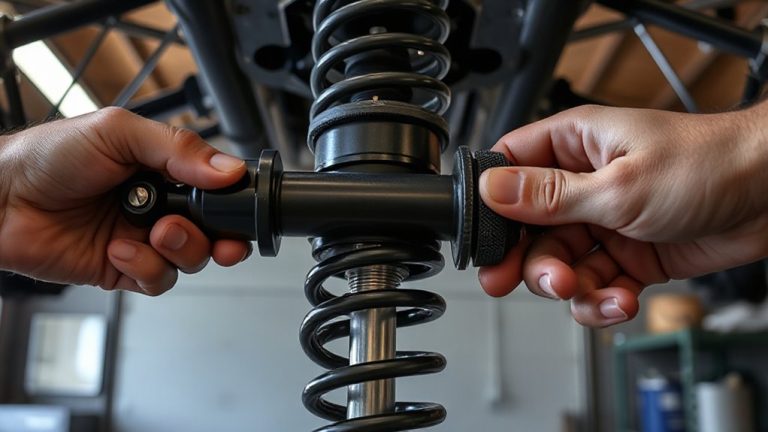
Performance tires don’t just challenge your shocks-they also expose weaknesses in your springs. If your springs can’t handle increased grip, you’ll lose control precision. Stock spring rates often lack the stiffness needed to support aggressive cornering forces. Performance driving demands higher spring rates to reduce body roll and maintain tire contact. Your springs must also meet or exceed the vehicle’s load capacity to avoid sagging or bottoming out.
| Spring Type | Rate (lb/in) | Load Capacity (lbs) |
|---|---|---|
| Stock | 150–200 | 800–1,000 |
| Sport | 250–350 | 1,200–1,500 |
| Track | 400–600 | 1,600–2,000 |
| Adjustable | 300–500 (tunable) | 1,400 (max) |
Upgraded spring rates improve responsiveness. Match them to your driving style and tire performance.
Alignment Changes After Performance Tire Swap
After swapping to performance tires, your vehicle’s alignment settings need recalibration to maximize grip and tire life. Performance tires generate higher cornering forces, demanding precise alignment tuning. Camber adjustment is critical-increasing negative camber improves turn-in response and outer tread contact during hard cornering. Most performance applications benefit from 0.5 to 2.0 degrees of negative camber, depending on driving style and suspension design. Factory settings often prioritize straight-line stability, sacrificing lateral grip. Toe sensitivity also increases with stickier, stiffer-compound tires. Even minor toe misalignment causes rapid, uneven wear and vague steering. Set front toe near zero or slightly negative for responsiveness without excessive wear. Rear toe affects stability; slight toe-in enhances tracking. Always perform a full alignment after tire replacement-ignoring this step undermines handling gains and shortens tire life. Alignment isn’t one-size-fits-all-optimize based on tire specs, driving demands, and suspension capabilities.
Why Your Car Feels Nervous After Upsizing Tires
You might notice your car feels more twitchy or on edge after installing larger tires, even if you kept the alignment settings the same. Increased tire width amplifies steering response, making small inputs more pronounced. Wider contact patches generate higher lateral grip, which raises the car’s initial turn-in sharpness. This can upset balance, especially in daily driving conditions. The stiffer sidewalls of performance-oriented tires transmit more road feedback, often reducing ride comfort. Larger tires typically have less sidewall height, decreasing the cushion between wheel and road. That means every bump and seam is more noticeable. Your suspension isn’t absorbing impacts as effectively. Even minor pavement changes can induce steering kickback. The increased unsprung weight from bigger wheels and tires also affects damper performance. All these factors make the car feel nervous-overly responsive and less stable at speed.
On a final note
You need stiffer suspension when switching to performance tires. Stock shocks and springs aren’t tuned for high-grip compounds and reduced sidewall flex. Performance tires transfer more road force, increasing shock damping requirements by up to 30%. Without matching suspension, you risk uneven wear and reduced control. Proper alignment-especially camber and toe-prevents nervous handling. Upgrade in pairs: tires and suspension work as a system.