Exploring Environmental Conditions’ Impact on Car Detailing Products
You risk poor wax and sealant performance when temperatures exceed 100°F, as rapid solvent evaporation disrupts film formation and causes hazing. Curing fails below 50°F due to slowed chemical reactions. Humidity over 60% reduces drying efficiency by up to 40%, increasing streaks and residue. UV radiation degrades carnauba wax in just 4–6 weeks. For best results, apply products in conditions with 60–85°F and 40–60% humidity-you’ll see how environment shapes durability.
Notable Insights
- High temperatures above 90°F disrupt wax and sealant curing, causing streaks and reduced durability.
- Ideal curing occurs between 60°F–85°F and 40–60% humidity for optimal film formation and adhesion.
- High humidity slows solvent evaporation, increasing drying time and risk of hazing or residue.
- UV exposure degrades wax quickly, reducing gloss retention and lasting only 4–6 weeks in direct sunlight.
- Moisture from dew or frost interferes with coating bonding, requiring 12–24 hours of dry conditions for full cure.
How High Heat Ruins Wax and Sealant Cure
When temperatures climb above 90°F (32°C), the curing process for most waxes and sealants becomes unreliable. High heat accelerates solvent evaporation, preventing proper film formation. You risk heat damage when applying products in direct sunlight or on hot surfaces. The surface temperature above 100°F (38°C) can trigger premature drying, leaving streaks or hazing. This disrupts cross-linking in polymer-based sealants, weakening durability. Molecular breakdown occurs when thermal energy exceeds bond stability thresholds in carnauba or synthetic wax compounds. UV exposure intensifies this degradation, reducing protective life by up to 50%. Ideal curing happens between 60°F and 85°F (15–29°C). At those temps, molecular alignment supports hydrophobic layer formation. You’ll achieve longer-lasting gloss and protection. Always check surface temps with an infrared thermometer before application. Avoid midday sun. Work in shaded, climate-stable areas whenever possible to guarantee complete, effective cure. A reliable RCA to speaker wire adapter ensures audio systems in vehicles remain functional during detailing, especially when testing protection results with music playback.
Why Humidity Hinders Polish and Cleaner Results
Though humidity plays a subtle role in surface preparation, it considerably affects how polishes and cleaners perform on automotive finishes. High moisture levels slow chemical evaporation, prolonging drying times and reducing effectiveness. When applied in humid conditions, liquids struggle to evaporate, leaving residues that interfere with polishing action. This happens because water vapor in the air reduces the evaporation rate of solvents by up to 40%, depending on relative humidity. Elevated humidity also alters surface tension, causing products to bead or sheet unpredictably instead of spreading evenly. Improper coverage leads to inconsistent cleaning and swirls. For best results, relative humidity should stay between 40% and 60%. Outside this range, product performance declines measurably. You’ll notice hazing, streaking, and reduced contaminant removal. Controlling the environment guarantees proper solvent release and uniform finish interaction, essential for achieving a flawless, polished surface every time. Top professional detailing products are specifically formulated to perform optimally under controlled environmental conditions, making the choice of professional detailing products crucial for consistent outcomes.
Wax Fading in Sunlight? Here’s Why UV Kills Shine
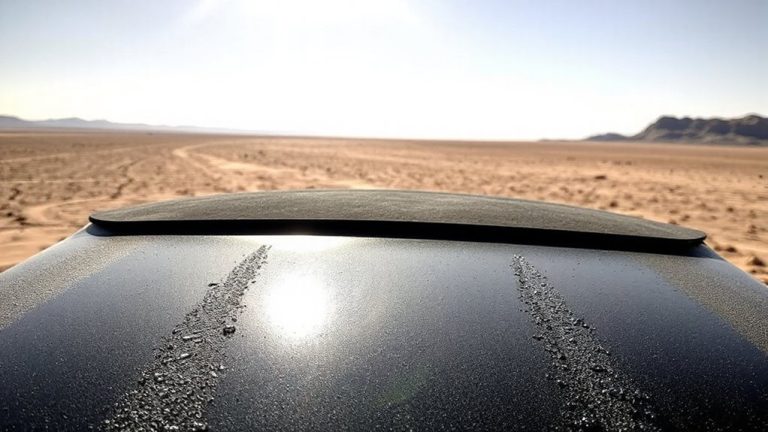
Why does your car’s glossy finish vanish so quickly after a detailed wax? Sun damage is the primary culprit. Ultraviolet (UV) radiation accelerates wax degradation by breaking down the molecular structure of both natural and synthetic waxes. Carnauba wax, popular for its deep gloss, typically lasts 4–6 weeks under direct sunlight due to UV exposure. Synthetic polymer sealants fare better, resisting wax degradation for up to 6 months. UV photons penetrate the wax layer, causing oxidation and micro-cracking that diminish reflectivity. A study measuring gloss retention found UV-exposed surfaces lost 40–60% of initial shine within 8 weeks. You can expect faster deterioration on dark-colored vehicles, which absorb more heat and intensify sun damage. Applying a UV-blocking ceramic coating adds a sacrificial layer that reduces photodegradation by up to 75%. To maximize longevity, park in shaded areas or use a UV-reflective car cover. Wax maintenance in sunny climates demands more frequent reapplication. Installing high-quality car window tint can also reduce interior UV exposure and protect both surfaces and occupants.
Cold Weather and Its Effect on Car Care Chemicals
Cold temperatures markedly alter the performance and application of car care chemicals, shifting the challenges from UV degradation to viscosity changes and chemical stability. You’ll notice waxes and sealants thicken below 40°F (4°C), making even application nearly impossible. Solvent-based products evaporate slower, increasing drying time and risk of streaking. Frost formation on surfaces interferes with adhesion, preventing proper bonding of coatings. Ice buildup in containers can compromise chemical integrity, especially in water-based formulas that expand when frozen. Always store products above freezing to maintain efficacy. Some polymers become brittle in cold weather, reducing durability. Apply treatments only when ambient and surface temps are above 50°F (10°C) for best results. Avoid contact with frozen surfaces-residue may trap moisture, accelerating corrosion. Check manufacturer specs: many recommend 60–80°F (15–27°C) for application. Cold doesn’t destroy most chemicals, but it severely limits performance.
How Morning Dew Undermines a Fresh Coating
When moisture from morning dew settles on a freshly applied coating, it can disrupt the curing process and compromise long-term protection. Dew formation occurs when surface temperatures drop below the dew point, causing water vapor to condense. Even thin layers of moisture interfere with molecular cross-linking, reducing coating durability. Surface tension of water causes beads to form, trapping humidity against the coating surface. These micro-droplets create uneven curing zones, leading to inconsistent hardness and gloss. Most ceramic coatings require 12–24 hours of dry conditions to fully cure. Exposure to dew within this window risks haze, reduced hydrophobicity, and premature degradation. Environmental monitoring is essential-ideal application occurs when humidity is below 60% and temperatures are above 50°F (10°C). You must avoid outdoor applications overnight, especially in grass-adjacent areas where dew accumulation is highest. Plan detailing tasks accordingly to guarantee maximum performance and longevity.
Seasonal Detailing: Adjusting Products by Climate
Though seasonal shifts influence vehicle finish care, few consider how temperature and humidity directly affect product chemistry. As climates change, so must your detailing approach. In colder climate zones, sealants with low-VOC solvents evaporate slower, requiring extended cure times-sometimes up to 48 hours below 50°F (10°C). Conversely, in hot, humid regions, high moisture content impedes solvent release, increasing the risk of hazing. Seasonal shifts demand product reformulation: use acrylic-based coatings in winter for flexibility; switch to ceramic-enhanced formulas in summer for thermal stability up to 570°F (300°C). Application viscosity also varies-lower temps increase thickness, reducing spreadability. You’ll need to adjust pad pressure and dwell time accordingly. Always check technical data sheets for application windows: most products specify 59–86°F (15–30°C). Matching products to your climate zone guarantees adhesion, durability, and maximum finish protection year-round.
Best Practices for Applying Coatings in Hot Conditions
Applying coatings in hot conditions requires precise timing and product selection to avoid premature drying and uneven curing. Heat management is critical-work in shaded areas or during early morning/late afternoon when ambient temperatures are below 85°F (29°C). Direct sunlight can raise surface temps over 150°F (65°C), causing flash curing. Use an infrared thermometer to monitor panel temperatures. Surface cooling with a quick-drying isopropyl alcohol (IPA) mist-30% IPA to 70% distilled water-lowers substrate heat without leaving residue. Apply coatings in thin, even layers; thick applications trap heat and create fisheyes. Work on one panel at a time using a low-lint applicator. Allow minimum 45 minutes between coats for solvent release. Ideal humidity levels range between 40–60%. Exceeding 85% reduces curing efficiency. Follow manufacturer induction times strictly-many ceramic coatings specify 2–4 hours of cure before exposure to elements.
On a final note
You must adjust detailing practices to environmental conditions for best results. High heat above 85°F accelerates wax and sealant curing, causing hazing and poor adhesion. Humidity over 60% slows solvent evaporation, reducing polish effectiveness. UV exposure degrades wax polymers, cutting gloss longevity by up to 40%. Cold temperatures below 50°F increase chemical viscosity, impairing application. Morning dew raises surface moisture, inhibiting coating bonding. Always detail in shaded, climate-stable environments.