Aftermarket Intercooler Spray Mist Systems for Transient Cooling Events
You can stop heat soak from killing turbo performance with an aftermarket intercooler spray mist system. These systems cut intake temps by 30–50°F in seconds using fine water or methanol mist. Spray activates at 10–15 psi via boost or temperature triggers, cooling the intercooler surface through rapid evaporation. A 12V pump delivers fluid through 0.014-inch nozzles, angled 30–45° for full coverage. You’ll get consistent power during repeated sprints or towing-there’s more to optimize below the hood.
Notable Insights
- Aftermarket intercooler spray mist systems provide rapid cooling during transient boost events to combat heat soak.
- Systems use evaporative cooling, where fine water or methanol mist absorbs heat as it vaporizes on the intercooler surface.
- On-demand activation via boost pressure or temperature sensors ensures spray occurs only during high-load driving conditions.
- Water offers superior cooling capacity, while methanol adds octane and freeze resistance but requires more maintenance.
- Proper installation includes precise nozzle placement, filtration, and PWM control for optimal mist coverage and system reliability.
What Is Heat Soak and Why Does It Hurt Turbo Power?
When your turbocharged engine runs, hot exhaust gases spin the turbo to force more air into the intake, but that compressed air heats up substantially-often reaching 150°F to over 250°F, depending on boost levels and ambient conditions. That heat builds up in the intercooler over time, causing heat soak. Thermal lag delays heat dissipation, reducing cooling efficiency between drives. As the intercooler retains stored heat, it can’t cool incoming air effectively, diminishing charge density. This leads to reduced power and increased knock risk. Prolonged heat soak worsens airflow restriction, especially in tightly packed core designs. Even minor flow losses amplify under high boost, sapping performance. Your engine compensates by retarding timing, further cutting output. Over time, sustained high intake temps stress internal components. Heat soak doesn’t just limit peak power-it degrades consistency, throttle response, and reliability. Managing it is critical for sustained performance.
How Intercooler Spray Mist Systems Cool Your Intake Air
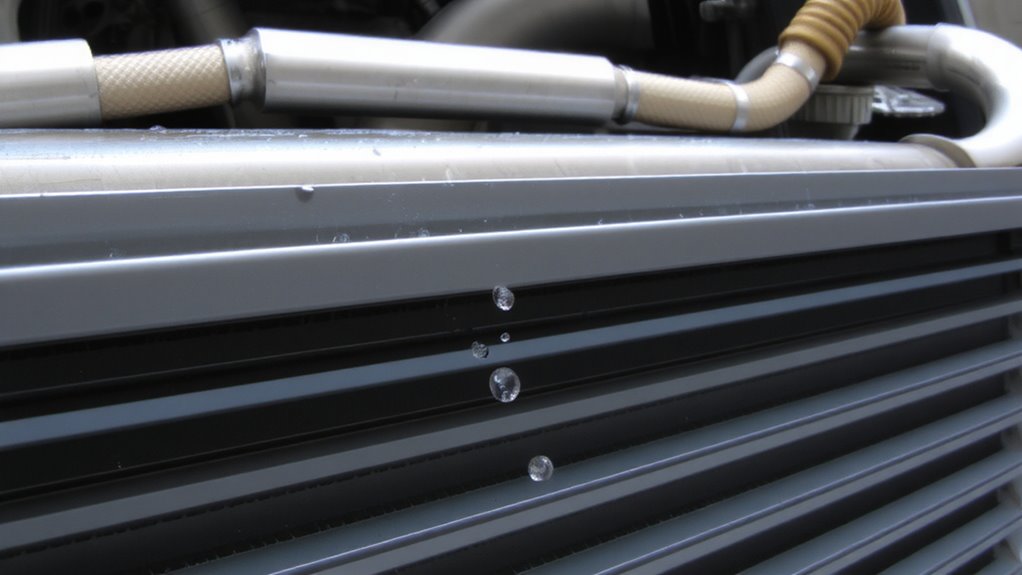
While your intercooler works to reduce intake air temperature, it can’t shed heat fast enough under sustained boost, which is where intercooler spray mist systems step in. These systems leverage thermal dynamics by spraying a fine mist onto the intercooler’s surface. As the liquid absorbs heat, it undergoes a phase change-from liquid to vapor-carrying thermal energy away. This process drastically lowers intake air temps in seconds.
| Mechanism | Effect |
|---|---|
| Spray mist contact | Instant surface cooling |
| Phase change | High heat absorption |
| Evaporative cooling | Sustained thermal reduction |
You get denser air and more power without waiting for airflow to cool the intercooler. The system activates on demand, synchronizing with boost pressure. With precise solenoid control and nozzle targeting, cooling is uniform and efficient. Properly tuned, it reduces intake temps by up to 50°F during transient events-proving critical in high-load scenarios.
Water or Methanol? Which Spray Mix Cools Best?
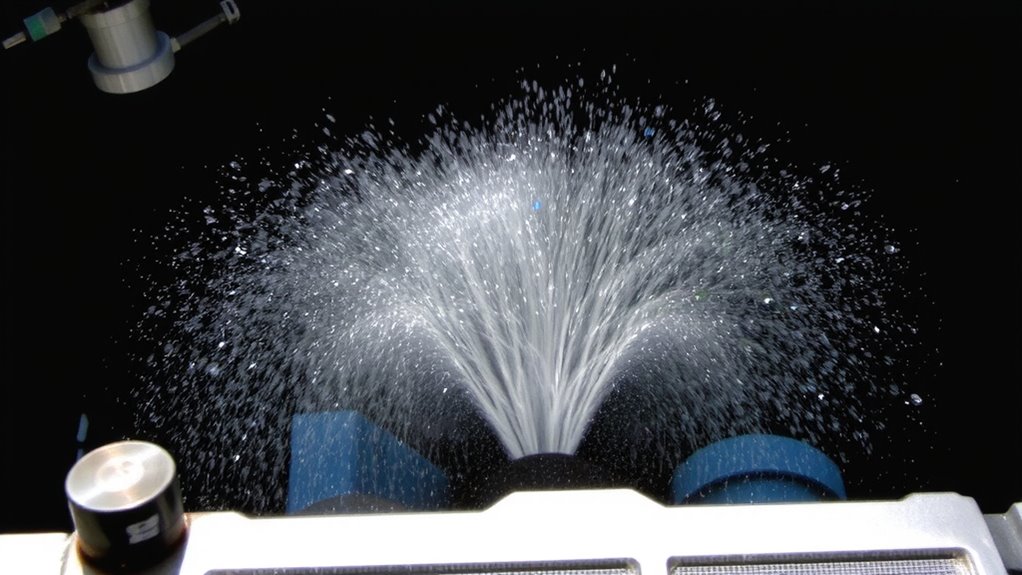
What if you could cut intake temperatures further by choosing the right spray fluid? Water cools primarily through evaporation, absorbing 2,260 kJ/kg of heat, making it highly effective for thermal absorption. It has low fluid viscosity, ensuring fine atomization and rapid vaporization in the intercooler. However, it freezes at 0°C and offers no octane enhancement. Methanol absorbs less latent heat-1,100 kJ/kg-but its chemical stability under high heat and added octane boost improve combustion efficiency. It has higher fluid viscosity than water, which can affect spray nozzle performance over time, requiring more frequent maintenance. Methanol also lowers freezing points and resists bacterial growth in fluid lines. While water provides superior cooling per gram, methanol delivers added performance benefits. Your choice depends on climate, engine tuning, and desired balance between cooling and fuel enrichment.
When Should You Trigger the Spray? Activation Strategies
How effectively you time the spray could make or break your intercooler mist system’s performance. Spray timing must align precisely with heat buildup to maximize cooling without wasting fluid. You should activate the spray just before or during high-load events like hard acceleration or towing. Delayed activation reduces intake charge cooling, while spraying too early wastes fluid and diminishes benefit. Trigger sensors, such as boost pressure or intake air temperature sensors, provide real-time data to optimize activation. Most systems engage at 10–15 psi of boost, ensuring spray only during meaningful thermal load. Using a controller with adjustable thresholds lets you fine-tune response based on driving conditions. Properly calibrated trigger sensors prevent unnecessary cycling, extending component life. Think of it like timed fuel injection-precision matters. Accurate spray timing enhances efficiency, lowers intake temps by 30–50°F, and supports consistent power delivery when you need it most.
Spray System Components: Pumps, Nozzles & Controllers
You’ve optimized the timing-now it’s time to focus on what delivers the performance: the core hardware. Your pump must handle constant on-off cycles without overheating-high pump durability is essential. A 12V diaphragm pump rated at 2.5 gallons per hour guarantees consistent flow without voltage spikes. Cheap units fail early; stick to brushed motors with overcurrent protection. Nozzles are just as critical-micro-orifice designs at 0.014 inches atomize water efficiently but are prone to nozzle clogging if unfiltered. Use 100-micron in-line filters and distilled water. A PWM-compatible controller lets you modulate spray duration from 0.5 to 5 seconds, syncing with boost pressure via a 3–8 psi switch. Match nozzle flow (0.5–1.2 L/min) to intercooler volume to avoid pooling. These specs guarantee reliability, precision, and thermal efficiency when cooling matters most.
How to Install Nozzles and Plumbing for Even Mist Coverage
Where should you place the nozzles to maximize cooling without wetting the intercooler core? Mount them 6–8 inches forward of the intercooler face, angled at 30–45 degrees to create an overlapping mist cloud. Proper nozzle alignment guarantees even dispersion across the entire intake area, preventing dry spots and runoff. Use at least two nozzles for intercoolers over 24 inches wide. Align spray patterns so they converge just before reaching the core. For pipe routing, use 1/4-inch nylon or stainless lines to minimize pressure loss and resist kinking. Route pipes away from exhaust components and moving parts, securing them every 6 inches with insulated clamps. A symmetrical layout maintains balanced flow. T-fittings should be high-quality brass to prevent cracking. This setup sustains consistent atomization during transient events, improving thermal efficiency without pooling.
Do Spray Systems Really Add Power? Track vs. Street Results
Could an intercooler spray mist system actually increase horsepower, or is it just a cosmetic upgrade? Real world testing shows these systems do deliver measurable power gains under specific conditions. On the track, where intake air temperatures spike during back-to-back runs, mist cooling reduces intake temps by 30–50°F, improving air density and combustion efficiency. Dyno tests confirm 5–12 hp gains in turbocharged engines during sustained high-load operation. However, on the street, gains are often negligible due to lower duty cycles and ambient humidity effects. The system’s effectiveness depends on nozzle placement, water-to-methanol ratio, and trigger logic. Properly tuned, it enhances charge cooling during transient boost events. But without precise calibration, benefits diminish. Power gains aren’t automatic-they’re situational, repeatable only when thermal load justifies the spray.
On a final note
You get cooler intake temps when you need them most. A properly tuned spray mist system lowers air charge temperature by 30–70°F during transient boost events. This reduces knock tendency and improves air density. Systems using 45% methanol / 55% water offer better latent heat absorption than water alone. Activating spray at 70% throttle or higher guarantees efficient use. Nozzles must deliver even mist across the intercooler face-uneven coverage causes surge risks.