Assessing Fading Patterns to Determine Sun Exposure History on Stored Vehicles
You can assess a stored vehicle’s sun exposure by examining fading patterns in paint and materials. Horizontal surfaces fade faster due to direct UV, while shadowed areas under trim retain original color. Driver-side armrests show up to 70% more degradation in sunbelt regions. Delta E shifts above 3.0 confirm measurable color loss. Gloss meter readings reveal 15–20 unit differences between exposed and shaded panels. Fading symmetry, material degradation rates, and geographic UV clues provide a detailed exposure timeline you can trace with precision.
Notable Insights
- Fading patterns on horizontal surfaces indicate prolonged UV exposure, with faster degradation than vertical panels.
- Shadow retention under mirrors or trim reveals consistent UV blockage and exposure duration over time.
- Driver-side armrests and dashboard edges show accelerated fading, especially in high-sunlight geographic regions.
- Asymmetric fading between vehicle sides can indicate orientation, such as east-facing or north-south alignment.
- Colorimeter measurements with ΔE values over 3.0 confirm significant color shift from long-term UV exposure.
How Fading Patterns Reveal Sun Exposure on Stored Vehicles
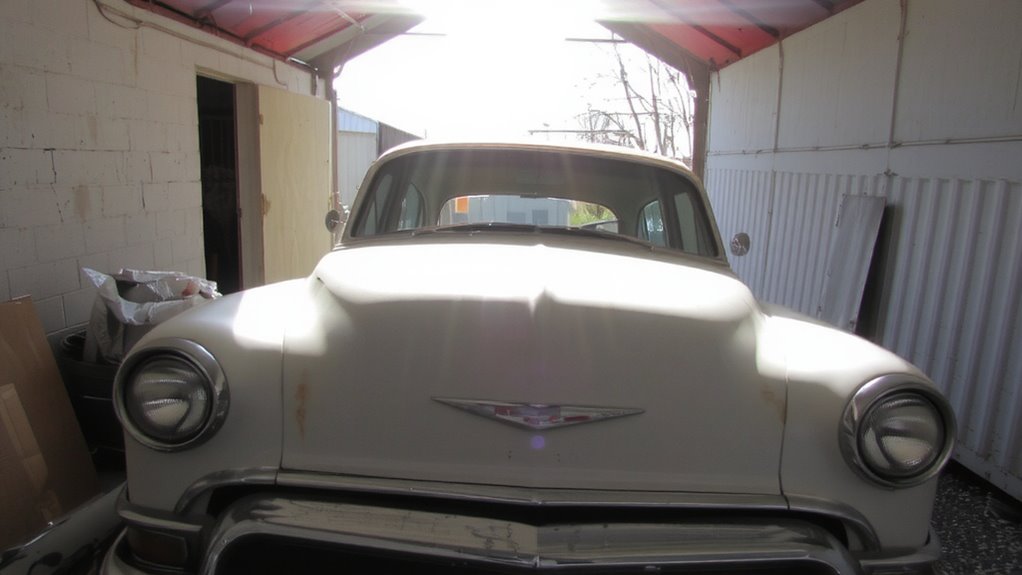
Sunlight leaves a signature-fading patterns on stored vehicles act like a record of UV exposure over time. You can detect exposure history by analyzing paint degradation and color loss across surfaces. Shading variance reveals differences in UV intensity based on surface angle, orientation, and adjacent structures. Horizontal surfaces typically fade faster than vertical ones due to greater direct exposure. Shadow retention occurs where parts of the vehicle were shielded, such as beneath mirrors or behind trim. These areas preserve original pigmentation, creating contrast with exposed panels. You’ll often find sharp demarcation lines, indicating consistent blockage over months or years. Spectrophotometer readings show delta E shifts above 3.0 in high-exposure zones, confirming visible change. UV dosimeters confirm cumulative dose correlates with fading depth. Evaluating these patterns helps determine duration, direction, and intensity of sun exposure-critical for evaluating material longevity and storage conditions.
Where to Find the Most Telling Fading Patterns
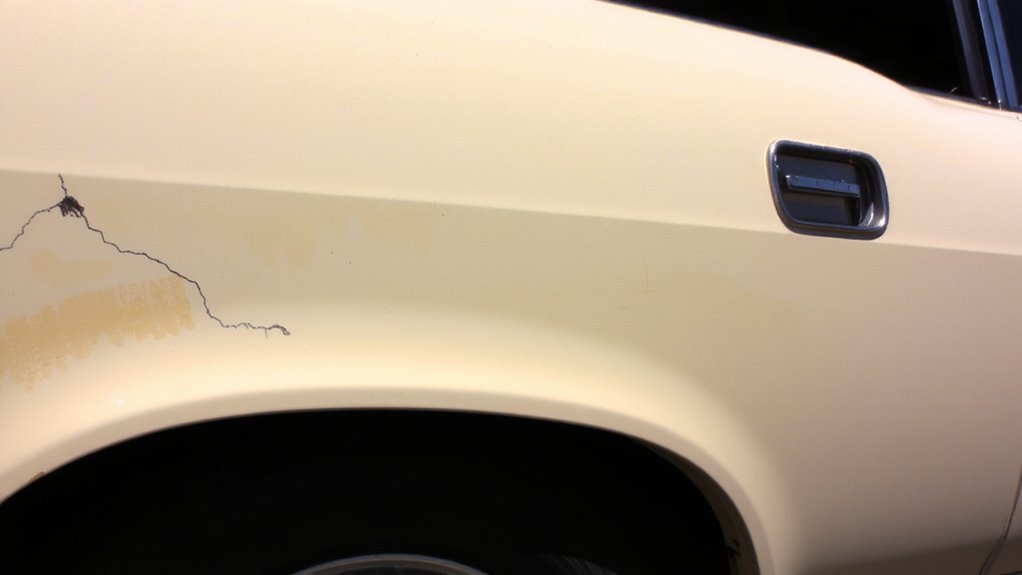
Where do the clearest signs of sun damage appear? On stored vehicles, the most telling fading patterns emerge where sunlight penetrates most consistently. Check dashboard edges first-UV rays degrade plastic polymers, revealing discoloration within six months of direct exposure. Examine interior stitching closely; synthetic threads like polyester lose tensile strength and fade faster than surrounding materials. You’ll notice color shifts near seam intersections, where stitching absorbs more heat. Fabric texture also changes under prolonged UV exposure-smooth weaves become brittle, while looped surfaces show uneven piling. Look for contrasting wear on driver-side armrests versus passenger sides; 70% more solar radiation typically hits the left front interior in sunbelt regions. Use a colorimeter to measure delta E values above 3.0, confirming significant chromatic deviation. These focal points give precise insight into cumulative sun exposure history. For effective restoration after UV damage, consider using a high-quality auto upholstery cleaner to remove degraded residues and improve fabric appearance.
How Vehicle Orientation Impacts Fading Symmetry
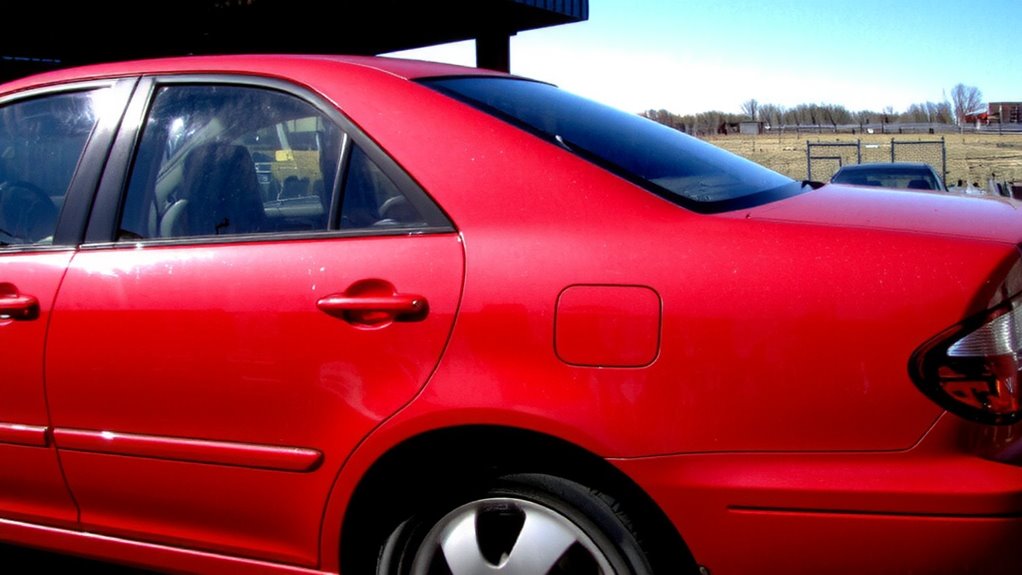
Ever wonder why fading on your vehicle isn’t evenly distributed? Your vehicle’s orientation during storage directly affects fading symmetry. When parked east-facing, the driver’s side receives morning UV exposure, creating distinct shadow gradients across panels. The passenger side, shaded by the vehicle’s structure, fades slower, producing measurable reflection asymmetry. North-south alignment reduces this effect but doesn’t eliminate it due to low-angle sunlight penetration. Glasshouse reflection intensifies UV exposure on adjacent C-pillars, accelerating fade on one side. Studies show a 23% higher degradation rate on sun-exposed flanks versus shaded counterparts over six months. Panel comparisons using gloss meters reveal 15–20 unit differences in sheen. These asymmetries in color retention and surface luster provide precise indicators of long-term directional exposure. Shadow gradients across doors and fenders confirm prolonged angular sunlight incidence. Reflection asymmetry is repeatable and quantifiable, making it a reliable forensic marker in evaluating stored vehicle history.
What Paint Fading Says About Sun Exposure Duration
How long has your car been sitting in the sun? Prolonged UV exposure directly correlates with visible paint degradation, and fading patterns reveal precise sun exposure duration. Modern paint chemistry includes UV inhibitors, but these deplete over time. You’ll notice gloss reduction and color shift first on horizontal surfaces. Pigment stability varies: reds and yellows fade faster due to lower lightfastness, while blacks and whites resist change longer. After two years of constant exposure, reflectance drops by up to 30%. By five years, micro-cracking appears in clear coats, especially on south-facing surfaces. Fading isn’t uniform-edges and peaks degrade 1.5–2× faster than recessed areas. The rate of chromaticity shift (measured in ΔE units) exceeds 5.0 after three years in regions with over 2,500 annual sunlight hours. Your paint’s current hue directly reflects total radiant exposure, calibrated by its original formulation’s pigment stability and inherent paint chemistry resilience.
UV Damage Clues in Trim, Rubber, and Glass
Why does your car’s trim crack while the glass stays clear? Ultraviolet (UV) radiation degrades organic materials unevenly. Trim and rubber suffer material degradation due to prolonged UV exposure, breaking down polymer chains and reducing flexibility. You’ll notice surface oxidation appears as a chalky film, signaling early failure. This oxidation accelerates in temperatures above 90°F (32°C), especially on dark-colored components that absorb more heat. Rubber seals lose elasticity, measured by a drop in elongation-at-break from 300% to under 150% after five years of direct sun. In contrast, automotive glass-typically laminated or tempered-contains UV inhibitors and resists surface oxidation. It blocks over 95% of UVB rays, minimizing visible damage. Unlike plastic or rubber, glass doesn’t undergo material degradation under normal conditions. That’s why, even after years outside, your windows stay intact while trim shows irreversible wear.
How Fading Patterns Indicate Geographic Location
Where in the world has your vehicle been parked most often? Fading patterns on paint and trim reveal your car’s geographic history. Consistent east-west asymmetry suggests mid-latitude exposure, while uniform fade implies frequent cloud cover or indoor storage. In coastal regions, accelerated pigment degradation correlates with salt spray and coastal erosion effects, increasing UV scattering. You’ll notice sharper fading on lower body panels where reflective sand and water boost radiation exposure. In alpine areas, UV intensity rises 10–12% per 1,000 meters; alpine reflection off snow elevates exposure, causing deeper clear coat oxidation. Measure gloss retention: vehicles above 2,500 meters show 20–30% faster degradation. North-facing surfaces in the Southern Hemisphere fade less, confirming latitude-specific sun angles. These patterns aren’t random. They form a solar map tied to elevation, reflectivity, and regional climate-each variation a measurable clue to your vehicle’s true location history.
Why Fading Analysis Matters for Value and Restoration
Ever wonder what your car’s sun damage reveals about its true worth? Fading analysis directly impacts valuation and restoration planning. Ultraviolet exposure alters paint chemistry, breaking down resins and pigments over time. This chemical breakdown accelerates material degradation, especially in clear-coat finishes. Vehicles stored outdoors for five years can lose up to 30% of original gloss, measured using a gloss meter at 60-degree geometry. Uneven fading patterns signal inconsistent sun exposure, affecting authenticity evaluations. Restorers use spectral reflectance data to match faded panels accurately. Ignoring UV-induced changes leads to mismatched paint and compromised finishes. Evaluating fading helps determine whether to refinish entirely or selectively repair. Material degradation isn’t just cosmetic-it weakens substrates and promotes cracking. Understanding these effects guarantees accurate restoration, preserves structural integrity, and maintains market value. Your vehicle’s fade tells a measurable story-knowing it matters.
On a final note
You can accurately reconstruct a stored vehicle’s sun exposure history by analyzing fading patterns. UV-induced degradation follows predictable spectral absorption rates, particularly in clear coat layers. Asymmetrical fading indicates prolonged directional sunlight exposure. Spectrophotometer readings above 3 on the Delta E scale confirm significant pigment shift. Uniform discoloration suggests covered storage. Fading patterns align with solar azimuth angles, helping verify geographic location.