Monitoring Ambient Garage Humidity’s Influence on Stored Brake Fluid Shelf Life
Your garage’s humidity directly degrades stored brake fluid. Brake fluid absorbs moisture from the air-DOT 3 and DOT 4 can gain up to 2% water by volume annually in humid conditions. At over 80% relative humidity, moisture uptake hits 3.8% per year, slashing boiling points and risking brake failure. Even sealed plastic bottles aren’t fully moisture-proof. Store fluid below 50% RH in opaque, airtight HDPE containers. Use desiccant breathers and monitor with a capacitive hygrometer accurate to ±2% RH. You’ll want to know what comes next.
Notable Insights
- Ambient humidity directly affects brake fluid shelf life by accelerating moisture absorption due to its hygroscopic nature.
- Relative humidity above 60% significantly increases moisture uptake, reducing fluid integrity even in sealed containers.
- Daily temperature fluctuations in garages cause container breathing, drawing in humid air and promoting contamination.
- Storing brake fluid in environments below 50% RH minimizes moisture ingress and extends usable shelf life.
- Use digital hygrometers to monitor garage humidity and ensure storage conditions remain within safe limits.
Why Humidity Ruins Brake Fluid in Garages
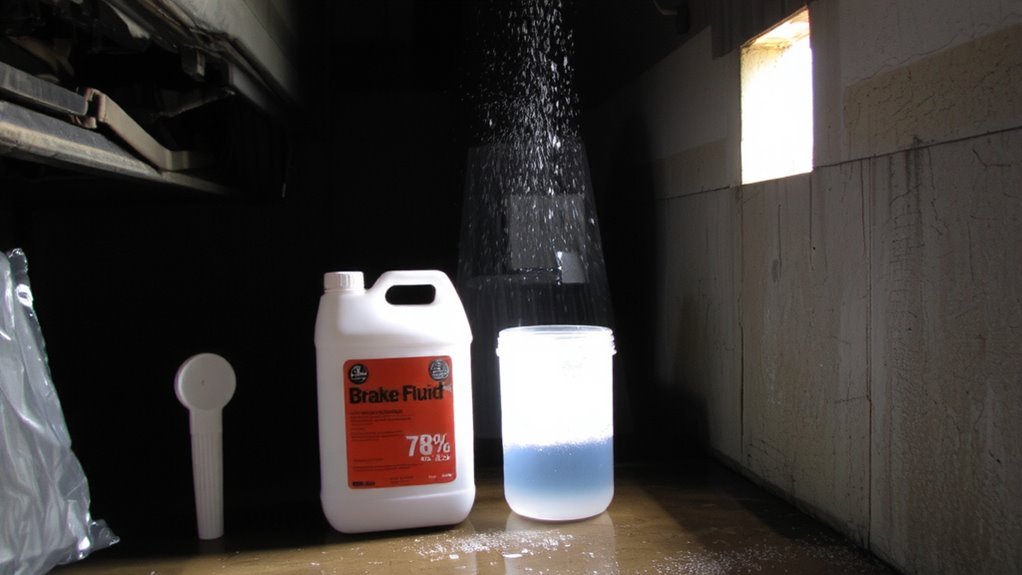
Even a single drop of water can compromise brake fluid integrity, and in humid garage environments, that’s exactly what happens over time. Brake fluid is hygroscopic, meaning it actively absorbs moisture from the air. Once water enters the system, it triggers chemical degradation, reducing performance. Moisture-laden fluid lowers the boiling point-DOT 4 fluid can drop from 230°C to under 150°C with just 3% water content. This increases the risk of vapor lock and brake fade. The presence of water also accelerates the oxidation process, breaking down additives and forming corrosive acids. These byproducts damage seals, calipers, and ABS components. Internal corrosion starts at 1.5% moisture concentration, which many sealed containers can reach within six months in 60%+ relative humidity. You can’t see this damage, but it’s measurable. Preventive monitoring isn’t optional-it’s essential for maintaining fluid specification and system reliability. Humidity control protects both stored and installed brake fluid.
How a Damp Garage Shortens Brake Fluid Shelf Life
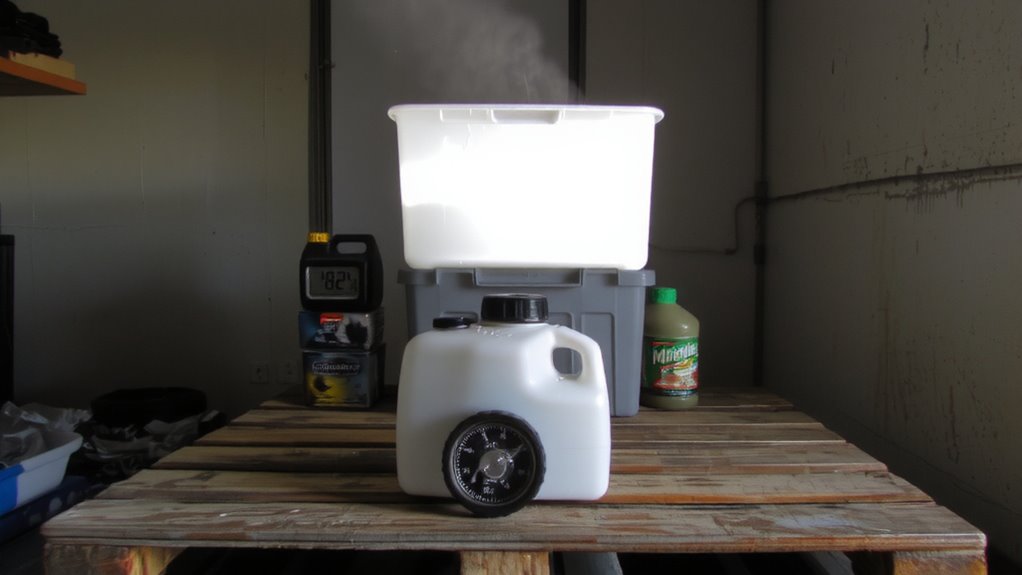
When ambient humidity exceeds 60%, brake fluid in unopened containers degrades far faster than most realize, and your garage environment plays a direct role. Moisture permeates plastic brake fluid bottles over time, accelerating chemical degradation. Temperature fluctuations worsen this effect-daily swings from 60°F to 90°F cause container expansion and contraction, drawing humid air inside. This hidden moisture lowers the fluid’s boiling point and promotes internal corrosion.
| Humidity Level | Degradation Rate (per year) |
|---|---|
| <40% | Minimal (0.5% moisture uptake) |
| 60–80% | Moderate (2.1% moisture uptake) |
| >80% | Severe (3.8% moisture uptake) |
Sealed containers aren’t immune. Over 12 months in damp conditions, fluid can absorb enough water to reduce wet boiling points by up to 50°F. You’re not just storing fluid-you’re fighting chemistry. Without climate control, you lose.
Signs Your Brake Fluid Has Absorbed Moisture
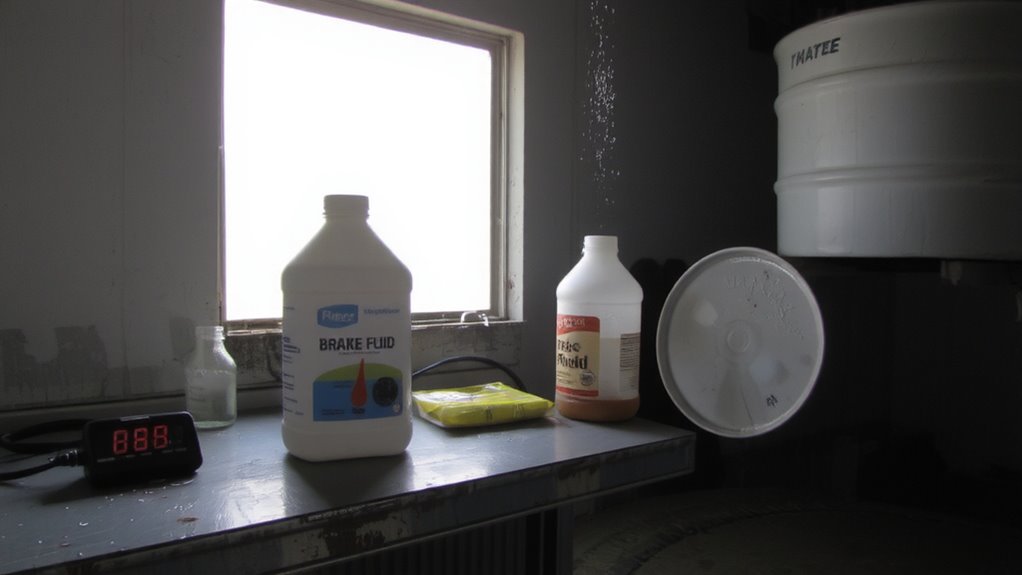
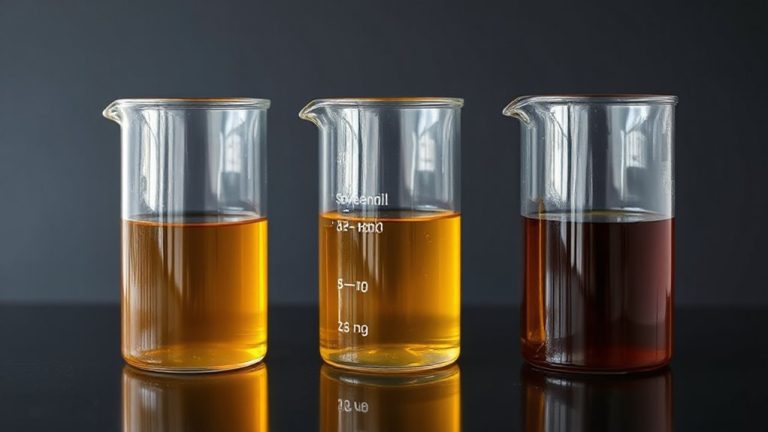
How can you tell if your brake fluid has soaked up moisture? Brake fluid discoloration is a key visual clue. Fresh fluid is typically clear or pale amber, but moisture absorption causes it to darken, often turning deep yellow or brown. This shift happens because water lowers the fluid’s boiling point, promoting oxidation and contamination within the system. You may also notice reduced braking performance. Moisture-laden fluid can vaporize under high temperatures, creating compressible air bubbles that lead to a spongy brake pedal and longer stopping distances. DOT 3 and DOT 4 fluids are hygroscopic, meaning they attract water from the air-up to 2% moisture content by volume over time. Once contaminated, the fluid can’t be restored. Regular inspection and timely replacement maintain system integrity.
Test Brake Fluid After Humidity Exposure
If you’ve stored your vehicle in a damp garage or ridden through humid conditions, moisture may have already started seeping into your brake fluid. That happens because of its hygroscopic properties-brake fluid naturally absorbs water from the air. Even sealed reservoirs aren’t immune over time. Moisture contamination accelerates chemical degradation, lowering the fluid’s boiling point and compromising braking performance. Test it with a refractometer or electronic brake fluid tester; these tools measure water content accurately, often down to 0.1%. DOT 3 and DOT 4 fluids typically fail at 3% moisture content, but performance declines considerably at just 2%. Color alone isn’t reliable-some fluids darken with use, not moisture. Testing gives objective data. If boiling point drops below 180°C (356°F) under wet conditions, replace it immediately. Regular testing after humidity exposure guarantees safety and maintains system integrity. For accurate diagnostics, consider using tools like a cooling system pressure tester to rule out external moisture ingress paths.
Store Brake Fluid in a Dry, Sealed Environment
Keeping your brake fluid in ideal condition starts long before it reaches the calipers-it begins the moment you open the bottle. You must store brake fluid in a dry, sealed environment to prevent moisture absorption. Brake fluid is hygroscopic, meaning it attracts water vapor from the air. Even brief exposure to humid conditions can trigger fluid degradation. Ideal storage means keeping the container tightly sealed in a low-humidity space, ideally below 50% RH. Once opened, fluid begins absorbing moisture at a rate of up to 2% water content per year if improperly stored. This reduces boiling point-critical for braking performance. DOT 3 fluid at 3% moisture content can drop from a 401°F dry boiling point to as low as 284°F. Sealed, airtight containers made of opaque HDPE plastic prevent UV exposure and maintain fluid integrity. Unsealed or damp storage accelerates chemical breakdown, compromising safety.
Best Humidity Tools for Brake Fluid Safety
Since humidity directly impacts brake fluid integrity, choosing the right monitoring tools is essential for long-term safety and performance. Your hygrometer selection determines accuracy and reliability. Digital hygrometers with capacitive sensors offer ±2% RH accuracy in the 10–90% range, ideal for garages. Look for models with data logging and external probes for continuous, traceable monitoring. Sensor calibration is critical-factory-calibrated units drift over time. Choose devices supporting user recalibration via salt-test verification or NIST-traceable certificates. Devices like the ThermoPro TP55 or Extech HD450 guarantee stability in temperature swings from 32°F to 122°F. Avoid analog dials; they lack precision below 20% RH. A well-calibrated hygrometer acts like a smoke detector for moisture-silent but crucial. Proper use prevents hygroscopic brake fluid from absorbing vapor through micro-leaks in containers. Monitor weekly, log values, and replace sensors every 24 months. Your brake system’s reliability depends on it.
Stop Brake Failure Before It Starts
Moisture is the silent killer of brake systems, and you can’t afford to ignore it. It accelerates brake pad degradation by compromising friction materials, reducing stopping power. Contaminated brake fluid lowers boiling points, risking vapor lock under hard braking. You need fluid with less than 3.7% water content-anything above drastically increases the risk. Hydraulic system corrosion occurs when water separates from glycol-based fluid, attacking steel lines, calipers, and master cylinders. Rust particles clog micro-valves in ABS modules, impairing function. Store brake fluid below 40% relative humidity to maintain DOT 3 or DOT 4 specifications. Once opened, fluid absorbs moisture at 1.5% per hour in 80% humidity-seal integrity is critical. Use desiccant breathers on reservoirs to slow contamination. Monitoring ambient garage humidity preserves fluid integrity. Preventative storage practices protect your system, ensuring reliable response and avoiding costly repairs. You gain safety through diligence, not luck.
On a final note
You must store brake fluid in a sealed container at 30–50% relative humidity. Moisture absorption above 3% degrades glycol-based fluids, lowering boiling points by up to 50%. Use desiccant caps and humidity indicators for real-time monitoring. Exposed fluid exceeding 200°F wet boiling point fails safety standards. A hygrometer with ±2% accuracy guarantees environmental control. Replace fluid every 12 months or after unsealed storage. Proper containment prevents system corrosion and brake fade.