Battery Maintenance Strategies for Different Vehicle Types in Storage
You should store each battery at 12.6–12.8 volts for lead-acid and AGM types, while lithium-ion must stay below 14.0 volts to avoid damage. Keep batteries in a cool, dry place between 40°F and 60°F. Disconnect to stop parasitic drain, clean terminals with baking soda, and apply anti-corrosion protection. Use a smart charger with float mode tailored to your chemistry-AGM at 13.8–14.0 volts, lithium at 14.4–14.6 volts. A maintenance charger prevents sulfation and keeps energy stable over time. Different vehicles need specific strategies to maximize lifespan and performance. You’ll find tailored methods ahead that match your setup exactly.
Notable Insights
- Disconnect batteries in all vehicles to prevent parasitic drain during long-term storage.
- Store batteries in a cool, dry place between 40°F and 60°F to slow self-discharge and degradation.
- Maintain charge by recharging every 4–6 weeks or using a float-mode maintenance charger.
- Clean terminals with baking soda and apply anti-corrosion protection before storage.
- Keep batteries at 12.6–12.8 volts for lead-acid and AGM types; follow voltage limits for lithium-ion.
How Battery Type Impacts Storage Needs
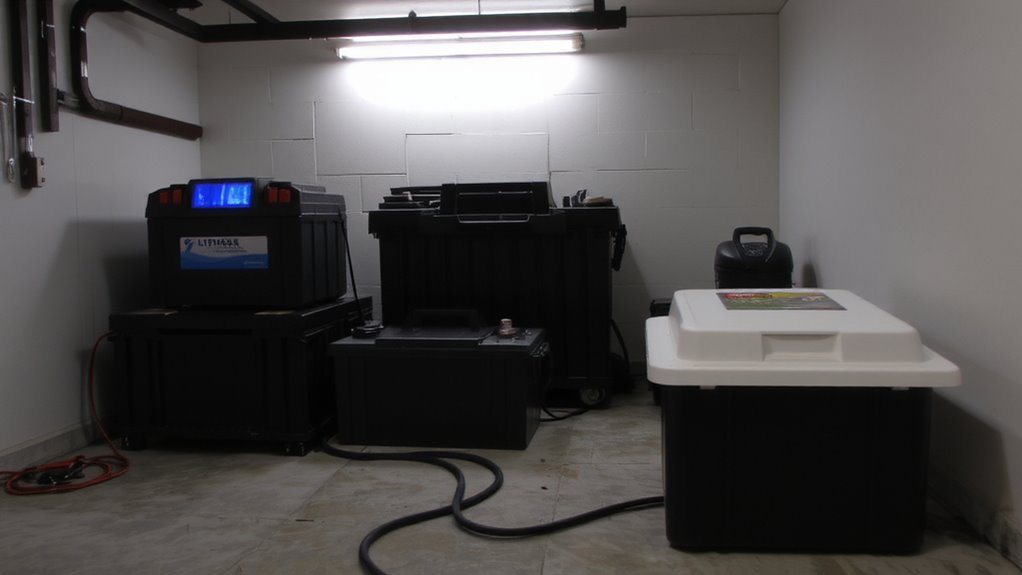
While all vehicle batteries degrade over time, the rate and best storage practices depend heavily on the battery type. You must consider battery chemistry because it directly affects self-discharge rates and longevity. Lead-acid batteries lose charge faster than AGM or lithium-ion types. AGM batteries, with lower self-discharge, maintain voltage requirements longer-typically 12.6–12.8 volts when fully charged. Lithium-ion units retain charge better but demand precise voltage requirements during storage; exceeding 14.0 volts risks damage. Battery chemistry also dictates temperature sensitivity: flooded lead-acid units degrade faster above 75°F, while lithium chemistries are stable across broader ranges. You should monitor voltage monthly. For long-term stability, maintain 50–80% charge depending on chemistry. Never store a battery below 12.0 volts. Each type has specific thresholds. Matching your maintenance to battery chemistry guarantees peak storage life and performance when restarting. Using a reliable battery tester ensures accurate voltage readings and optimal maintenance.
How to Store a Car Battery Long-Term
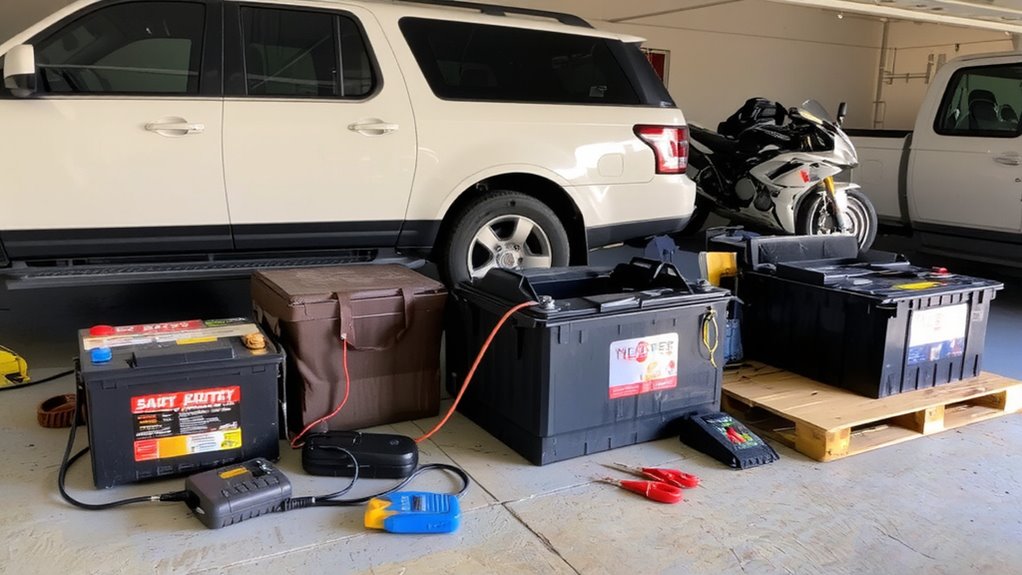
A properly stored car battery can retain its performance and extend its service life, even during extended periods of inactivity. Disconnect the battery to prevent parasitic drain, which can deplete charge over weeks. Clean the terminals with a baking soda solution to prevent corrosion. Apply terminal sealing using a dielectric grease or anti-corrosion spray-this blocks moisture and oxidation. Store the battery in a cool, dry place with temperatures between 40°F and 60°F (4°C to 15°C). Use battery insulation, like a thermal sleeve or non-conductive container, to protect against temperature swings and physical damage. Check voltage monthly; a 12-volt lead-acid battery should read at least 12.4 volts when fully charged. Recharge if voltage drops below 12.2 volts to avoid sulfation. Proper storage maintains capacity and guarantees reliable starting after long-term inactivity. For stubborn corrosion, consider using a dedicated battery terminal cleaner to ensure optimal electrical contact.
Keep Your Motorcycle Battery Charged in Storage

If you want your motorcycle battery to survive storage without losing its charge or degrading prematurely, keeping it on a maintenance charger is your best bet. These smart chargers deliver a small, steady current to prevent sulfation. Battery location matters-some sit under seats or side panels, making access tricky. Use a pigtail connector to simplify hookups. Charging frequency depends on battery type and ambient temperature. For optimal performance, consider using one of the best 12-volt batteries designed for long-term reliability and resistance to discharge during storage.
| Factor | Recommendation |
|---|---|
| Charging frequency | Weekly check, float charge applied continuously |
| Voltage (AGM) | 13.8–14.0 V max |
| Voltage (Li-ion) | 14.4–14.6 V max (use only compatible charger) |
| Battery location | Guarantee ventilation; avoid fuel lines or heat sources |
Always disconnect if not using a maintenance charger. Never store a battery on concrete without insulation.
Store RV Dual Batteries Without Draining Them
Since your RV relies on dual batteries to power both the engine and house systems, preventing drain during storage is critical to avoid costly replacements or starting failures. Use a battery isolation switch to disconnect loads and stop parasitic draw. This simple device cuts power to non-essential circuits while preserving charge. For long-term storage, remove both batteries and store them in a dry, temperature-stable environment. Maintain charge with a smart charger featuring dual charging capability-this allows simultaneous, independent charging of starter and house batteries. Choose a charger with AGM or lithium profiles if your batteries aren’t flooded lead-acid. Charge every 4–6 weeks or use a maintenance charger with float mode. Ideal storage voltage is 12.6–12.8V per battery. Battery isolation combined with dual charging guarantees both batteries remain balanced, fully charged, and ready for your next trip.
Stop Boat Battery Corrosion During Storage
While moisture and salt in marine environments accelerate electrochemical reactions, your boat’s battery terminals are especially vulnerable to corrosion during storage. Anode oxidation occurs when dissimilar metals react, forming resistive layers that hinder conductivity. You must prevent this degradation to maintain peak performance. Electrolyte stratification also develops in flooded lead-acid batteries, where acid concentration settles at the bottom, increasing internal corrosion risk. Mitigate these issues with proactive care.
| Step | Action | Purpose |
|---|---|---|
| 1 | Disconnect terminals | Stops parasitic drain and slows anode oxidation |
| 2 | Clean with baking soda solution | Neutralizes acid residue and removes corrosion |
| 3 | Apply anti-corrosion gel | Forms protective barrier against moisture and salt |
Store the battery fully charged to minimize stratification. Recharge every 4–6 weeks using a marine-rated charger with float mode. Keep the battery in a dry, temperature-stable location to reduce chemical volatility and prolong service life.
Best Battery Maintainers by Vehicle Type
A reliable battery maintainer keeps your vehicle’s electrical system in peak condition during storage. For motorcycles, use a 1.5-amp maintainer with automatic float mode to match their smaller battery capacity. Battery selection matters-LiFePO4 batteries need specialized lithium chargers, unlike AGM or flooded lead-acid types. ATVs and snowmobiles benefit from 2-amp units with temperature compensation, adjusting charging frequency based on ambient conditions. Marine deep-cycle batteries perform best with 5-amp smart chargers featuring multi-stage charging. Cars in long-term storage should use 2- to 4-amp maintainers with desulfation mode, running maintenance charges every 24 hours automatically. Choose maintainers with reverse polarity protection and spark-proof connections. Charging frequency varies by chemistry and self-discharge rate; smart maintainers detect voltage drop and adjust accordingly. Always match maintainer output to your battery’s specifications to prevent overcharging or undercharging.
7 Costly Battery Storage Mistakes to Avoid
If you leave your vehicle’s battery unattended during storage, you risk irreversible damage that can cut its lifespan by more than half. Neglecting voltage monitoring accelerates sulfation, especially in lead-acid batteries below 12.4V. Overcharging risks damage lithium and AGM types when chargers lack auto-regulation. Use a smart maintainer with temperature compensation. Avoid these critical errors:
| Mistake | Risk | Solution |
|---|---|---|
| No voltage monitoring | Sulfation, capacity loss | Check every 4 weeks |
| Overcharging risks | Heat, cell degradation | Use a smart charger (<2A) |
| Storing connected | Parasitic drain | Disconnect negative terminal |
| Ignoring temperature | Reduced efficiency | Store above 32°F (0°C) |
Maintain 12.6–12.8V for best health. Smart maintainers prevent overcharging risks and guarantee stable voltage monitoring.
On a final note
Your battery’s chemistry determines its storage voltage needs. Lead-acid batteries require 12.6V for full charge; lithium-ion stays stable at 3.6–3.7V per cell. Use a smart charger with temperature compensation to prevent overcharging. Store all batteries at 50–70% charge in cool, dry places-ideally between 32°F and 77°F. Disconnect loads to avoid parasitic drain. A proper maintainer, matched to your vehicle type, preserves lifespan and guarantees reliable restarts after storage.