The Critical Role of Coil Springs in Maintaining Ride Height and Stability
Your coil springs maintain ride height and stability by supporting the vehicle’s weight and absorbing road impacts. They keep suspension aligned and work with dampers to control bounce at 1.5–2.5 Hz. Worn springs sag, reducing clearance and disrupting geometry. This affects tire contact, increases rollover risk, and accelerates wear. Proper spring rates-like 150 vs. 100 lb/in-ensure balanced load support. Keep them clean and inspect every 12,000 miles. A closer look reveals how failing springs silently compromise safety and handling.
Notable Insights
- Coil springs absorb road impacts to protect the vehicle frame and maintain consistent ride height under varying loads.
- They preserve suspension alignment by keeping components within design specifications for optimal wheel positioning and stability.
- Proper spring rates ensure even load distribution, preventing sagging and maintaining balanced ride height across the vehicle.
- Coil springs work with dampers to control oscillation frequency, typically between 1.5–2.5 Hz, enhancing ride smoothness and control.
- Worn springs reduce ride height, disrupt suspension geometry, and increase risks like uneven tire wear and reduced handling safety.
What Coil Springs Do (And Why They Matter)
While your vehicle travels over uneven pavement, coil springs play an essential role in keeping it stable and balanced. They absorb impacts from bumps and maintain consistent ride height under varying loads. Proper load distribution depends on coil springs to prevent sagging and uneven tire contact. Without them, weight shifts could compromise handling and comfort. Suspension alignment relies on intact, properly functioning springs to keep wheels perpendicular to the road. Misaligned suspension often results from worn or fatigued coils, leading to uneven wear and reduced control. Most modern vehicles use high-tensile steel springs with a spring rate between 150 and 300 lb/in, tailored to specific chassis dynamics. Coil diameter, wire thickness, and pitch determine resilience and responsiveness. When these components degrade, performance drops measurably. Maintaining factory specifications guarantees maximum safety and longevity. Your vehicle’s stability hinges on these precisely engineered parts working as designed.
How Low Ride Height Hurts Safety and Handling
Your coil springs maintain the factory-specified ride height, and when that height drops below design limits, safety and handling suffer immediately. Reduced visibility occurs as the vehicle sags, placing your headlights too low and limiting your view of the road. You’re less visible to other drivers, increasing collision risk. The lowered center of gravity might seem stable, but it disrupts suspension geometry, reducing wheel travel and tire contact. This compromises braking and cornering. You’ll experience an increased rollover risk during sharp maneuvers because the altered roll center shifts weight unpredictably. Anti-roll bars and shock absorbers can’t function properly when the chassis is too low. Critical clearances-like those for bump stops and control arms-are exceeded, accelerating component wear. Even small deviations-just 1.5 inches below spec-can degrade handling by over 30%. Maintaining proper ride height isn’t just about appearance-it’s a core safety requirement.
How Coil Springs Keep Your Car Stable
When your vehicle hits a bump, it’s the coil springs that absorb the initial impact and prevent the frame from crashing down into the axle. They compress to manage shock forces, then rebound smoothly, maintaining consistent ride height. Proper load distribution depends on evenly matched spring rates, typically measured in pounds per inch (lb/in), guaranteeing neither end sags under weight. Uneven load distribution compromises handling and tire contact. Coil springs also preserve suspension alignment by keeping components-control arms, struts, and joints-positioned within design specifications. Misaligned suspension leads to uneven tire wear and reduced steering response. Springs work alongside dampers to control oscillation frequency, usually tuned between 1.5 to 2.5 Hz for passenger vehicles. This balance guarantees stability during cornering, braking, and sudden maneuvers. Without functional coil springs, your car loses structural control, reducing safety and performance even on smooth roads.
Common Signs of Worn or Failing Coil Springs
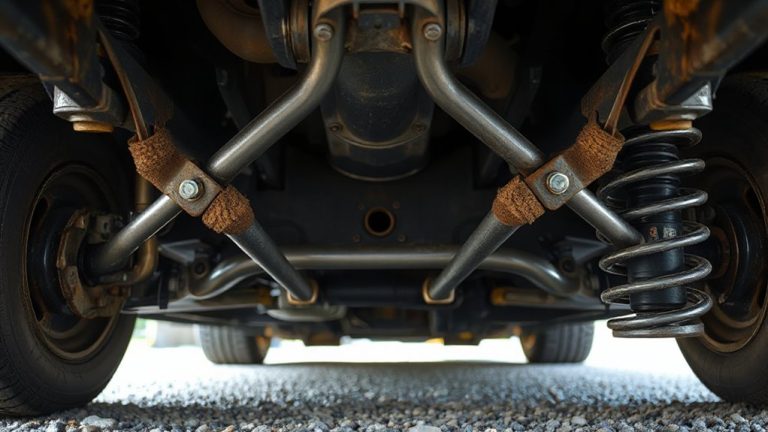
What do you notice when your car no longer rides the way it used to? Sagging suspension is one of the first visible signs your coil springs are failing. You’ll see reduced ground clearance, especially at the corners where springs have fractured or lost tension. This affects alignment and handling. You may also face persistent noise complaints-metallic clunking over bumps indicates springs are loose or broken. Worn springs can’t absorb road impacts effectively, leading to harsh ride quality. Inspect for uneven ride height; a variance of more than 1 inch between sides signals a problem. Coil spring rate deteriorates over time-typically after 80,000 miles-reducing load-bearing efficiency. Progressive springs lose their designed stiffness, compromising vehicle stability. These symptoms demand immediate inspection. Ignoring them raises safety risks and strains other suspension components.
How Bad Coil Springs Cause Uneven Tire Wear
Though they’re often overlooked, failing coil springs directly influence tire contact with the road, leading to uneven wear patterns. When coil springs sag or break, they disrupt suspension balance, causing one corner of the vehicle to sit lower. This shift alters weight distribution and strains opposing suspension components. As a result, tire alignment drifts out of specification, increasing camber and toe angles beyond acceptable tolerances. Misaligned tires don’t contact the road evenly-inner or outer edges wear faster than the center.
| Wear Pattern | Likely Cause |
|---|---|
| Excessive inside wear | Negative camber from low spring |
| Outer edge wear | Compressed spring on opposite side |
| Feathering | Toe misalignment due to shifted suspension balance |
You’ll see these signs long before total failure. Regular inspections help maintain proper ride height, tire alignment, and even tread life. Ignoring coil spring issues only accelerates tire degradation.
Coil Spring Upgrades: Performance or Comfort?
You’ve seen how worn coil springs upset alignment and wear down tires-now consider how upgrading them can reshape your vehicle’s behavior. Coil spring materials like high-grade silicon-manganese steel offer increased durability and resistance to sag. These materials maintain consistency under stress, preserving ride height over time. Spring rate tuning allows precise control over stiffness, measured in pounds per inch (lb/in). A higher spring rate, say 150 lb/in versus stock 100 lb/in, reduces body roll and improves cornering. Softer rates prioritize comfort, absorbing bumps without harshness. You can choose progressive-rate springs for a balance-responsive under load, compliant over rough roads. Upgraded springs also work better with modern shocks and struts. Proper tuning matches your driving style, whether spirited or relaxed. Performance gains don’t have to sacrifice comfort when materials and spring rate tuning are optimized.
Easy Maintenance Tips for Longer-Lasting Springs
Longevity begins with inspection. Check your coil springs every 12,000 miles for cracks, sagging, or misalignment. Look closely at the lower coils, where stress and corrosion accumulate most. Perform spring cleaning during routine suspension service-remove debris, dirt, and brake dust with mild detergent and a soft brush. Avoid high-pressure washing, as it can damage protective coatings. Rust prevention is critical. Apply a corrosion-resistant coating or wax-based undercoating annually, especially in humid or salt-exposed regions. Zinc-rich primers add extra protection if reapplied every 18 months. Guarantee spring seats are lubricated with silicone-based grease to prevent binding. Maintain correct ride height; sagging more than ½ inch reduces handling precision by up to 30%. Replace springs in axle pairs to preserve balance. Proper care extends service life beyond 80,000 miles.
On a final note
Your coil springs maintain precise ride height, typically compressing 1–2 inches under normal load. They support vehicle weight, ensuring correct suspension geometry. Worn springs lose 10–15% of their original height, reducing control. Proper spring rate-measured in pounds per inch-matches factory specs, usually 150–300 lb/in. This optimizes stability, tire contact, and braking. Replacing degraded springs restores alignment, improves safety, and prevents uneven wear.