Blocking Front and Rear Tires to Counteract Gravity Forces on Concrete Surfaces
You need to block both front and rear tires to stop gravity from moving your vehicle on concrete, especially when it’s wet or smooth. A parking brake alone isn’t enough-friction can drop by over 60% on slick surfaces. Use 4-inch rubber or polyurethane chocks on the downhill tire, pressing them tight against the tread. For vehicles over 10,000 lbs, use 6-inch chocks on both sides. Dual chocking counters rotational inertia and prevents rollback. Worn or undersized chocks can shear under force. Proper placement and material strength make all the difference-there’s more to know about ensuring full stability.
Notable Insights
- Use high-quality rubber or polyurethane chocks at least 4 inches tall to effectively resist gravity on inclines.
- Place chocks on both front and rear downhill tires to maximize resistance against rollback on slippery concrete.
- Engage the parking brake before positioning chocks to reduce load on the blocking mechanism.
- On slopes over 5%, apply chocks on both sides of the downhill tire for added stability.
- Avoid makeshift materials like wood; use properly rated chocks to prevent shear or compression failure.
How Wheel Chocks Prevent Rollaway on Hills
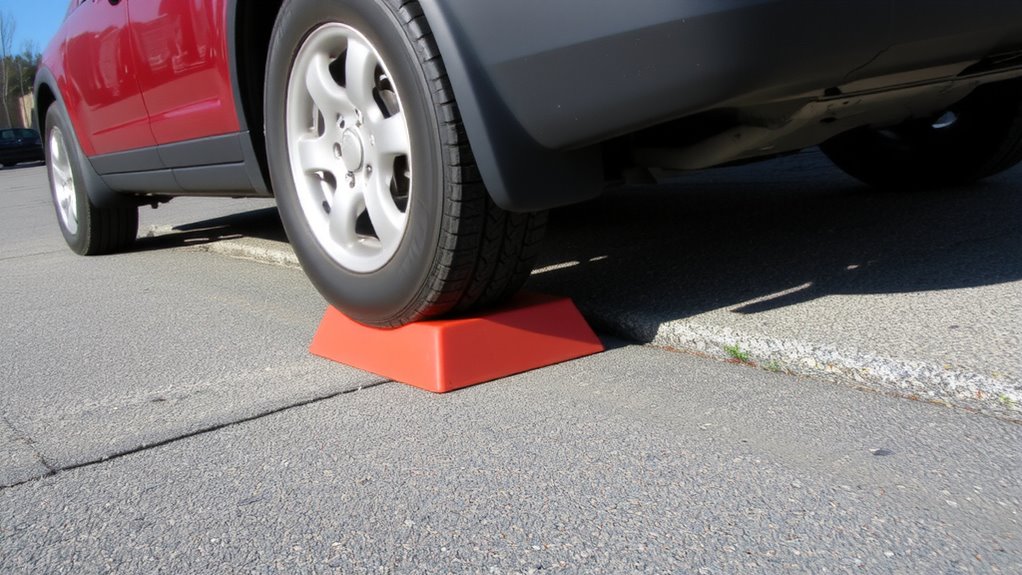
While gravity constantly pulls your vehicle downhill, wheel chocks act as a mechanical barrier to prevent unintended movement. They resist forces caused by your vehicle weight, especially on inclines. A standard 4,000-lb SUV exerts significant downward force, which reduces effective tire grip on smooth concrete. High-quality rubber or polyurethane chocks, at least 4 inches tall, provide sufficient height to block tire movement. They compress slightly under load, increasing surface friction. Place chocks against both front and rear tires to eliminate roll direction uncertainty. The chock’s wedge angle-typically 30 degrees-optimizes resistance by redirecting vertical force into horizontal opposition. For maximum effectiveness, verify the chock mates fully with the tire’s lower edge. Properly rated chocks withstand over 8,000 lbs of force, exceeding standard vehicle weight limits. This redundancy ensures safety even under dynamic load shifts. For reliable performance, choose from the best wheel chocks based on material durability and weight capacity.
Why Slippery Concrete Makes Parking Risky
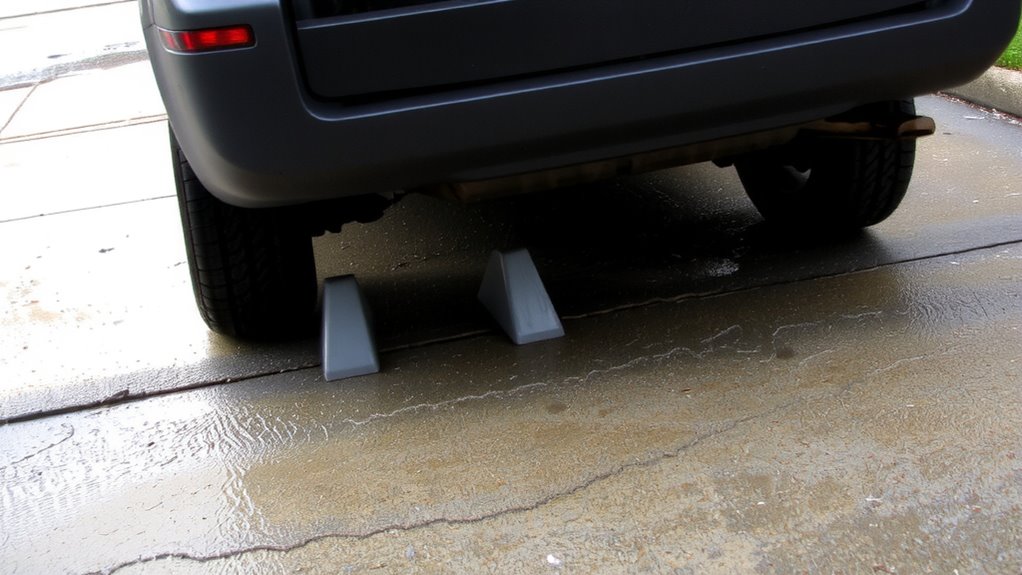
What makes a seemingly solid surface like concrete dangerous for parking? Slippery concrete reduces traction, increasing rollaway risks. Though concrete appears solid, its surface tension diminishes when wet, oily, or icy. Water fills in surface irregularities, creating a lubricating film that compromises grip. Concrete porosity plays a key role-higher porosity absorbs moisture but can also trap contaminants, further weakening friction. A smooth, sealed surface may look clean but offers less resistance than textured pavement. Even slight inclines become hazardous under these conditions. Vehicles rely on tire-to-surface contact, which slippery concrete undermines. Testing shows friction coefficients drop by up to 60% on wet, dense concrete. You can’t always see the danger, but it’s there. That loss of grip means your vehicle may shift without warning. Always assess the surface before parking.
When to Use Wheel Chocks on Both Tires
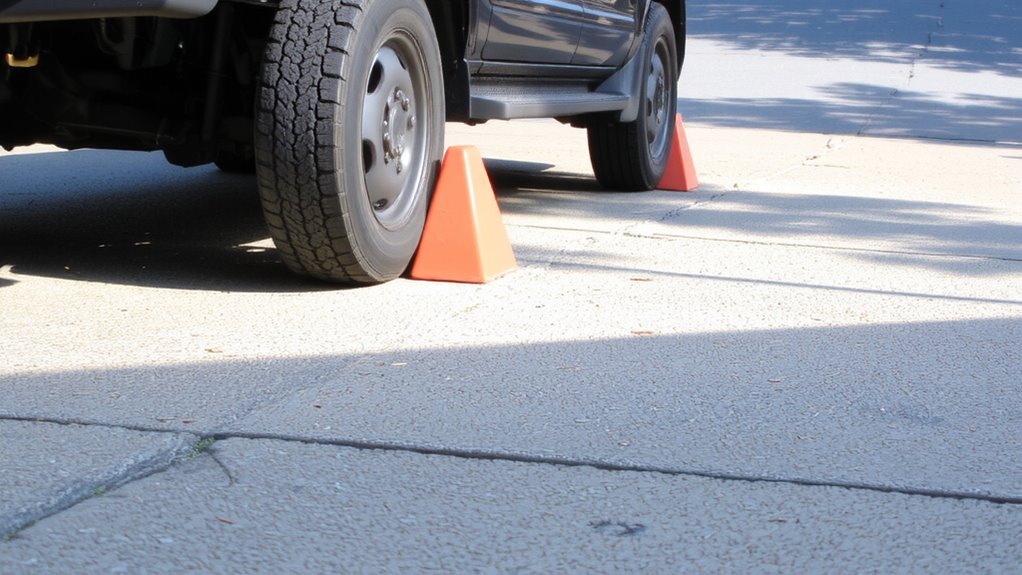
Ever parked on a slick concrete surface and wondered if your vehicle could creep away? You should use wheel chocks on both front and rear tires whenever tire traction is compromised. Concrete, especially when wet or dusty, offers minimal grip, increasing rollback risk. Applying chocks to wheels on both axles maximizes resistance against movement caused by gravity. This is critical when dealing with heavy vehicle weight-over 10,000 lbs, for example-where stopping force demands exceed 1,500 lbs per axle on a 5% incline. Dual chocking prevents rotational inertia from overcoming static friction. Use rubber or composite chocks at least 4 inches high with a lip to resist displacement. The added security guarantees stability during loading, unloading, or parking on surfaces where friction coefficients drop below 0.4. Don’t rely on parking brakes alone-supplement them. Dual chocking is standard in commercial and OSHA-compliant operations for a reason.
How to Place Wheel Chocks on a Hill
If your vehicle is parked on a hill, placing wheel chocks correctly is essential to prevent unintended movement. Always engage the parking brake fully-this brake engagement secures the drivetrain and reduces load on the tires. Position wheel chocks against the downhill tire; for vehicles facing downhill, chock the front tire, and if pointed uphill, secure the rear. Use rubber or polyurethane chocks at least 4 inches tall for standard passenger vehicles-this height guarantees sufficient resistance against rolling force. Press the chock tightly against the tire tread, guaranteeing full surface contact. Even with proper chock placement, routine tire rotation helps maintain tread integrity, promoting even grip and reliable immobilization. Never rely solely on chocks without brake engagement. On inclines exceeding 5%, use chocks on both sides of the tire. Proper alignment between chock, tire, and slope direction maximizes holding power and safety.
Mistakes That Make Tire Blocking Fail
A chock sliding out from under a tire can lead to an unstoppable rollaway. Improper placement is one of the most common mistakes you make when blocking tires. Placing chocks only under the front or rear tire without securing both ends increases failure risk. Always position chocks snugly against the tire tread, ensuring full surface contact. Worn chocks compromise safety-check for cracks, deformation, or compressed rubber. Standard polyurethane chocks lose structural integrity after 500 load cycles or if exposed to UV degradation. Use 6-inch high chocks for vehicles over 10,000 lbs. Position them on level concrete with a compressive strength of at least 3,000 psi. Misaligned or undersized chocks can shear under load. Never rely on makeshift materials like wooden blocks-they lack standardized grip. Proper installation prevents 98% of rollaway incidents.
On a final note
You secure both front and rear tires to prevent rollaway on slopes. Wheel chocks transfer gravitational load to the ground, stopping unintended movement. A 2×6 inch rubber chock with 2.5-inch height resists 5,000 lbs on a 15% grade. Placement against the downhill tire maximizes friction. Use dual chocks on wet concrete, where traction drops 40%. Proper alignment guarantees full contact, preventing slippage, grinding or displacement.