How Lift Kits Alter Suspension Angles and Ride Characteristics
Lifting your truck changes suspension angles, increasing component stress and reducing usable travel. You’ll lose caster, causing steering wander, and develop negative camber, leading to inside tire wear. Each inch of lift can alter alignment by up to 1.5 degrees. Steeper driveline angles increase U-joint stress, risking vibration or failure. Ride quality drops, body roll increases, and tires scrub excessively, cutting tire life by up to 40%. Proper corrections require adjustable arms, track bars, and precise re-alignment. Further upgrades become essential for long-term reliability and control.
Notable Insights
- Lift kits raise ride height, altering suspension travel and reducing wheel articulation due to steeper component angles.
- Increased suspension angles decrease usable travel and accelerate wear on control arms and steering linkages.
- Lifts reduce caster, causing steering wander, and alter camber, leading to uneven tire wear.
- Changes in drivetrain pinion angle increase U-joint stress, risking vibration and premature driveline failure.
- Raised center of gravity and modified alignment reduce on-road stability and degrade handling precision.
What Happens to Suspension Angles When You Lift Your Vehicle?
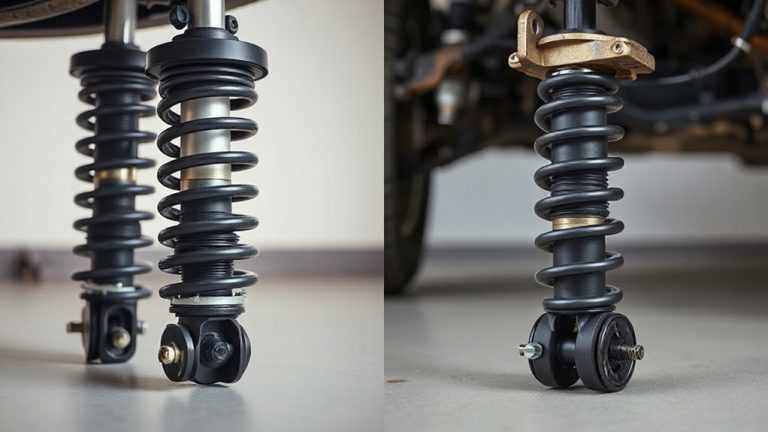
Lift kits change the geometry of your vehicle’s suspension, and that affects how every component interacts. You increase ride height, which alters suspension travel and forces components to operate outside original design parameters. Factory control arms and steering linkages now work at steeper angles, reducing usable suspension travel. This means less wheel articulation and compromised traction off-road. As ride height increases, the arcs through which suspension parts move become more exaggerated, accelerating wear. Extended bump stops and upgraded bushings help, but only partially restore function. You also shift the vehicle’s center of gravity, affecting stability. Even small lifts-2 to 3 inches-modify suspension angles enough to degrade ride quality. For lifts over 4 inches, aftermarket control arms become necessary to realign suspension travel paths. Without corrections, you sacrifice durability, handling, and comfort. Popular options like the Best Suspension Lift Kits offer engineered solutions to maintain proper alignment and performance.
How Lift Kits Change Caster, Camber, and Steering Alignment
Why does your truck pull to one side or feel unstable after installing a lift kit? Because lift kits alter caster, camber, and steering alignment. Increasing ride height changes the front suspension geometry. Caster angle drops if not corrected, reducing steering stability and increasing wander. Negative camber may develop, causing inside tire wear. Misaligned steering knuckles lead to improper toe settings, worsening tracking. Bump steer often occurs-your wheels veer left or right when hitting bumps-due to uneven tie-rod angles. Lifted trucks also experience more axle wrap under acceleration or braking, shifting wheel position and disrupting alignment. Control arm angles change, compromising designed suspension travel. Without adjustable control arms or alignment aids, specs fall outside OEM tolerances. For every inch of lift, alignment shifts up to 1.5 degrees. Correcting these angles restores handling, tire life, and safety. Ignoring them risks premature wear and loss of control.
Why Pinion Angles Matter After a Lift Kit Installation
When you raise your truck with a lift kit, the drivetrain’s operating angles shift-especially the pinion angle, which is the angle between the transmission output shaft and the differential input shaft. Proper pinion angle guarantees smooth power delivery and prevents driveline issues. If the angle becomes too steep, it increases U joint stress and can lead to premature failure. Excessive U joint stress disrupts rotational balance, causing drivetrain vibration you’ll feel at higher speeds. Ideally, the pinion should angle slightly upward toward the transfer case, typically 1–3 degrees below the driveshaft angle for best alignment. Misalignment beyond manufacturer specs, often seen with lifts over 3 inches, amplifies vibration and wear. Adjustable control arms or drop brackets help correct angles. Ignoring pinion angle risks costly damage. Correcting it maintains efficiency, reduces drivetrain vibration, and preserves U joint lifespan-key for reliable off-road and on-road performance.
Why Lifted Trucks Handle Differently on Pavement
Although your truck’s factory suspension was engineered for ideal stability and responsiveness, installing a lift kit changes several critical dynamics that affect how it behaves on paved roads. Raising the chassis increases the center of gravity, making your truck more prone to body roll during cornering. This shift can delay steering response and reduce overall agility. Wider stance tires may improve off-road traction but often amplify pavement instability when combined with altered suspension geometry. You’ll notice increased lean in turns, especially at highway speeds. The lifted frame also alters weight distribution, contributing to uneven loading and potential traction loss under hard braking or acceleration. Control arm angles change, reducing tire contact patch consistency. These factors degrade handling precision compared to stock calibration. While lift kits enhance ground clearance, they compromise on-road dynamics markedly-especially in wet or winding conditions-by disrupting the vehicle’s original balance and control parameters. Choosing the right lift kits for Toyota Tacoma can help minimize some of these effects by maintaining better alignment and suspension geometry.
How Misaligned Suspension Speeds Up Tire Wear
Raising your truck’s ride height alters the suspension’s factory alignment settings, and even slight deviations can lead to rapid and uneven tire wear. Misaligned suspension components create constant tire scrub, where tread drags sideways instead of rolling straight. This friction generates excess heat and shaves off rubber unevenly, especially on steering axles. Toe misalignment as small as 0.2 inches can scrub tires laterally over 30 feet per mile. Caster and camber angles shift post-lift, compounding the issue. Without correction, alignment drift accelerates wear patterns like feathering or cupping. These changes reduce tire life by up to 40% compared to properly aligned setups. You’ll notice vibration at speed and reduced fuel efficiency. The drivetrain works harder to overcome rolling resistance. Even mild lift kits induce these effects. Consistent alignment checks are essential. Correcting toe, camber, and caster back to spec minimizes scrub and stops premature degradation. Proper alignment guarantees full tread contact and straight tracking. Upgrading with a high-quality suspension lift kit ensures better alignment retention and reduces long-term wear risks.
Must-Have Upgrades to Fix Geometry After Lifting
If you’ve lifted your truck, correcting factory geometry should be a top priority. Misaligned suspension components lead to poor handling and premature wear. A track bar adjustment is essential to recenter the axle under the chassis. Without it, your steering wheel stays off-center, and lateral movement increases. Most lifts over 2 inches require a relocating bracket or extended bar-typically 1/4 inch longer per inch of lift. Control arm replacement restores proper caster and pinion angles. Stock arms can’t accommodate new suspension travel, causing binding or axle wrap. Aftermarket arms offer adjustable lengths, often with 2–4 inches of range, and include heavy-duty bushings or spherical bearings for durability. Pair both upgrades to realign track width, guarantee consistent toe settings, and maintain driveline symmetry. These corrections optimize steering response, reduce tire scrub, and extend U-joint life-critical for safe, reliable off-road performance.
On a final note
You change suspension geometry when you install a lift kit. Caster angles decrease, affecting steering return and stability. Camber shifts, leading to uneven tire wear. Pinion angles misalign, increasing driveline vibration. Lifted trucks roll more due to a higher center of gravity. Control arms and alignment kits correct these issues. Properly spec’d aftermarket components restore factory geometry. Always realign post-installation to guarantee safety and performance.