How Self-Leveling Suspension Prevents Rear Sag When Hauling Cargo
Your self-leveling suspension stops rear sag the moment you load up. Sensors detect changes in ride height and signal the ECU to activate the air compressor. Air springs inflate to maintain factory ride height within ±5 mm, even under 1,500 pounds. This keeps your alignment, headlight aim, and braking performance unchanged. The system responds in under 2 seconds, preserving handling and reducing wear. You stay level, safe, and in control-no guesswork needed. There’s more to how each part works together than you might expect.
Notable Insights
- Self-leveling suspension uses sensors to detect rear axle sag and automatically activates an air compressor to correct ride height.
- Air springs inflate to counteract cargo weight, maintaining factory ride height within ±10 mm during loading.
- The system preserves proper suspension geometry, ensuring stable handling and even tire contact under heavy loads.
- Real-time adjustments within seconds prevent alignment shifts and reduce uneven tire wear by up to 30%.
- By maintaining level posture, it ensures correct headlight aim and reduces stress on suspension components and vehicle frame.
What Causes Rear Sag When Hauling Cargo?
When you load heavy cargo into the rear of your vehicle, the added weight compresses the suspension springs, which can lead to rear sag if the system isn’t designed to handle the load. Excessive sag alters ride height, reducing headlight aim and tire contact with the road. Over time, sustained weight increases stress on the vehicle’s frame, potentially causing frame bending-especially in unibody designs not rated for high payloads. Rear suspension components also experience increased leverage forces. This causes leaf springs to deform under pressure, promoting axle wrap during acceleration or braking. Axle wrap reduces traction and accelerates drivetrain wear. Factory springs rated for 1,500 lbs. may deflect 2+ inches under 800 lbs. of cargo, exceeding safe geometry limits. Without adaptive support, these mechanical responses compromise stability, steering precision, and braking efficiency. The cumulative effect degrades vehicle handling and accelerates fatigue in critical structural zones.
How Self-Leveling Suspension Keeps Your Vehicle Level
Though conventional suspensions struggle under heavy loads, self-leveling systems actively maintain your vehicle’s ride height using automated adjustments. These systems guarantee ideal load balance by continuously monitoring changes in weight distribution. When you add cargo, sensors detect downward force on the rear axle and trigger an air compressor to inflate air springs. This response counters sag and restores factory ride height, typically within +/- 5mm tolerance. Proper weight distribution is preserved, preventing uneven tire wear and compromised handling. The system operates in real time, adjusting within seconds of detecting a load change. By maintaining level posture, your vehicle sustains aerodynamic efficiency, headlight alignment, and suspension geometry. Unlike passive springs, self-leveling suspension adapts to varying payloads, from 200 to 1,500 pounds, guaranteeing consistent performance. This stability enhances braking precision and cornering control. You get reliable load balance whether hauling tools or towing trailers, without manual intervention.
What Parts Make Self-Leveling Suspension Work?
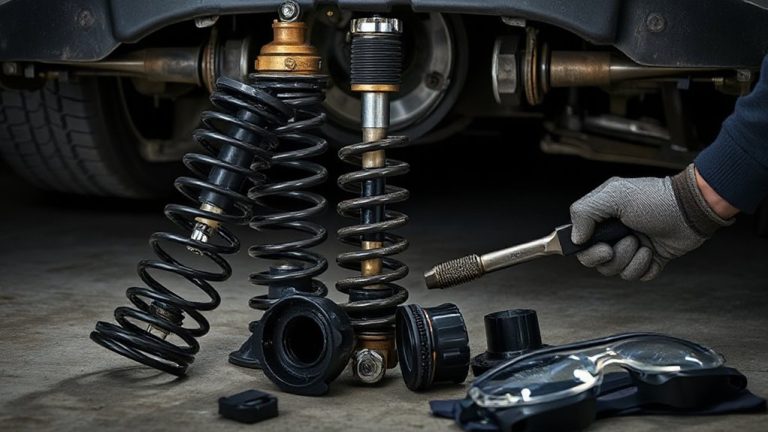
The core of self-leveling suspension lies in its integrated components, each designed to respond instantly to load changes. Air springs replace or supplement traditional coil or leaf springs, inflating or deflating to maintain ride height. They’re made from durable rubber or composite materials, rated for thousands of cycles and pressures up to 100 psi. You’ll find them at the rear axle, where cargo load has the greatest impact. Connected to an onboard air compressor via pneumatic lines, they adjust automatically based on sensor input. Shock absorbers work in tandem with air springs, controlling oscillations and damping road impacts. Unlike standard shocks, these are valved for variable ride heights and changing loads. Sensors monitor chassis position, sending data to an electronic control unit. The ECU triggers air valve adjustments within 200 milliseconds of detecting sag. This system keeps your rear axle level, regardless of cargo weight.
Why Proper Ride Height Matters Under Heavy Loads
You’ve seen how air springs, sensors, and the ECU work together to react to load changes in real time. Maintaining proper ride height is critical when hauling heavy loads. When your vehicle sags, the alignment shifts, causing uneven tire wear and reducing tire lifespan by up to 30%. It also alters suspension geometry, increasing stopping distances by as much as 15% under full load. Sagging changes headlight aim, creating glare for oncoming drivers and raising safety risks. Proper ride height guarantees ideal weight distribution, keeping the vehicle level and stable. This stability improves cornering response and reduces the chance of trailer sway. Without it, critical components like control arms and bushings experience added stress, leading to premature failure. Self-leveling suspension actively maintains factory ride height-typically within ±5 mm of design specification-preserving handling, safety, and tire wear under real-world loads. You’re not just carrying weight-you’re staying safe and in control.
Where Does Self-Leveling Suspension Help Most?
When you’re carrying heavy cargo or towing at maximum capacity, self-leveling suspension delivers the most benefit at the rear axle, where load-induced sag is most pronounced. It automatically adjusts air pressure in rear air springs to maintain factory ride height, typically within ±10 mm of level. This guarantees superior alignment, headlight aim, and tire contact. Consistent load distribution prevents excessive strain on chassis components and improves braking efficiency. On uneven terrain, the system enhances off road stability by minimizing body roll and pitch. Sensors detect changes in attitude and trigger air compressors in under 2 seconds to correct imbalances. Unlike static springs, self-leveling systems adapt in real time, preserving handling across dynamic conditions. Whether you’re hauling construction materials or towing a 3,500 kg trailer, the rear suspension compensates instantly. This precision improves control, reduces fatigue, and extends component life-especially critical during long hauls or frequent loading cycles.
On a final note
You maintain ideal ride height with self-leveling suspension under heavy loads. This system automatically adjusts rear damping force using a compressor, height sensors, and pneumatic or hydraulic struts. It compensates for sag by monitoring vehicle level in real time-typically within ±5 mm of design spec. Consistent geometry preserves headlight aim, tire wear, and handling. It’s critical for vans, trucks, and SUVs regularly carrying payload near GVWR.