Tire Sidewall Clearance: 1-Inch Rule for Fender Fitment
You need at least 1 inch of clearance between your tire sidewall and fender. Measure with the tire inflated, suspension loaded, and using your actual rim width-wider rims add up to 0.3 inches in width. Account for suspension compression, steering lock, and up to 0.5 inches of loaded growth in diameter and width. Check clearance at full articulation and lock; use chalk to mark contact points. Insufficient space causes rubbing. There’s more to get right beyond the basics.
Notable Insights
- Measure tire sidewall to fender distance at closest point with tire inflated to recommended pressure and vehicle at ride height.
- Account for up to 0.5 inches of sidewall bulge and load-induced growth when calculating minimum 1-inch clearance.
- Use actual rim width for measurements, as wider rims increase tire section width by up to 0.3 inches.
- Check clearance at full steering lock and under suspension compression to address articulation and steering dynamics.
- Validate fitment by testing with chalk marks, bouncing corners, and inspecting contact points under real-world conditions.
Measure Tire Sidewall Clearance in 3 Steps
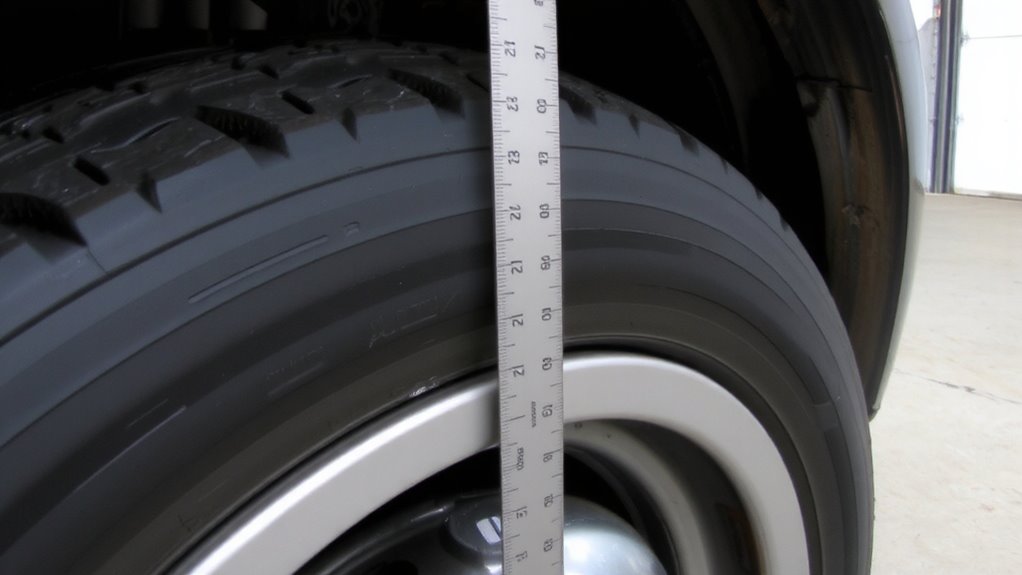
Before you modify your fenders, you need to measure tire sidewall clearance properly-this prevents rubbing and guarantees safe operation. Start by deflating the tire completely, then reinflate it to the recommended pressure; this accounts for tire pressure effects on sidewall bulge. A fully inflated tire can expand up to 0.5 inches outward under load. Next, measure the distance between the tire’s sidewall and the fender at the closest point using a ruler or caliper-aim for a minimum of 1 inch clearance. Rim width impact is critical: wider rims stretch the tire wider, increasing sidewall tension and altering clearance by up to 0.3 inches. Always use the actual rim width you plan to run. Finally, rotate the wheel fully to check for irregularities. Record measurements at top, bottom, and both sidewalls to verify consistency and accuracy across the entire tire profile.
Adjust for Suspension Travel and Steering
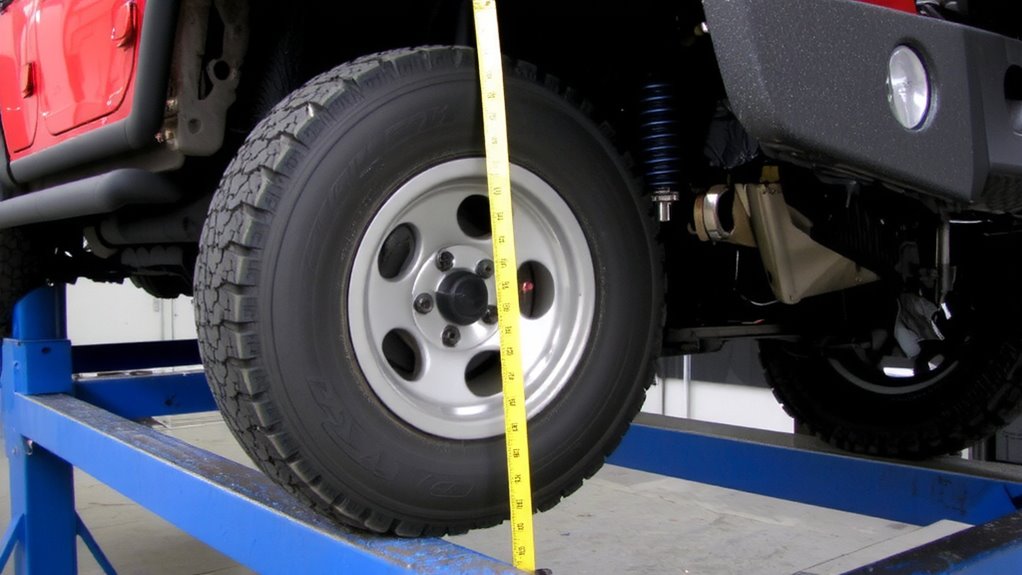
While your tires may clear the fenders at rest, suspension travel and steering articulation can drastically reduce that margin. You must account for full droop, compression, and turning angles to prevent rubbing. When the suspension compresses, your tire moves upward, decreasing clearance. Ride height affects this range-lowering your vehicle reduces available travel and increases contact risk. Bump stops absorb impact at full compression, but worn or undersized ones let the tire travel farther into the fender well. Inspect them regularly and replace if compressed beyond 50% of original thickness. During steering, especially at full lock, tires pivot and shift laterally, increasing sidewall proximity to inner liners and frame points. Test at full left and right lock with suspension loaded. Clearance under articulation is often tighter than expected. Always measure dynamically, not just statically, to guarantee reliability.
Calculate Needed Clearance for Bigger Tires
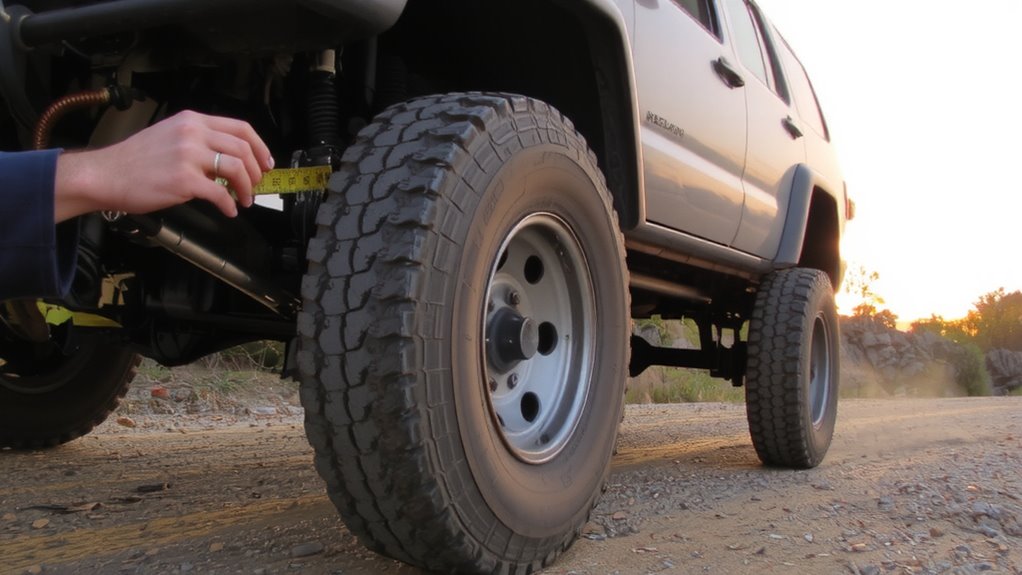
If you’re upgrading to larger tires, you’ll need to calculate the exact clearance required to avoid interference under all driving conditions. Start by measuring the difference in overall diameter and section width between your current and new tires. Even a 10mm increase can cause rubbing. Rim width impact is critical-wider rims spread the tire tread, increasing effective width and altering sidewall angle. This affects both clearance and handling. Use a tire sizing calculator to compare specifications across a tire brand comparison chart, as dimensions vary by manufacturer. For example, a 275/70R18 from Brand A may be taller and wider than Brand B’s version. Always verify actual mounted dimensions. Account for full suspension compression and full lock steering. Minimum safe clearance is 1/2 inch at the closest point under maximum articulation.
Anticipate Tire Growth Under Load
Tire expansion matters when you’re pushing through rough terrain or hauling heavy loads. As you add weight, the tire’s shape changes slightly due to tire material elasticity-the rubber and internal plies stretch under stress. This isn’t failure; it’s expected behavior. Even at proper inflation, loaded tires grow in diameter and width. The degree of growth varies based on load index variance, which reflects how much weight a tire can safely carry at maximum inflation. A tire rated for 2,000 lbs may grow noticeably less than one near its limit. Under full load, growth of up to half an inch in diameter and width isn’t uncommon. You must account for this added size when calculating fender clearance. Ignoring expansion risks rubbing under load, especially during cornering or suspension compression. Use manufacturer load growth data if available. Design for worst-case scenarios, not unloaded dimensions.
Test for Rub: Turn, Bounce, Verify
You’ve accounted for tire growth under load-now confirm your fender modifications actually work in real-world conditions. Turn the steering wheel fully left and right, then inspect for contact between tires and fender liners or sheet metal. Suspension articulation can expose hidden clearance issues. Bounce the vehicle firmly at each corner to simulate uneven terrain. Watch for rub spots, especially with aggressive tread design that increases tire footprint under compression. Check throughout the entire suspension travel range. Tire age affects sidewall stiffness; older tires may deflect less but crack under stress, altering clearance. Use chalk marks on tires or fenders to identify contact points. Verify clearance at full lock and compressed suspension. Even a 3mm gap can be sufficient if no rubbing occurs. Document results before finalizing modifications. This test guarantees durability, safety, and proper fitment under dynamic driving conditions.
Avoid Common Clearance Mistakes
Why do so many fender mods fail shortly after installation? You overlook critical variables like tire material and fender design. Tire material expands under heat, increasing sidewall bulge by up to 3% at operating temperature. If you don’t account for this growth, you’ll experience rubbing during cornering. Your fender design must provide at least 15 mm of static clearance to accommodate dynamic movement. Without it, suspension compression causes contact. Never rely solely on visual estimates-measure at full lock and full bump. Use steel measuring tapes for precision. Also, consider wheel offset; incorrect values misalign the tire within the fender well. A mismatch here negates proper clearance. Finally, aftermarket fenders often have stiffer liners that reduce usable space. Always test beyond factory tolerances. These oversights compromise function, safety, and longevity-don’t let them ruin your build.
On a final note
You now have the tools to accurately determine tire sidewall clearance. Measure precisely at the closest points-typically 1/4 inch minimum is required. Account for full suspension compression and extreme steering angles. Factor in tire growth; larger tires expand up to 1.5 inches in diameter under load. Test rigorously. Inadequate clearance causes damage. Proper calculation prevents interference, ensuring safe, legal operation and maximizing performance without compromising fender integrity or drivetrain components.