How to Install Speakers in Vehicles With Integrated Factory Amplifiers
You must match your new speakers to your factory amplifier’s output, typically 20–50 watts RMS at 4 ohms per channel. Use ommk–92 dB sensitivity speakers with polypropylene cones and butyl rubber surrounds to maintain durability and sound quality. Avoid 2-ohm or 8-ohm speakers-they cause overheating or power loss. Always disconnect the battery and verify impedance with a multimeter. Proper setup guarantees phase coherence and prevents distortion. The next steps reveal how to secure these results and optimize system performance.
Notable Insights
- Use 4-ohm speakers to match factory amplifier output and prevent overheating or shutdown.
- Select speakers with 87–92 dB sensitivity to perform well with low-power factory amp systems.
- Ensure OEM-fit dimensions and mounting depth for proper installation without modifications.
- Verify impedance and polarity with a multimeter before connecting speakers to avoid phase issues.
- Disconnect the battery and recalibrate factory DSP settings after installation for optimal sound.
Understand Your Car’s Factory Amplifier
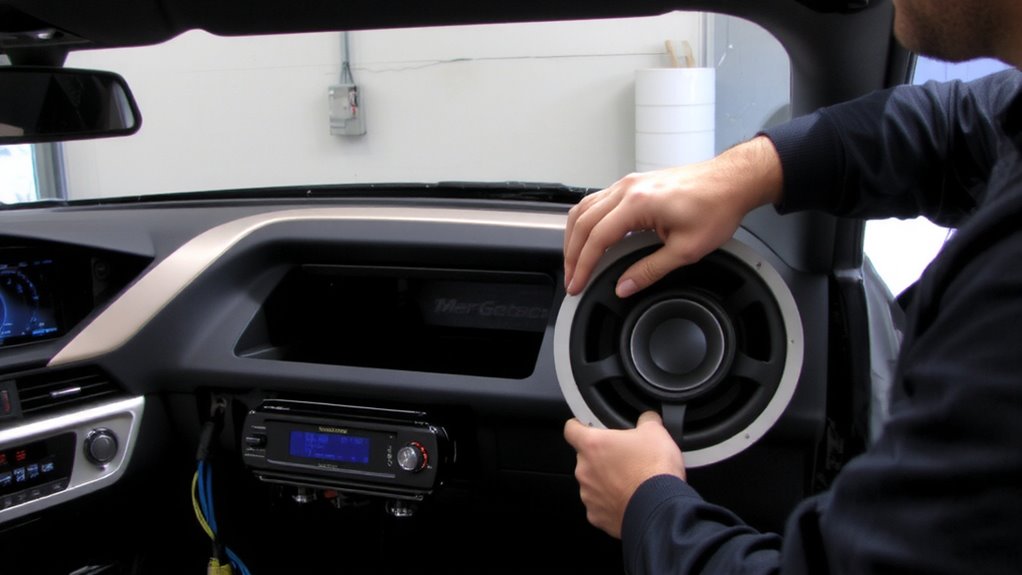
Why do some factory amplifiers cause headaches when upgrading speakers? Because they’re designed specifically for stock components, using proprietary signal processing and audio filtering. Your factory amp tailors frequency response to match original speakers, often applying aggressive crossovers and equalization. If you replace the speakers without accounting for this, sound quality suffers-possibly leading to distortion or damage. These amplifiers typically output 20–50 watts RMS per channel, with non-standard impedance handling, usually rated for 3–8 ohms. They rely on embedded DSP chips that manage timing, gain staging, and channel separation. Unlike aftermarket units, they don’t offer gain controls or input flexibility. Signal processing is static, meaning it can’t adapt to new speaker sensitivities or impedance curves. Audio filtering is fixed, so tweeters may receive too much bass or woofers too much treble. Understanding these traits helps you work with-not against-the system’s design.
Choose Speakers Compatible With Factory Amp
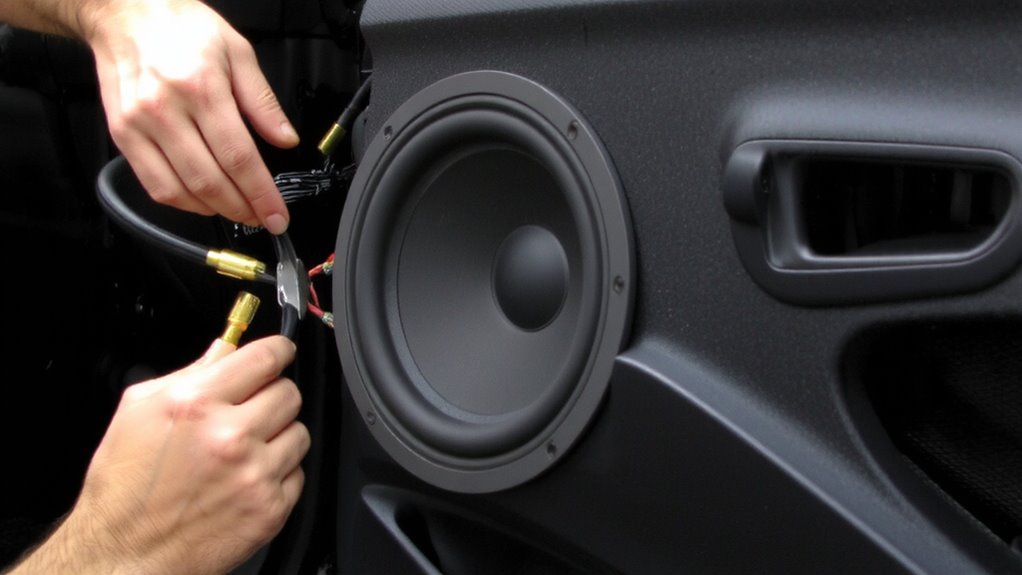
Since factory amplifiers are tuned to work with specific speaker characteristics, selecting compatible replacements is critical to maintaining sound quality and system integrity. You need speakers that match the original design specs to avoid distortion or amplifier strain. Look for models with high speaker durability, such as polypropylene cones and rubber surround materials, which resist heat, moisture, and repeated flexing. These features guarantee long-term performance in your vehicle’s environment. Sound insulation also plays a key role-opt for speakers with shielded baskets and butyl rubber surrounds to minimize cabin noise interference and improve clarity. Factory systems often operate at lower power levels, so sensitivity ratings between 87–92 dB work best. Choose OEM-fit aftermarket speakers that maintain proper mounting depth and grilles. This guarantees a seamless installation and preserves factory acoustics without requiring modifications.
Match Speaker Impedance to Factory Amp
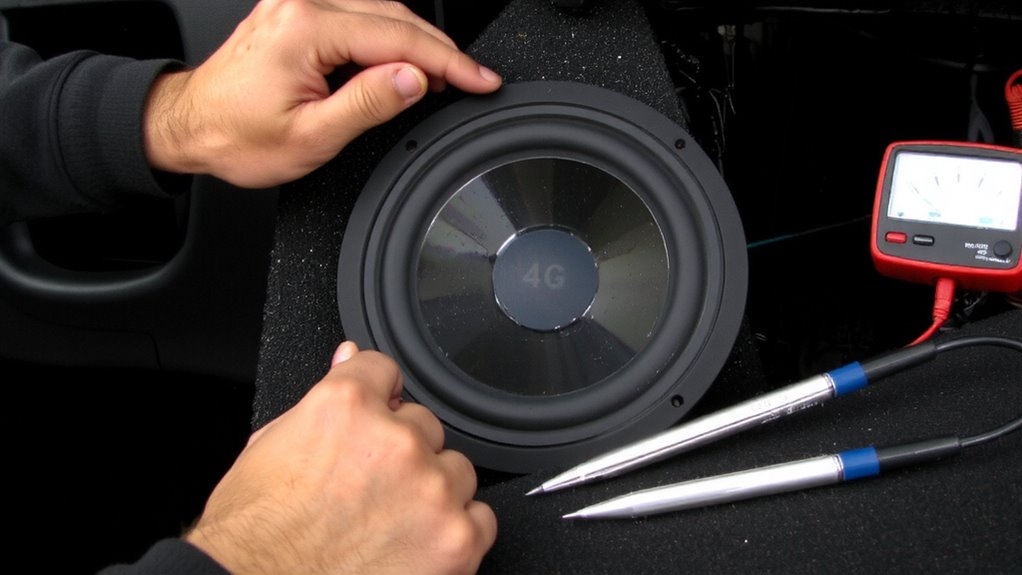
Most factory amplifiers deliver stable performance only when paired with speakers of the correct impedance, so matching this spec is non-negotiable. Your amp expects a specific load, usually 4 ohms; deviating causes overheating or shutdown. Install 4-ohm speakers unless your manual states otherwise. Mismatched impedance leads to signal degradation, distorting sound and stressing components. Always verify the factory amp’s output per channel-many deliver 20–50 watts RMS at 4 ohms. Using 2-ohm speakers drops resistance too low, overloading the amp. High-impedance speakers (8 ohms) restrict current flow, reducing output and efficiency. Correct speaker polarity matters just as much-reversed polarity cancels bass and muddies imaging. Connect positive to positive, negative to negative. Ensuring proper polarity maintains phase coherence across all speakers, preventing cancellations that mimic signal degradation. Match impedance precisely-it’s not just safe, it’s essential for fidelity.
Get Tools for Factory Amp Speaker Upgrade
Before you begin upgrading speakers on a vehicle with a factory amplifier, gather the right tools to guarantee a clean, efficient installation. Proper tools guarantee correct wiring techniques and preserve signal flow from the factory amp. Use a digital multimeter to verify speaker output and check impedance matches. A crimping tool and heat-shrink tubing secure connections, minimizing signal loss. Trim pry tools prevent door panel damage during access.
| Tool | Purpose |
|---|---|
| Wire stripper/crimper | Prepares leads and guarantees solid connections |
| Panel removal tools | Safely disengage door clips without scratches |
| Multimeter | Confirms signal flow and checks for shorts |
Label wires as you work to maintain correct polarity and routing. Quality connectors and 16-gauge oxygen-free copper wire enhance signal flow. Understanding wiring techniques prevents phase issues and impedance mismatches. Always double-check factory harness configurations before connecting new speakers.
Remove Door Panels and Disconnect Power
Start by disconnecting the negative terminal on your car battery to kill power-this stops accidental shorts and protects the factory amplifier. This simple step is one of the most critical safety precautions you can take. Once power is off, remove the screws securing the door panels using a trim tool and socket set. These fasteners, often T20 Torx or 8mm bolts, secure door hardware like armrests and speaker grilles. Carefully pry the panel away from the door, releasing plastic clips without breaking them. Lift the panel upward to clear the window track. Disconnect the wiring harnesses for lights, switches, and the factory speaker. Label each connection if you’re replacing multiple units. Always inspect door hardware for wear or corrosion. Proper handling guarantees clean reinstallation later. Working without power eliminates risks during disassembly.
Test Speakers With Factory Amp Before Reassembly
Why risk sealing everything back up only to find a speaker isn’t working? Test each speaker with the factory amp before reassembly. Power the system and play a familiar track. Listen for clear sound quality and consistent volume across all channels. Poor sound quality or static hints at wiring faults. Check connections at both the speaker and amplifier ends. Signal integrity relies on secure, corrosion-free contacts. Use a multimeter to verify continuity if a channel fails. Factory amplifiers output 15–50 watts RMS per channel; mismatched impedance causes distortion. Confirm each speaker is 2, 4, or 8 ohms per factory specs. A blown speaker draws no current; an open circuit reads infinite resistance. Test every channel independently. This step catches errors early. It guarantees signal integrity and peak sound quality. Skipping it risks unnecessary disassembly later. Verify function now-save time and effort.
Tune Factory System for New Speakers
How does your factory audio system respond after installing new speakers? You’ll need to recalibrate the signal processing to match the new components. Factory amplifiers apply preset digital signal processing (DSP) tailored to original speaker specifications. Installing different speakers alters the frequency response, often causing imbalances in highs, mids, and lows. You must adjust equalization, crossover settings, and channel balancing through the factory infotainment system or dealership diagnostic tool. Modern systems use 24-bit DSP with sample rates up to 96 kHz for precise signal processing. A mismatched frequency response curve-measured in decibels across 20 Hz to 20 kHz-can create harsh treble or weak bass. Use real-time audio analysis to verify output accuracy. Adjust until the frequency response is within ±3 dB across the audible spectrum. This guarantees factory tuning aligns with your new speakers’ performance.
On a final note
You’ve upgraded your speakers successfully. Always verify impedance compatibility-most factory amplifiers deliver 50 watts RMS at 4 ohms per channel. Mismatched impedance risks overheating or distortion. Reconnect power only after secure wiring. Test each speaker for clarity and phase alignment. Fine-tune with the head unit’s EQ: reduce bass slightly if distortion occurs. Properly matched components extend system life. Your audio now performs to engineered specifications-clean, balanced, and efficient.