How to Lubricate Steering Idler Arm Ball Stud on a 2010 Chevrolet Silverado
Locate the idler arm ball stud behind the passenger-side front wheel, where it connects the center link to the frame. It uses a ¾-14 threaded shank and a 90-degree Zerk fitting. Use a high-pressure grease gun with a flexible hose and metal coupler to apply NLGI #2 lithium-based grease. Pump 5–6 strokes until fresh grease purges from the boot. Verify the fitting is intact and the boot is sealed. Check for over 1/8 inch play or stiffness, which signals replacement. Lubricate every 15,000 miles to prevent wear and maintain smooth articulation. Proper maintenance ensures long-term steering reliability and component life. Further details clarify inspection and replacement criteria.
Notable Insights
- Locate the idler arm ball stud behind the passenger-side front wheel, connected to the frame with a 15mm bolt.
- Use NLGI #2 lithium-based grease compatible with rubber boots to prevent damage during lubrication.
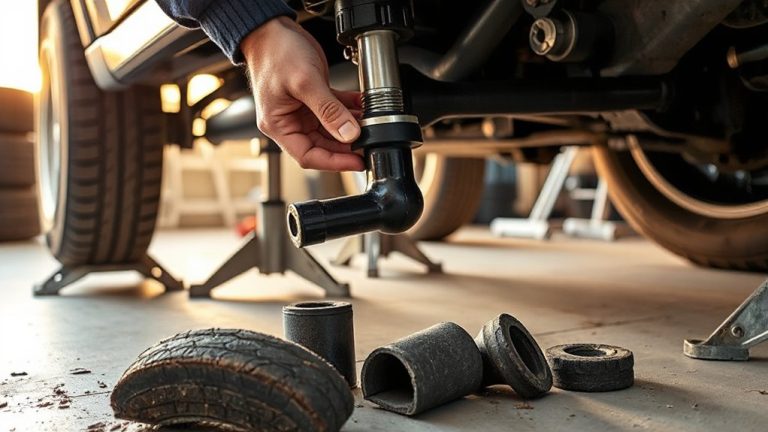
- Attach a high-pressure grease gun with a metal coupler to the 90-degree Zerk fitting on the ball stud.
- Pump 5–6 strokes of grease until fresh lube emerges from the boot; stop if resistance spikes sharply.
- Inspect for over 1/8 inch play, torn boots, or grinding; replace if damaged or play exceeds 0.060 inches.
Find the 2010 Silverado’s Idler Arm Ball Stud
The idler arm ball stud on your 2010 Chevrolet Silverado is located on the passenger side of the truck, just behind the front wheel, and connects the center link to the frame to maintain proper steering geometry. You’ll find it bolted to the frame bracket with a 15mm fastener. The stud features a ¾-14 threaded shank and swivels within a greasable socket. It’s part of the steering linkage alignment system, ensuring the front wheels respond accurately to input. If play exceeds 0.060 inches, consider ball joint replacement. Misalignment affects toe settings, accelerating tire wear. The stud boot should be intact, with no cracks or grease leakage. Confirm secure mounting and smooth movement before lubrication. Proper location and inspection are essential for effective service. Missing it means risking improper steering linkage alignment.
Pick the Right Grease and Tools for the Job
Grease quality makes or breaks your idler arm service life. Use only NLGI #2 lithium-based grease with excellent water resistance and shear stability. Check grease compatibility with rubber boots-some formulations degrade seals, leading to premature failure. You’ll need a high-pressure grease gun with a flexible hose and metal coupler that fits the 90-deg Zerk fitting on the ball stud. Guarantee tool durability by choosing chromoly steel construction; cheap aluminum guns fail under repeated use. A swivel head helps reach tight spaces near the frame rail. Use grease cartridges sealed with foil to prevent contamination. Never mix grease types unless certified compatible-doing so reduces lubricity and shortens component life. Your choice directly impacts wear protection and service intervals. A reliable setup costs slightly more but prevents comebacks. For optimal performance, consider one of the top-rated greases based on real-world durability and compatibility testing.
Grease the Ball Stud in 5 Minutes
You’ll get this job done fast if you work efficiently and follow the correct procedure. Attach a grease gun to the zerk fitting on the idler arm’s ball stud. Pump high-quality lithium-based grease until fresh lubricant emerges from the boot-this usually takes under five minutes. Use a grease with NLGI #2 rating and a drop point above 350°F for reliable performance. If the fitting is damaged, perform a grease fitting replacement before proceeding. Do not mistake this for ball stud removal; the joint stays intact. A properly lubricated ball stud reduces friction and prevents premature wear. Check the manufacturer’s specs: typical operating pressure is 1,800 psi, so guarantee your grease gun delivers within range. One full cycle of the pump equals roughly 0.125 cubic inches of grease-apply five to six strokes. Stop if resistance increases sharply. Over-greasing can rupture the boot.
Check for Play, Cracks, or Boot Damage
While the idler arm’s ball stud remains lubricated, it’s critical to inspect for mechanical defects that could compromise steering integrity. Check for excessive play, which signals ball stud wear and eventual failure. Grasp the stud and attempt to move it; more than 1/8 inch of movement means replacement is needed. Inspect the rubber boot closely-tears or cracks mean poor boot seal integrity, letting in dirt and moisture. A compromised boot accelerates corrosion and shortens component life.
| Defect Type | Acceptable Condition |
|---|---|
| Ball Stud Play | ≤ 1/8 inch movement |
| Cracks | None visible |
| Boot Seal Integrity | No splits, tears, or stiffness |
| Ball Stud Wear | Smooth motion, no grinding |
Address issues immediately to maintain safe steering operation.
Grease Every 15K Miles to Prevent Wear
Regularly maintaining your idler arm ball stud with fresh grease every 15,000 miles helps prevent premature wear and extends component life. This simple step is essential for effective wear prevention and guarantees smooth articulation under load. Use high-quality lithium-based grease with a NLGI #2 rating for maximum performance. Your Silverado’s steering system relies on precise gear alignment, and a dry ball stud introduces play that disrupts this balance. Over time, inadequate lubrication accelerates metal-on-metal contact, degrading both the stud and socket. A grease zerk fitting on the idler arm allows quick access-apply grease until it purges slightly from the boot. This confirms full penetration and proper sealing. Following this 15K-mile interval aligns with GM’s recommended service schedule and supports long-term steering integrity. Consistent lubrication reduces friction-induced heat, preserving rubber components and maintaining factory steering geometry.
Keep Steering Smooth With Routine Care
Occasionally, a well-maintained idler arm ball stud makes the difference between precise steering and vague, wandering handling. You should inspect the ball stud every 15,000 miles, guaranteeing it has no play beyond 0.05 inches. Excess movement disrupts steering alignment, leading to uneven tire wear and reduced control. Maintaining proper suspension balance is critical; a worn idler arm can offset the pitman arm, misaligning the drag link. This imbalance strains other steering components, including the tie rods and center link. Lubricate with JGC-1 grease or equivalent, injecting until fresh grease emerges. A properly lubricated joint resists corrosion and sustains smooth articulation. Check mounting bolts torque to 55 lb-ft. Consistent care preserves steering geometry, enhances responsiveness, and extends front-end life. Routine attention guarantees your Silverado tracks straight and handles predictably, protecting investment and safety on every drive.
On a final note
You’ve now lubricated your 2010 Silverado’s idler arm ball stud correctly. Use lithium-based #2 grease with a 2,000–3,000 psi NLGI rating. Grease every 15,000 miles to maintain joint integrity. A well-lubed ball stud reduces friction in the parallelogram steering system, minimizing wear on the tie rod ends and pitman arm. Inspect the rubber boot for cracks; compromised seals invite contaminants. Proper maintenance guarantees precise steering response and extends the front-end component life.