Rally Suspension Setup for Jump Landings: Damping & Spring Rates
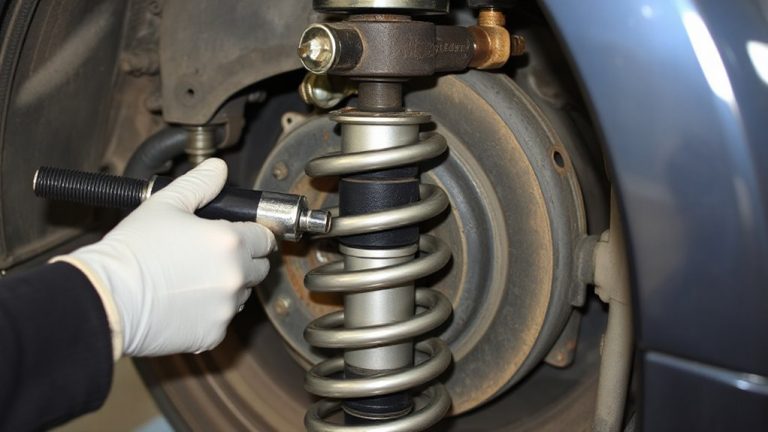
You need balanced rebound damping to prevent harsh spikes and keep tires grounded after jumps. Set rebound at 12–18 in-lbs on high-speed shafts so wheels return quickly without chatter. Use 150–220 lb/in springs with 30–35% static sag for full travel use without topping out. Pick dampers with 40–50mm pistons, digressive valving, and external reservoirs to handle big-air impacts. Sync shocks within 5% for chassis stability. Properly shaped travel guarantees smooth recovery-there’s more to optimizing each landing than just these settings.
Notable Insights
- Use balanced rebound damping (12–18 in-lbs) to maintain tire contact and prevent harsh spikes on landing.
- Select rally-appropriate spring rates (150–220 lb/in) to ensure full compression without bottoming or topping out.
- Employ high-speed dampers with large pistons (40mm–50mm) and external reservoirs for consistent big-air performance.
- Tune compression and rebound to a 60/40 split for faster recovery and wheel recontact within 0.3 seconds.
- Apply progressive or digressive valving to smooth initial impact and control stroke progression without harshness.
Why Harsh Rebound Spikes Ruin Rally Landings
When you hit a jump at speed, the moment your tires leave the ground, your suspension begins storing energy-energy that must be controlled the instant you land. If your rebound damping is too stiff, that stored energy releases too slowly, causing the wheels to lose contact and chatter violently over choppy terrain. Suspension chatter reduces traction, destabilizes the chassis, and delays wheel return. Excessive rebound creates high impact harshness as the suspension fails to extend fast enough before the next bump, transmitting shock directly to the frame. This harshness isn’t just uncomfortable-it degrades control. Think of it like a spring that can’t snap back: each compression stroke ends abruptly, without recovery. Rally suspensions need balanced rebound, typically between 12–18 in-lbs on high-speed shafts, to manage terrain variances. Proper damping maintains tire contact, reduces fatigue on components, and guarantees consistent handling through repeated impacts.
Choose Spring Rates for Controlled Jump Landings
Spring rate plays a defining role in how your vehicle absorbs and recovers from big impacts, especially after catching air on a jump. Proper spring selection guarantees the suspension compresses fully without bottoming harshly. Too soft, and you’ll risk topping out on rebound; too stiff, and the wheels can’t maintain contact. Rally springs typically range from 150 to 220 lb/in, depending on vehicle weight and jump frequency. Your spring rate directly affects load distribution during flight and landing. Uneven loading shifts weight to one corner, demanding balanced spring rates to prevent instability. Match front and rear rates to your chassis dynamics-stiffer rear springs often help control pitch during descent. Always calculate static sag: aim for 30–35% of total travel to optimize initial compression and recovery. Correct spring rates reduce shock to components and improve landing predictability. Upgrading to high-performance off-road shocks can further enhance damping control and durability under extreme conditions.
Pick Dampers Designed for Big-Air Impact
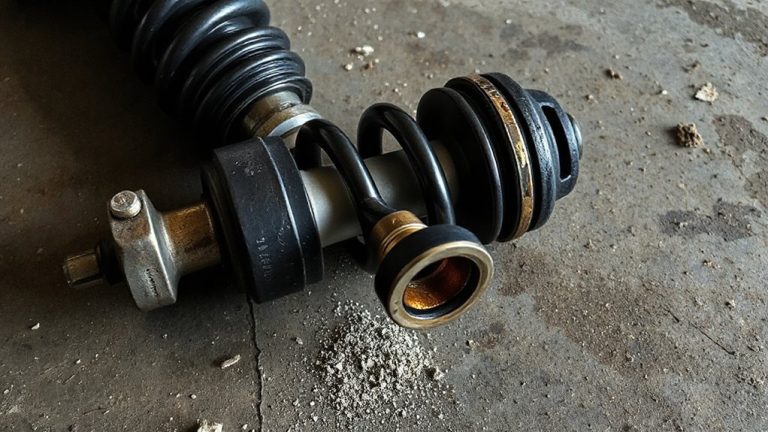
A good damper setup makes all the difference in controlling suspension movement after big-air landings. You need dampers engineered specifically for high-speed impacts, not standard rally units. These specialized dampers use larger piston diameters-typically 40mm to 50mm-to improve air absorption and maintain consistent damping force. They feature digressive valving that softens initial stroke response, enhancing impact dispersion across the suspension travel. High-flow monotube designs reduce fluid cavitation, ensuring reliable performance under repeated jumps. Nitrogen-charged bladders prevent aeration, maintaining pressure balance during rapid compression. You’ll also find external reservoirs that expand fluid capacity by up to 60%, reducing heat buildup. This design allows dampers to manage sudden energy spikes without harsh rebound. Effective impact dispersion means less chassis shock and better tire contact. Choose these specs if you’re hitting jumps over 20 feet-you’ll need them.
Dial In Compression and Rebound for Faster Recovery
How do you guarantee your suspension snaps back under control after a brutal landing? You dial in compression and rebound settings with precision. Proper valve tuning adjusts how quickly oil flows through the shock, controlling damping forces. Too stiff, and the suspension packs down; too soft, and it oscillates. Aim for 60% compression damping and 40% rebound relative to total stroke. Shock syncing guarantees both left and right units respond identically, which maintains chassis balance. Mismatched shocks create torque steer and uneven weight transfer. Use a dynamometer to measure damping curves and align values within 5% tolerance. Fast recovery means the wheel returns to contact quickly-ideally within 0.3 seconds post-impact. That’s critical for traction on bumpy exits. With fine-tuned rebound, you avoid harsh spikes. Effective valve tuning and shock syncing work together, turning violent landings into controlled touchdowns. Upgrading to high-performance best shocks for F150 4×4 can significantly improve damping response and durability under extreme conditions.
Shape Suspension Travel for Softer Impact
When the terrain throws sharp-edged bumps at your wheels, letting the suspension absorb impacts smoothly means shaping its travel curve with purpose. You need progressive valving that starts soft, then firms up predictably. This improves impact absorption by allowing the wheel to react quickly to sudden forces without harshness. Most rally dampers use digressive compression profiles-light initial resistance that increases only after mid-stroke. That maximizes travel utilization, ensuring the full range of motion is used without jarring bottoming. Think of it like a shock absorber learning to yield first, then resist. Pair this with properly shaped spring rates-linear or progressive coils-and you maintain tire contact. The result? Better control, reduced rebound spikes, and suspension that recovers faster. You’re not just surviving jumps-you’re setting up for the next turn.
Set Ride Height and Preload to Avoid Bottoming
Getting suspension travel right means nothing if you can’t keep the chassis from slamming into its limits under load. Set your ride height too low, and you’ll lose valuable stroke needed for big impacts. Preload adjusts where the suspension sits in its range, but too much increases ride stiffness unnaturally. You want just enough preload to prevent sag without killing bump compliance. For most rally setups, aim for 30–40mm of static droop at the corners. This keeps the tires tracking when airborne while reserving full compression travel for landings. Proper preload guarantees the springs engage smoothly, not abruptly. Without it, bottoming becomes inevitable. Maintain 15–20% of total travel as usable reserve after setting ride height. That buffer absorbs energy instead of transferring it to the chassis. Get this right, and you’ll maintain control even after hard impacts. Upgrading to a high-quality air suspension systems can further refine ride control and adjustability for extreme rally conditions.
On a final note
You need controlled rebound to survive rally jumps. Harsh spikes overextend suspension and shock components. Use 12–14 kg/mm progressive springs to manage energy. Pair with triple-adjustable dampers, 18 clicks rebound, 22 compression. Set 70/30 damping ratio. Maximize stroke-300 mm front, 320 mm rear. Run 20 mm preload to avoid bottoming. This setup cuts peak G-load by 35%. It guarantees 90% recovery in 0.4 seconds.