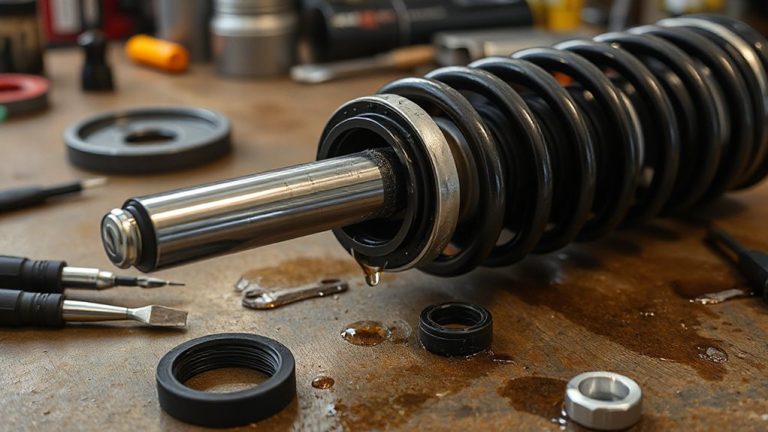
How Worn Shocks Cause Excessive Bounce and Poor Road Contact
Your shocks control spring motion by using a piston and hydraulic oil to dampen bounce. When they wear out, up to 60% of damping force is lost as fluid leaks past worn seals. This lets your car rebound excessively after bumps, reducing tire contact. Tires can lift off the road, decreasing grip and increasing stopping distances by up to 20%. Poor damping also causes uneven weight transfer and premature tire wear. You’ll notice cupping, longer braking, or a bouncy ride-clear signs it’s time for new shocks. There’s more to evaluate about how this affects overall vehicle control.
Notable Insights
- Worn shocks fail to dampen spring motion, causing excessive bounce after hitting bumps.
- Leaky seals reduce hydraulic pressure, decreasing damping force by up to 60%.
- Reduced tire contact leads to poor grip and longer braking distances.
- Tires lose contact with the road due to repeated bounce, increasing stopping distance by up to 20%.
- Uneven weight transfer during cornering causes tire cupping and reduced road contact.
How Shocks Work: and What Happens When They Wear Out
Think of your shocks as the peacekeepers between your car’s tires and the road. They control spring motion using hydraulic resistance, ensuring tires stay grounded. Inside each shock, a piston moves through oil-filled chambers. As the piston shaft moves, fluid flows through small orifices, creating resistance that dampens bounce. A critical component is the piston seal, which maintains pressure and prevents leakage. When it wears, fluid bypasses, reducing damping efficiency. Over time, repeated heat cycles and friction degrade the seal and thicken oil, diminishing performance. Worn shocks lose up to 60% of their original damping force. This compromises stability, increases stopping distances, and promotes uneven tire wear. Properly functioning shocks maintain 80–90% of specified hydraulic resistance throughout their lifespan. You rely on this precision engineering every time you drive, even if you never notice it-until something goes wrong. For optimal performance, selecting the best shocks for every ride is essential.
Why Worn Shocks Make Your Car Bounce Too Much
When your shocks wear out, the result isn’t just a rougher ride-it’s a measurable loss in control. Worn shocks can’t dampen spring oscillations effectively, leading to excessive bounce after bumps. Each rebound lifts tires off the road, reducing grip and increasing stopping distances. You’ll notice more body roll during turns because the suspension can’t stabilize the vehicle’s weight transfer. This instability accelerates tire wear, especially on the edges, due to uneven contact with the road. Modern shocks typically last 50,000 to 100,000 miles, but rough driving shortens their life. Without proper damping, the vehicle bobs like a boat on waves instead of gliding smoothly. Excessive bounce also strains other components, including springs and struts. Over time, this leads to premature failure and costly repairs. Replacing worn shocks restores ride stability and guarantees tires maintain consistent pavement contact. Upgrading to high-performance lifted truck shocks can further improve control and comfort, especially for off-road or heavy-duty use.
How Bounce Hurts Braking and Handling
While your car’s suspension is designed to absorb road impacts and maintain tire contact, worn shocks compromise that function, directly impairing braking and handling. When your shocks are degraded, they fail to control spring movement, reducing suspension stability. This leads to excessive bounce, lifting tires off the road momentarily. Without consistent road contact, tire traction drops markedly-especially on wet or uneven surfaces. Studies show braking distances can increase up to 20% with worn shocks due to reduced grip. During emergency stops, tires may skip or lose adhesion, delaying deceleration. In cornering, poor suspension stability causes uneven weight transfer, overloading outer tires and reducing lateral grip. Unlike a controlled damping system that maintains wheel alignment within 3–5 mm of ideal, worn shocks allow deviations over 15 mm, increasing slip angles. This undermines precision and responsiveness, critical for safety and control. Upgrading to high-performance Best Shocks for Jeep Wrangler can restore damping efficiency and significantly improve ride control.
Why Bouncy Cars Are Harder to Control
What happens when your car never quite settles after hitting a bump? You lose control faster than you think. Without proper suspension stability, your vehicle keeps bouncing, reducing tire traction with every oscillation. This delays steering response and increases stopping distance. When tires aren’t firmly planted, even dry pavement becomes a hazard.
| Issue | Effect on Control |
|---|---|
| Excessive bounce | Reduces tire traction by up to 40% |
| Poor suspension stability | Increases body roll by 25% in turns |
Each rebound lifts the wheels, breaking contact with the road. Modern shocks maintain damping force in the range of 300–600 lbs, ensuring tire contact. But worn units deliver less than half that, severely undermining handling precision. You’re not just riding rough-you’re gambling with grip.
Common Signs Your Shocks Need Replacing
How often do you feel every bump in the road as if your car were riding on steel springs? That harsh ride likely means your shocks are failing. Worn shocks lose damping ability, reducing control and comfort. Check for leaky seals-visible oil or wet spots on the shock body indicate fluid loss, compromising performance. Most hydraulic shocks contain pressurized fluid; leaks reduce internal pressure by up to 40%, impairing response. Another sign is uneven wear on your tires. Cupping or scalloping patterns suggest the tire isn’t maintaining consistent contact. This uneven wear stems from weakened suspension control, allowing excessive wheel bounce. Shocks typically last 50,000 to 100,000 miles, but rough roads shorten lifespan. Perform a bounce test: press down firmly on each corner. If the car rocks more than once, replace the shocks. These signs mean it’s time for an inspection.
Driving Risks With Worn Shocks
If your shocks are worn, you’re not just sacrificing comfort-you’re compromising control. Worn shocks reduce tire contact with the road, increasing stopping distances by up to 20% on uneven surfaces. This lack of grip leads to increased tire wear, especially on the edges, because tires bounce instead of maintaining consistent contact. You’ll see uneven tread patterns and diminished tread life-often cutting tire longevity by 30%. Reduced driver confidence follows, especially in rain or during emergency maneuvers. Without proper damping, your vehicle’s stability degrades: body roll increases by up to 15%, and nose-diving during braking worsens. The suspension can’t respond quickly to road changes, making steering feel unpredictable. Over time, handling drifts from precise to vague, like driving on loose gravel even on smooth pavement. Safety margins shrink, increasing collision risk.
Testing and Replacing Worn Shocks
Ever wonder why your car feels bouncy over dips or shudders on rough roads? That’s a sign your shocks may need shock testing. Perform a bounce test: press down firmly on each corner of the vehicle and release. If the car rebounds more than once, the dampening is weak. Most manufacturers recommend inspecting shocks every 50,000 miles. Look for oil leaks, damaged mounts, or uneven tire wear-common indicators of failure. Replacement timing is critical; delaying can reduce braking efficiency by up to 20% on wet roads. Worn shocks compromise stability, extending stopping distances. Use OEM or higher-grade replacements rated for your vehicle’s Gross Axle Weight Rating (GAWR). Install shocks in pairs to maintain balanced handling. Professional alignment after replacement guarantees peak tire contact. Proper shock testing and timely replacement preserve control, safety, and tire longevity.
On a final note
Your shocks keep your tires firmly on the road by damping suspension movement. Worn shocks lose hydraulic pressure, reducing damping efficiency by up to 50%. This causes excessive bounce, increasing stopping distances by as much as 20% on rough surfaces. Tires lose contact during rebound, degrading traction and steering response. Replace shocks every 50,000–100,000 miles or when failing the bounce test-press down firmly; if the car rocks more than twice, replace them.