Inspecting Upper Ball Joints on a 2014 Dodge Charger
Lift your 2014 Dodge Charger safely using a floor jack and secure it with jack stands on reinforced frame points. Grasp the front tire at 12 and 6 o’clock and rock it vertically. Any movement exceeding 0.05 inches indicates excessive upper ball joint play. Use a dial indicator for accurate measurement, and inspect the dust boot for damage. Exceeding factory specs means replacement is required-OEM units are sealed and non-serviceable. Knowing what comes next helps guarantee long-term alignment and safety.
Notable Insights
- Safely lift the 2014 Dodge Charger and support it with jack stands on reinforced frame points.
- Grasp the front tire at 12 and 6 o’clock to check for vertical movement in the upper ball joint.
- Use a dial indicator to measure play; replace if movement exceeds 0.050 inches.
- Inspect the ball joint’s dust boot for damage or grease leaks using a flashlight.
- Replace the upper ball joint if clunking noises, loose steering, or uneven tire wear are present.
Check Upper Ball Joint Play – Step-by-Step
While the vehicle is safely lifted and the front wheels are off the ground, you can begin checking for upper ball joint play-a critical step in diagnosing suspension wear on your 2014 Dodge Charger. Grasp the tire at the 12 and 6 o’clock positions and rock it vertically. Any noticeable movement indicates potential wear. The ball joint design uses a stud-and-socket configuration with a lubricated bearing, meant to allow controlled articulation without free play. Factory specs permit less than 0.05 inches of vertical movement-exceeding this suggests failure. Excessive play disrupts suspension alignment, causing uneven tire wear and poor handling. Misalignment from a worn ball joint often shows as camber or toe deviations beyond ±0.5 degrees. You’re not replacing it yet-this step is diagnostic. Accurate assessment guarantees you don’t overlook early deterioration hidden by sealed dust boots. Proper inspection now prevents unsafe conditions later.
Use These Tools to Inspect Your Charger’s Ball Joints
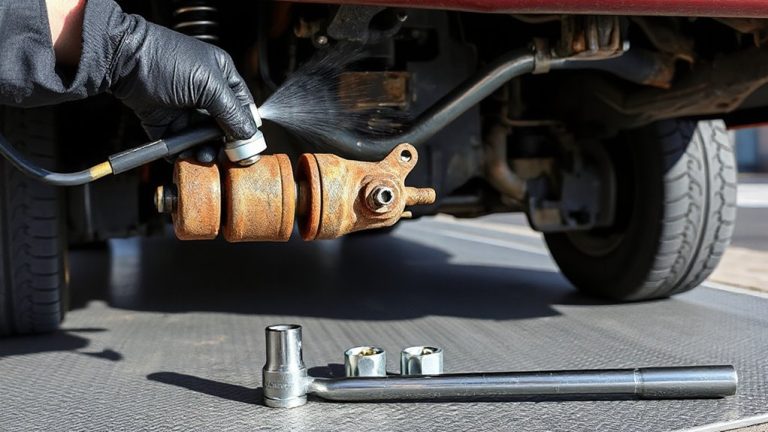
A pry bar, flashlight, and dial indicator are your best allies when inspecting the upper ball joints on your 2014 Dodge Charger. Use the pry bar to check for movement while the vehicle is lifted and wheels are off the ground. A flashlight helps you spot worn dust boots or leaking ball joint lubrication, which signals internal damage. The dial indicator provides precise measurements-exceeding 0.050 inches of vertical play means replacement is needed. Use a 15mm or 18mm socket wrench, depending on your strut design, to remove the cotter pin and nut securing the ball joint. Correct socket wrench types guarantee you don’t strip fasteners during disassembly. Always inspect the grease fitting; if clogged, proper ball joint lubrication can’t occur, accelerating wear. These tools and techniques give you accurate, reliable diagnostics without guesswork.
Spot These Warning Signs of Ball Joint Failure
What should you do when your 2014 Dodge Charger starts reacting strangely on rough roads? You likely have failing upper ball joints. A common sign is loose steering-your wheel feels vague or wanders without input. This happens because worn ball joints increase play in the suspension, exceeding the manufacturer’s maximum 0.050-inch tolerance. You may also hear a distinct clunking noise when hitting bumps. That sound comes from metal-on-metal impact inside the joint due to a compromised rubber boot and dried-out lubricant. Inspect for uneven tire wear, especially inside edges, which signals misalignment from joint slack. Vertical movement at the wheel, detected by rocking the tire top-to-bottom, confirms excess play. The control arm should remain stable. These symptoms mean the joint’s polyurethane bushing is degraded and can no longer maintain proper caster and camber angles. Address this early to avoid sudden failure.
Should You Replace or Keep Monitoring?
If you’ve confirmed excessive play-more than 0.050 inches-during your inspection, it’s not a matter of if, but when, you’ll need to replace the upper ball joints. Continued use risks failure, leading to loss of control. Ball joint longevity on your 2014 Dodge Charger typically reaches 100,000 miles under ideal conditions, but aggressive driving or poor road conditions can shorten that. Once wear exceeds factory specs, monitoring won’t prevent eventual replacement. These joints are sealed units with no service intervals, meaning once they degrade, they can’t be rebuilt. Most aftermarket replacements include a limited lifetime warranty, but original equipment parts fall under the manufacturer warranty only if under 36,000 miles or within the 3-year coverage period. If outside those limits, replacement is your only safe option. Don’t gamble with steering integrity-replace worn joints promptly.
Why Your 2014 Dodge Charger’s Ball Joints Matter
Your 2014 Dodge Charger’s upper ball joints are critical structural links connecting the suspension to the steering knuckle, allowing smooth articulation while maintaining wheel alignment. They enable precise control of suspension geometry during cornering, braking, and uneven road traversal. Ball joint durability directly impacts both safety and handling, with OEM units rated for approximately 100,000 miles under normal driving conditions. Each joint tolerates up to 0.05 inches of vertical play before requiring replacement. Worn ball joints compromise suspension alignment, increasing tire wear and reducing steering responsiveness. Misalignment as small as 0.5 degrees can degrade handling and fuel efficiency. The ball joint’s polymer bushing and greasable metal socket are engineered to resist lateral and axial load stresses exceeding 3,500 pounds. Consistent inspection guarantees peak performance. Properly functioning joints maintain camber and caster angles within factory specs-typically ±0.75 degrees-guaranteeing stability and predictable vehicle dynamics over time.
Always Follow These Safety Tips for Suspension Work
While tackling suspension work on your 2014 Dodge Charger, never underestimate the forces involved-failure to follow safety protocols can lead to serious injury. Always prioritize jack safety by using a floor jack rated for at least 3 tons, the minimum capacity needed for the Charger’s front axle weight. Lift stability is critical; support the vehicle with jack stands positioned under reinforced frame points, not suspension components. Never rely solely on a jack. The Charger’s curb weight exceeds 3,700 pounds, so improper support risks collapse. Work on a level, dry surface to maintain balance. Tighten stand knobs securely and confirm the vehicle doesn’t wobble. Avoid sudden movements under a lifted car. Always wear safety glasses and keep tools clear of the lift zone. These steps guarantee control, precision, and personal safety throughout the inspection.
On a final note
You must inspect your 2014 Dodge Charger’s upper ball joints regularly to guarantee safety and performance. Each joint should have less than 0.050 inches of vertical play, measured with a dial indicator. Exceeding this tolerance indicates wear and requires replacement. Use a load-bearing ball joint separator if service is needed. These joints are critical for steering response and alignment stability. Ignoring wear risks loss of control. Always follow factory torque specs-95 ft-lbs for the spindle nut.