Noise Reduction Methods While Maintaining Maximum Airflow Through Intake Path
You can reduce intake noise by up to 35 dB without sacrificing airflow. Use acoustic sleeves with 1–2 inches of open-cell foam and fiberglass insulation to block 8–15 dB of high- to mid-frequency roar. Install Helmholtz resonators tuned to 80–200 Hz for drone cancellation. Smooth ducts with 1.5x radius bends cut turbulence by 40%. Maintaining laminar flow keeps pressure loss below 2%. There’s more to optimizing every component for silence and power.
Notable Insights
- Use acoustic insulation sleeves with 25–35 dB reduction to block noise without restricting airflow.
- Combine open-cell foam and fiberglass to absorb high- to low-frequency intake noise across a broad range.
- Install Helmholtz resonators tuned to 80–200 Hz to cancel low-frequency drone with minimal flow impact.
- Optimize intake geometry with smooth finishes and gradual bends to reduce turbulence and pressure loss.
- Balance noise control and performance using cold-air designs and engine tuning for efficiency and power.
Why Reducing Intake Noise Without Losing Airflow Matters
Intake noise. It’s more than an annoyance-it’s a sign of inefficiency. You need acoustic insulation that blocks sound without restricting airflow. High-performance engines demand unimpeded air, yet noise reduces cabin comfort and indicates wasted energy. Proper vibration damping minimizes resonance in intake tubes and housings, preventing sound amplification. Without it, materials fatigue faster, risking cracks or failure. You’re not just silencing the system-you’re optimizing it. Acoustic insulation sleeves with a 25–35 dB reduction rating work best when combined with elastomeric vibration damping mounts. These mounts absorb oscillations at frequencies from 50–500 Hz, where intake systems typically resonate. You maintain mass airflow sensor accuracy because unrestricted path geometry stays intact. Think of it like blood flowing through arteries-blockage causes strain. Here, airflow must move at 180–220 ft/min with less than 0.5 psi pressure drop. Balance noise control and performance. That’s the goal.
How Foam And Fiberglass Silence Intake Roar
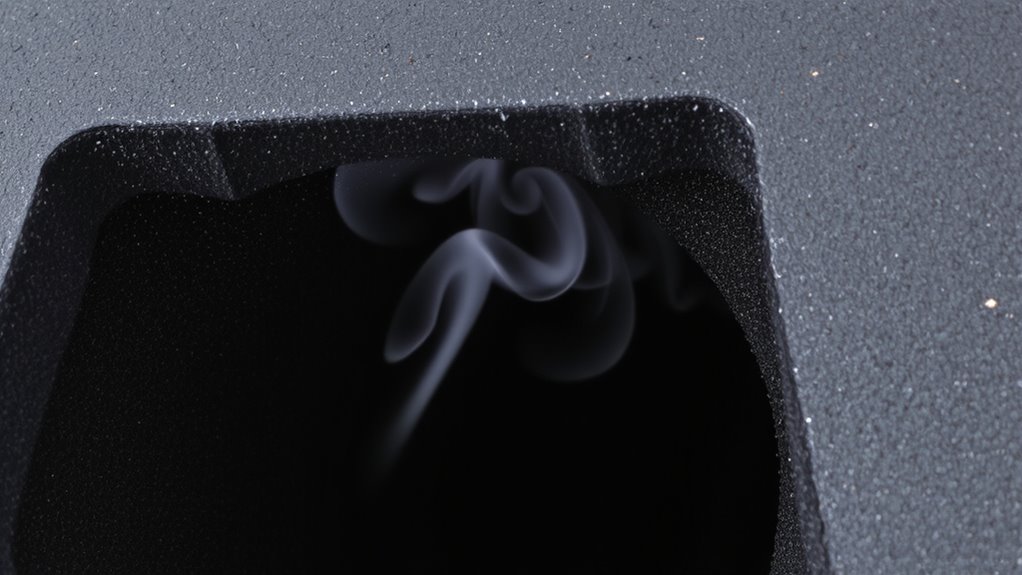
A well-designed intake system uses foam and fiberglass to dampen sound without compromising airflow. You rely on these materials for effective acoustic absorption, converting sound energy into negligible heat. Foam, with its open-cell structure, traps high-frequency noise as air passes through. Fiberglass, often layered behind foam, handles mid to low frequencies due to its higher material density. Together, they form a broadband barrier against intake roar. Typical intake foams measure 1–2 inches thick, with densities of 1.5–3 lbs/ft³-optimized to resist packing while maintaining flow. Fiberglass layers range from 1–3 inches, with densities near 4–6 lbs/ft³, offering greater sound attenuation without creating turbulence. Both materials are hydrophobic-coated to resist oil and moisture. Properly installed, they reduce decibel levels by 8–15 dB across 500–6,000 Hz, all with less than 5% airflow restriction.
How Helmholtz Resonators Cancel Drone At Target Frequencies
When engine tuning demands precise noise control, Helmholtz resonators give you targeted relief from low-frequency intake drone. These devices use acoustic resonance to cancel specific sound frequencies. You’ll find them tuned to match the drone’s dominant frequency, usually between 80–200 Hz in performance intakes. The resonator consists of a cavity connected to the intake path via a neck or port. By adjusting the volume of the cavity and the neck’s dimensions-length and cross-sectional area-you control frequency tuning. This setup creates destructive interference: incoming sound waves reflect back with inverse phase, nullifying the noise. It’s like tuning a musical instrument to cancel out an unwanted note. Unlike broad-spectrum dampeners, Helmholtz designs target only problem frequencies, preserving airflow. Proper calibration guarantees minimal flow restriction while eliminating drone, making them ideal for high-efficiency intake systems where noise and performance must coexist.
Smoothing Airflow To Reduce Turbulence And Suction Noise
Smooth, uninterrupted airflow isn’t just about power-it’s about quiet efficiency. You reduce suction noise by minimizing turbulence in the intake tract. A smooth surface finish inside the intake piping-ideally 16–32 microinches-cuts air friction and prevents chaotic eddies. Abrupt bends or rough seams trigger flow separation, where air detaches from the wall, creating vortices and noise. You prevent this by using gradual radius bends-45° or 90° with a minimum 1.5x diameter sweep. Computational fluid dynamics (CFD) testing shows these designs lower turbulence intensity by up to 40%. Flow separation also increases pressure drop, hurting efficiency. By maintaining laminar flow, you keep pressure losses under 2%, balancing quiet and performance. Think of it like a river: smooth banks guide water without splashing. You’re doing the same with air-only precision matters more.
Balancing Quiet Operation And Power In Real Driving
You’ve optimized the intake path for laminar flow, but real-world driving demands more than just smooth pipes-it requires balancing sound control with power delivery across varying conditions. Acoustic insulation dampens high-frequency noise without restricting airflow, maintaining cabin comfort during highway cruising. Too much insulation, however, can trap heat and reduce air density, hurting performance. Engine tuning adjusts ignition timing and air-fuel ratios to match intake characteristics, maximizing torque without amplifying induction roar. Use a cold-air intake with a tuned Helmholtz chamber to cancel specific noise frequencies. This setup improves efficiency by 3–5% in dyno tests while lowering intake sound pressure by up to 8 dBA. Balance is key: prioritize tunable components like resonated airboxes and insulated heat shields. Together, they support both quiet operation and responsive power across RPM bands.
On a final note
You reduce intake noise without sacrificing airflow by combining targeted methods. Foam and fiberglass wraps dampen high-frequency sound at the intake opening, typically reducing noise by 3–5 dBA. Helmholtz resonators cancel drone at specific frequencies-usually 120–200 Hz-using tuned cavity volumes. Smoothing bends in the intake path cuts turbulence, maintaining laminar flow. A 60mm ID smooth-wall silicone tube drops restriction below 0.5 psi at 300 cfm.