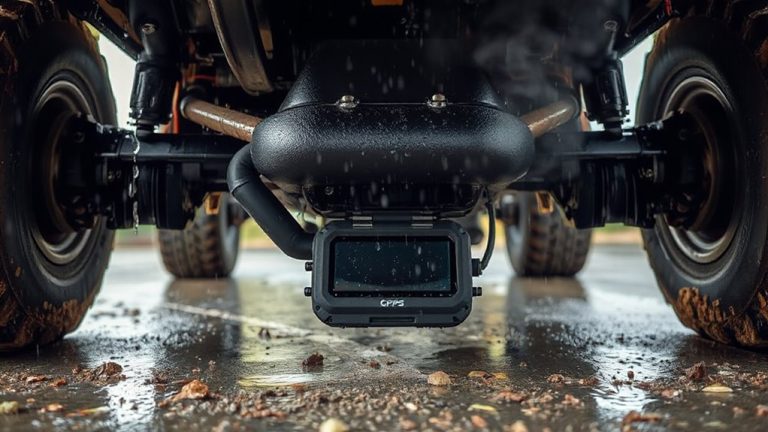
The Role of Rear Shocks in Controlling Axle Movement During Acceleration
Your rear shocks control axle movement during acceleration by resisting torque-induced rotation through hydraulic damping. They maintain suspension geometry and reduce rear squat with valved compression and rebound. High-performance units like the Bilstein B8 5112 use nitrogen charging and 10-stage valving for consistent response. Without proper damping, axle wrap triggers wheel hop at 8–12 Hz. Upgraded shocks keep tires planted and improve launch stability under high power. There’s more to learn about how this affects overall traction.
Notable Insights
- Rear shocks control axle rotation caused by torque reaction during acceleration.
- They dampen suspension movement to maintain proper geometry under power delivery.
- Shock valving resists axle wrap, reducing wheel hop and tire slippage.
- Upgraded shocks improve traction by minimizing oscillations at launch.
- Failing shocks lead to excessive squat, reduced damping, and loss of rear stability.
How Rear Shocks Control Axle Movement During Acceleration
When your vehicle accelerates, the rear axle tends to rotate in the opposite direction due to torque reaction, but rear shocks play a critical role in managing this movement. They resist axle wrap by damping rotational forces that shift the suspension geometry. Axle wrap occurs when the axle housing twists under rapid acceleration, causing loss of traction and potential damage. High-performance rear shocks use valved hydraulic systems to control rebound and compression, limiting unwanted motion. Properly tuned shocks maintain consistent tire contact and alignment. They work within your vehicle’s suspension geometry to stabilize the rear end during power delivery. Adjustable shocks let you fine-tune response based on load, driving conditions, or performance needs. Without effective damping, the axle rotates excessively, compromising stability. Rear shocks don’t eliminate axle wrap entirely but reduce its effects substantially. Their placement and mounting angles directly influence control efficiency.
What Causes Wheel Hop From Poor Axle Control?
Poor axle control doesn’t just reduce traction-it can trigger wheel hop, a violent oscillation that degrades performance and risks component failure. You experience wheel hop when the rear axle rotates excessively under acceleration, causing rapid suspension binding and rebound. This motion stems from axle wrap, where torque causes the housing to twist against the leaf springs or control arms. Without proper damping, the axle snaps back, slamming the tire into the pavement. Each impact breaks traction, leading to severe traction loss. The cycle repeats several times per second, measurable at 8–12 Hz in most rear-drive platforms. You’ll see driveshaft angles fluctuate over 15 degrees in uncontrolled setups. These oscillations stress U-joints, differential mounts, and tires, often exceeding design limits. Effective rear shocks prevent this by damping vertical axle movement, but worn or inadequate units let oscillations grow unchecked.
How Upgraded Shocks Improve Launch Traction
Though stock shocks may suffice for daily driving, they’re rarely built to handle the stresses of aggressive acceleration, leaving you vulnerable to traction loss at launch. Upgraded rear shocks deliver improved damping, minimizing axle oscillation that leads to wheel hop. Firm compression and rebound control keep the rear tires planted during hard launches. You’ll feel enhanced responsiveness the moment you hit the throttle, as valving adjusts instantly to changes in load. High-performance units use precision-tuned hydraulic circuits and nitrogen pressurization to maintain consistent resistance. This reduces fade under repeated stress. Adjustable models let you fine-tune settings for your vehicle’s weight and power output. Unlike stock dampers with soft, unpredictable stroke behavior, upgraded shocks react predictably, maintaining tire-to-pavement contact. The result? Sharper launches, reduced wheelspin, and faster elapsed times. Improved damping doesn’t just smooth the ride-it maximizes usable power delivery when grip matters most. For F350 Super Duty diesel 4×4 owners, selecting the right best shocks for F350 can significantly enhance rear axle control and overall launch performance.
Best Rear Shock Upgrades for High-Power Vehicles
A top-tier rear shock upgrade is essential for high-power vehicles where excessive torque and horsepower strain factory suspension components. You need shocks built for performance tuning and extreme material durability. Bilstein B8 5112 series shocks use monotube design with nitrogen gas charging to reduce fade during aggressive launches. They offer 10-stage velocity-sensitive valving for precise damping control. AFCO double-adjustable shocks let you fine-tune rebound and compression independently, ideal for drag or street applications. Their chromoly steel construction guarantees long-term material durability under high stress. QA1 Pro Series shocks provide 30-way adjustability and are valved specifically for rear axle control during hard acceleration. Lightweight aluminum bodies resist corrosion. Each model maintains consistent damping force up to 180°F, critical for repeatable performance tuning. These shocks control axle wrap and maintain tire contact, translating power to the pavement efficiently. For drivers seeking optimal handling and longevity, choosing the best shocks for every ride ensures both comfort and control under demanding conditions.
Signs Your Rear Shocks Are Failing Under Acceleration
Why does your rear end feel unstable when you hit the throttle? Failing rear shocks can’t control axle movement, leading to wheel hop and reduced traction. You’ll notice a bumpy ride, especially over uneven surfaces, because worn shocks lose damping ability. Fluid leaks are a clear red flag-oil on the shock body means internal failure. Without proper damping, your vehicle’s rear squats excessively during acceleration, destabilizing the chassis. Upgrading to high-performance lifted truck shocks can significantly improve rear axle control and overall driveability under power.
| Symptom | Cause | Performance Impact |
|---|---|---|
| Excessive rear squat | Worn valving | Reduced traction, longer acceleration times |
| Bumpy ride | Loss of hydraulic pressure | Poor ride comfort, reduced tire contact |
| Visible fluid leaks | Damaged seals | 50–70% loss in damping efficiency |
| Knocking noises | Loose mounts or blown shock | Axle misalignment, erratic handling |
On a final note
You rely on rear shocks to manage axle movement during acceleration. They dampen suspension oscillations, preventing wheel hop. High-performance shocks, like adjustable monotube designs, offer precise valving control. They handle forces up to 3,000 lbs of compression force. Stiffer damping settings improve traction. Billet aluminum bodies dissipate heat faster. Proper shock travel-typically 10 to 14 inches-maintains tire contact. Upgraded units enhance stability, power delivery, and control.