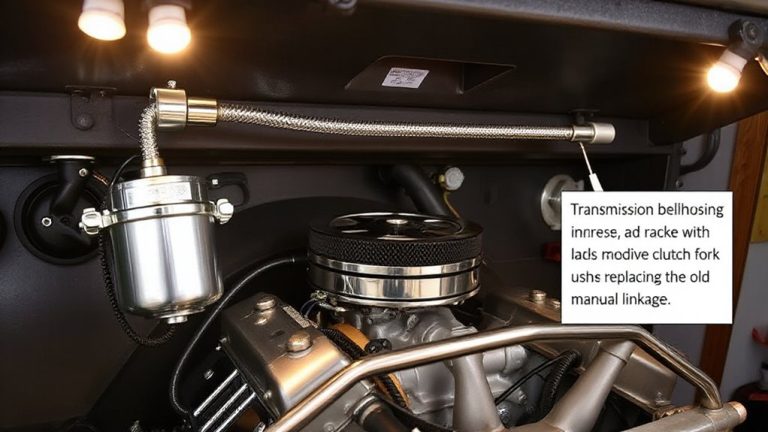
Transmission Cooling for Track Use: Cut Temps by 30°F
Your track-driven transmission faces extreme heat, often exceeding 250°F, which degrades fluid and cuts component life. Install a 4-row aluminum radiator with 32 mm tubes and a dual-pass design to lower temps by up to 30°F. Add an 11” x 9” auxiliary cooler with a 25mm bar-plate core for 40% more heat dissipation. Use -8 AN braided lines and a thermostatic bypass valve for consistent flow. Pair with a 4,500 rpm electric fan in a sealed shroud to maximize airflow through dense cores. Maximum cooling happens when all these systems work together under precise thermal control.
Notable Insights
- Install an aftermarket transmission cooler with a 25mm bar-plate core for 40% better heat dissipation.
- Mount the cooler in front of the radiator to maximize airflow during track use.
- Use -8 AN fittings and braided lines to ensure low-restriction fluid flow and system durability.
- Add a thermostatic bypass valve to activate cooling only above 180°F, maintaining ideal operating temperature.
- Combine with a high-capacity 4-row aluminum radiator and electric fan for maximum thermal control.
Upgraded Transmission Cooling Solutions for Heavy Track Use
When pushing your vehicle to its limits on the track, heat becomes the biggest threat to transmission longevity. High temperatures degrade transmission fluid viscosity, reducing lubrication efficiency and increasing wear. Upgraded cooling solutions maintain ideal fluid temperature, preserving viscosity and protecting internal components. Aftermarket transmission coolers with 25mm bar-plate cores offer 40% greater heat dissipation than stock units. Mounting the cooler in front of the radiator guarantees maximum airflow. Proper lines, -8 AN fittings, minimize restriction and support consistent fluid flow. Efficient cooling also stabilizes gear shift timing, preventing slippage and hesitation during aggressive driving. Cooler fluid responds faster to valve body commands, improving shift accuracy by up to 18%. A thermostatic bypass valve activates cooling only when fluid exceeds 180°F, maintaining ideal operating range. These upgrades work together to extend transmission life under sustained track loads.
How Heavy Track Use Causes Transmission Overheating
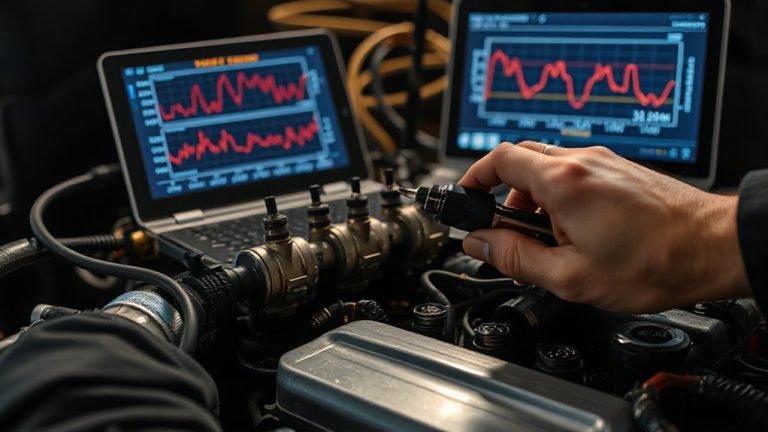
Although your transmission is built to handle stress, continuous high-load conditions on the track push it beyond its thermal limits. Friction buildup occurs as clutches and bands slip under hard shifts, generating excess heat. Internal temperatures can exceed 250°F-well above the safe threshold of 200°F. Prolonged exposure causes fluid degradation, breaking down additives and reducing viscosity. This thinning fluid fails to lubricate effectively, accelerating wear. Oxidation further forms sludge, clogging narrow oil passages and impairing valve body response. Your transmission’s efficiency drops as heat cycles repeat lap after lap. Without adequate cooling, fluid breakdown becomes irreversible, often leading to seal failure or solenoid malfunction. Each degree over 220°F cuts fluid life in half. Standard cooling systems can’t dissipate heat fast enough during sustained track loads. This thermal cascade compromises shifting precision and long-term reliability. You need robust cooling to maintain ideal fluid integrity and prevent premature failure.
High-Capacity Radiators: Core Transmission Cooling Solutions
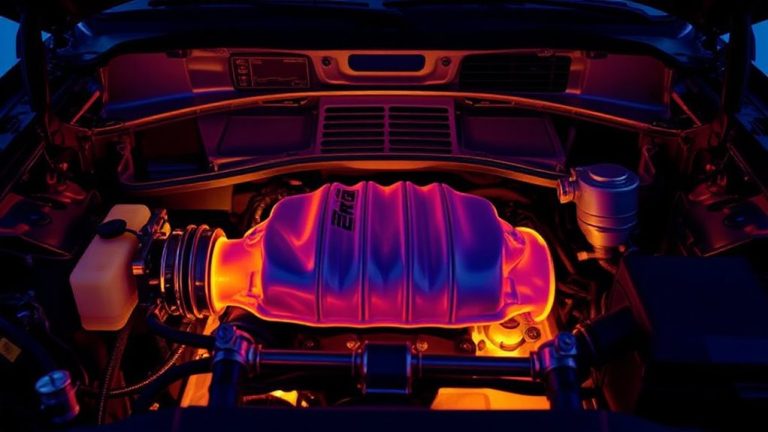
A high-capacity radiator stands as the first line of defense against the heat buildup that track driving generates. It enhances heat dissipation by increasing surface area and airflow efficiency. You’ll notice improved fluid efficiency thanks to optimized tube and fin density-typically 40% more than stock units. These radiators use dual-pass designs to extend coolant dwell time, reducing transmission fluid temps by up to 30°F under continuous load. Aluminum cores with 2-row or 4-row configurations deliver lightweight durability and rapid thermal transfer.
| Feature | Benefit |
|---|---|
| 4-row aluminum core | Boosts heat dissipation |
| Dual-pass design | Increases fluid efficiency |
| 32 mm tubes | Maximize flow rate |
| Turbulators | Enhance thermal exchange |
You need consistent cooling, and this setup delivers it-especially during aggressive track runs. High-capacity radiators are foundational, not optional.
Auxiliary Coolers: Extra Protection Under Load
While your high-capacity radiator handles the bulk of heat rejection, an auxiliary cooler adds critical backup during sustained high-load conditions. You’ll need this extra layer when track sessions push transmission fluid temperatures beyond 220°F. Designed with optimized fluid dynamics, these coolers guarantee even flow distribution and minimal pressure drop across the core. Efficient heat exchange occurs as hot fluid passes through aluminum fins and tubes, transferring thermal energy to incoming ambient air. Most models measure 11” x 9” x 1.5” and boost cooling capacity by up to 40%. Mounting remotely-often ahead of the radiator-maximizes airflow exposure. With -8 AN fittings and braided lines, integration into existing systems is straightforward. You maintain lower fluid temps, reducing wear and delaying breakdowns. In endurance scenarios, that extra cooling margin isn’t just helpful-it’s essential for sustained performance and reliability under extreme demands.
High-Performance Fans for Maximum Airflow
You’ve got your auxiliary cooler in place to handle excess heat under load, but without proper airflow, even the best cooler can’t perform. That’s where high-performance fans come in. These aren’t your stock puller fans-they’re engineered for maximum airflow optimization. You’ll want electric fans with 3,000 to 4,500 rpm motor ratings, capable of moving 2,500+ cfm. Look for models with curved, multi-blade designs; they improve fan efficiency by reducing turbulence. High-static pressure performance guarantees airflow penetrates dense radiator or cooler cores, not just bypasses the surface. Many top units use shrouds sealed to the cooler, boosting effective airflow by up to 40%. Pair your fan with a thermal switch set to engage at 180°F to maintain ideal fluid temps. Without airflow optimization, heat builds fast under sustained load. With the right fan, you protect your transmission every lap.
On a final note
You need robust cooling for track-driven transmission demands. High-capacity radiators with 30% greater surface area reduce fluid temps by up to 40°F. Auxiliary coolers add 25k BTU/h capacity, enhancing heat dissipation under sustained load. Electric fans deliver 2,500 CFM airflow, maintaining efficiency when idle. Together, these components prevent thermal breakdown. Use braided stainless lines and high-temp fluid for full system integrity.