Using Mass Airflow Sensors Designed for Larger Bore Throttle Bodies Post-Upgrade
You need a high-flow MAF sensor after installing a larger throttle body because factory units max out around 400 CFM and can’t accurately measure the 600–1200+ CFM airflow from big-bore systems. A mismatch causes incorrect fuel delivery, lean or rich conditions, and drivability issues. High-flow sensors like the Bosch 0280217174 or Granatelli MAFx support 700+ CFM and maintain signal accuracy. Proper placement, sealing, and ECU tuning are essential. The next steps reveal how to choose and calibrate the right setup for your upgrade.
Notable Insights
- Upgrade to a high-flow MAF sensor when installing a larger throttle body to maintain accurate airflow measurement.
- Select a MAF sensor rated for 600 CFM or higher to match increased airflow from big-bore throttle bodies.
- Ensure proper installation 6–10 inches upstream of the throttle body for stable airflow and accurate readings.
- Match MAF housing diameter to intake tubing to prevent turbulence and false air entry.
- Retune the ECU to align fuel maps with the new MAF sensor’s output for optimal performance.
Why a Bigger Throttle Body Needs a Matching MAF
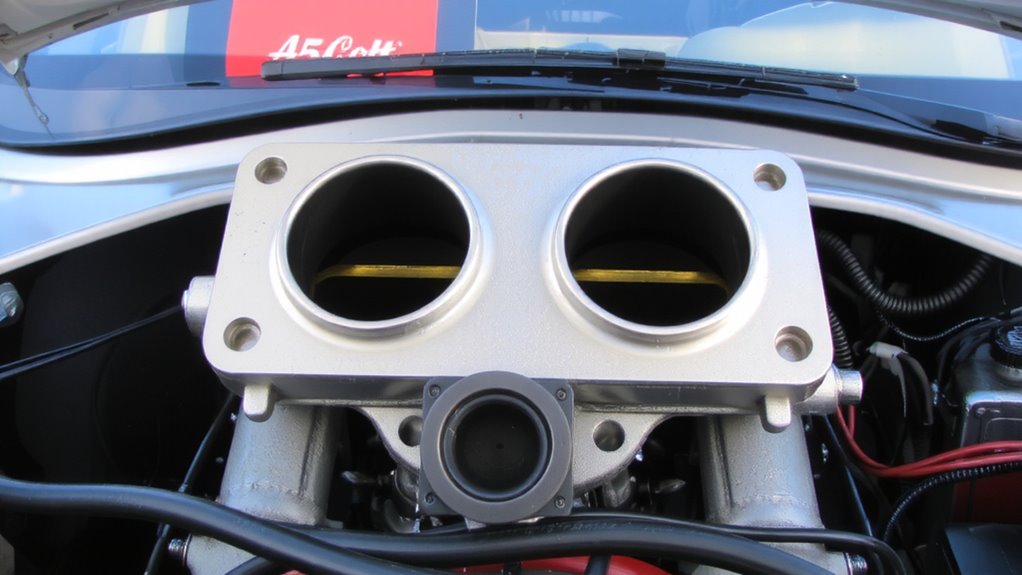
While increasing throttle body size lets more air into the engine, your factory mass airflow (MAF) sensor may not keep up. It’s calibrated for stock airflow volumes and can’t accurately measure higher intake rates. You’ll notice sluggish throttle response because the ECU receives incorrect airflow data. Air density changes further compound the error, especially at varying altitudes or temperatures. Without a matching high-flow MAF, your engine runs inefficiently. Aftermarket MAF sensors designed for larger throttle bodies support increased CFM ratings-often 20–30% higher-and feature recalibrated hot-wire elements. They maintain precise air/fuel ratios under load. You get linear signal output across the RPM range, improving drivability. Think of it like upgrading a water pipe but keeping the old flow meter-it just won’t read correctly. A matched MAF guarantees accurate metering, preserving performance gains.
How Big-Bore Throttle Bodies Affect MAF Readings and Fuel Delivery
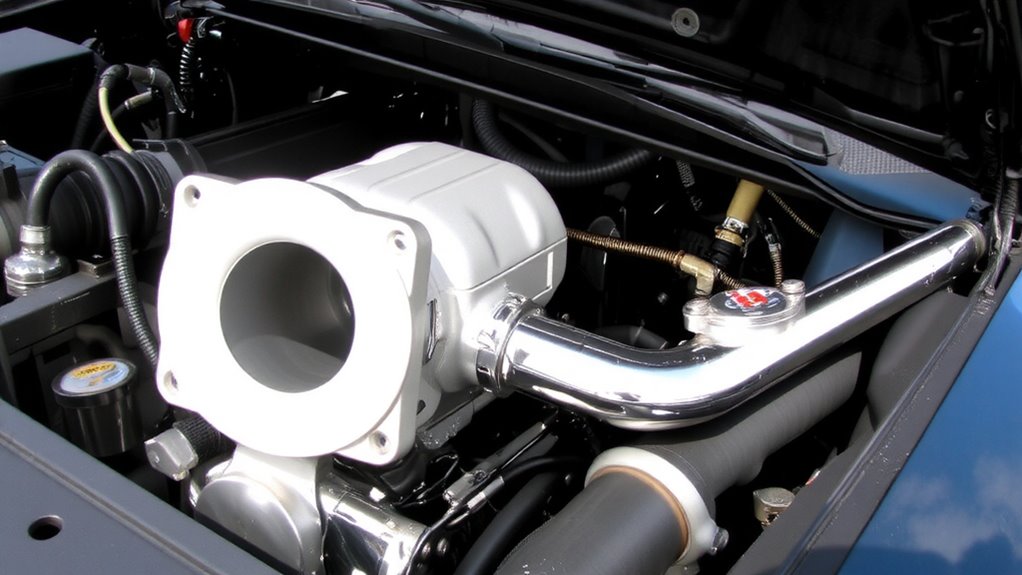
When you install a big-bore throttle body without updating the MAF sensor, airflow dynamics change in ways that disrupt fuel delivery. The larger opening reduces intake velocity, which affects how airflows through the sensor tube. Slower-moving air alters the cooling effect on the MAF’s hot wire, leading to inaccurate readings. Since the ECU relies on these signals to calculate fuel injection, errors result in poor air-fuel ratios. Even with unchanged air density, the reduced intake velocity skews mass airflow measurements because the sensor isn’t calibrated for the modified flow profile. This mismatch causes lean or rich conditions, especially at low RPMs where velocity differences are most pronounced. The engine may stumble, hesitate, or trigger check engine codes. Without correcting the MAF’s response to these new airflow characteristics, ideal combustion isn’t achievable. Fuel trims run extreme, hurting efficiency, power, and emissions.
Pick the Right High-Flow MAF Sensor
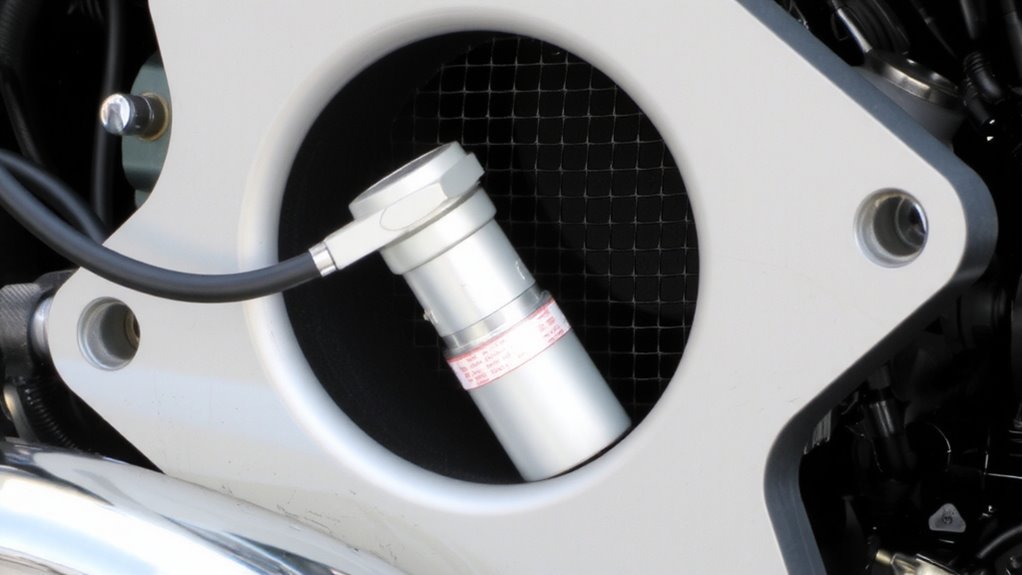
You can’t fix skewed airflow readings just by bolting on a bigger throttle body-it takes a high-flow MAF sensor tuned to match. You need a sensor calibrated for increased airflow dynamics, or your ECU will miscalculate fuel delivery. Standard MAF sensors max out around 400 CFM; high-flow units support 600 CFM or more, essential for larger bore throttle bodies. A mismatched sensor underreports airflow, causing lean conditions. Units like the Bosch 0280217174 or Granatelli MAFx handle elevated volumes with revised internal geometry and sensor calibration. They use larger sensing wires and optimized housings to maintain laminar airflow. Proper calibration guarantees voltage signals to the ECU scale accurately with airflow. Aftermarket sensors often include tuning files or adjustable outputs. Choose one matched to your throttle body size-typically 90mm+ systems need 700 CFM+. This guarantees precision across throttle shifts, idle stability, and peak load.
Signs Your MAF and Throttle Body Are Mismatched
How can you tell if your MAF sensor and throttle body aren’t playing well together? Idle instability is a key sign. Your engine may surge or drop RPMs unexpectedly at rest, especially with the AC on or during cold starts. This happens because the MAF can’t accurately measure reduced airflow at low throttle openings, leading to incorrect fuel trims. You’ll also notice hesitation under load-when you punch the throttle, there’s a delayed response or flat spot. That occurs because the MAF’s calibration doesn’t match the increased airflow volume of the larger throttle body. The sensor reads low, starving the engine of fuel when you need it most. These symptoms aren’t just annoying-they hurt performance and efficiency. A mismatch skews data sent to the ECU, disrupting the air-fuel balance critical for combustion.
Install Your MAF Sensor With a Big-Bore Throttle Body
Though airflow demands increase with a big-bore throttle body, the MAF sensor must still deliver precise readings to maintain peak engine function. Correct sensor placement guarantees undisturbed airflow measurement, typically 6–10 inches upstream from the throttle body. You’ll need a sensor housing matched to your intake diameter-common sizes are 3″ or 3.5″-to prevent turbulence or flow separation. A shielded, o-ring-sealed installation prevents false air entry, which skews readings. Mass airflow calibration must align with the increased volume; sensors rated for higher CFM (cubic feet per minute), like 1200+ CFM units, suit high-flow setups. Factory-style hot-wire sensors offer fast response but demand accurate calibration curves. Aftermarket MAFs from brands like Granatelli or DeatschWerks come pre-calibrated for big-bore applications, reducing guesswork. Secure all clamps and verify wiring continuity before startup.
Why ECU Tuning Is Required After MAF Upgrade
When upgrading to a larger mass airflow sensor, the engine’s air intake characteristics change substantially, requiring ECU tuning to maintain proper air-fuel ratios. Your vehicle’s ECU relies on precise data from the MAF sensor to calculate fuel delivery. Without retuning, you’ll likely experience sensor lag, where the signal doesn’t respond quickly to rapid throttle changes. This delay disrupts combustion efficiency and can cause hesitation or stumbles under acceleration. Signal drift may also occur, especially with aftermarket sensors, leading to inaccurate airflow readings over time. These errors result in rich or lean conditions that harm performance and emissions. Tuning recalibrates the ECU’s fuel maps to match the new sensor’s output curve. It guarantees real-time accuracy, optimizes throttle response, and safeguards engine longevity. Proper calibration is not optional-it’s essential for peak operation.
On a final note
You must match your MAF sensor to a larger throttle body to maintain accurate airflow measurement. A mismatch causes incorrect fuel delivery and lean or rich conditions. High-flow MAFs, like those rated for 1,200 cfm, guarantee signal accuracy with bore sizes up to 102 mm. Always recalibrate the ECU post-upgrade to interpret new airflow data correctly. Proper pairing guarantees peak AFR and power.