Verifying OEM Specification Compliance for Remanufactured Brake Rotors Purchased Online
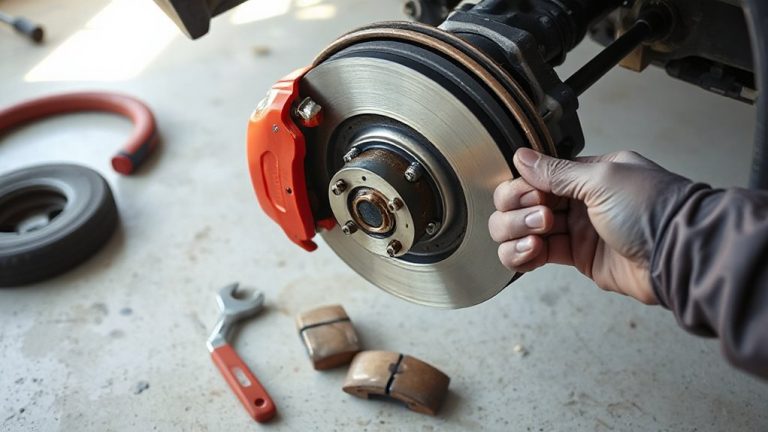
You must verify remanufactured brake rotors meet OEM thickness, lateral runout (within ±0.002 inches), and minimum specs. Confirm G3000 or G1000 gray iron composition via spectrographic analysis. Look for CNC-machined surfaces with 30–60 microinches RA finish and stamped OEM part numbers. Use your VIN to guarantee exact fitment. Products lacking ISO certification, test data, or clear tolerances risk performance. Meeting these standards guarantees reliable stopping power and durability under real-world conditions. More details follow on identifying compliant listings.
Notable Insights
- Confirm rotors meet OEM thickness, runout tolerance (within 0.002 inches), and minimum thickness specifications.
- Verify use of OEM-grade castings with spectrographic analysis for G3000/G1000 gray iron material composition.
- Check product pages for stamped identifiers, OEM-matching images, and detailed technical data like runout and flatness.
- Use VIN decoding to ensure exact fitment including diameter, bolt pattern, center bore, and ABS compatibility.
- Watch for red flags: unclear warranty, missing ISO certification, low pricing, or absence of OEM performance test data.
Why OEM Specs Matter for Remanufactured Brake Rotors
While it might seem cost-effective to overlook OEM specifications when remanufacturing brake rotors, doing so compromises safety and performance. You need safety assurance, which OEM compliance directly provides. Rotors machined to original thickness, runout, and metallurgical standards reduce brake fade and failure risks. Performance consistency depends on adhering to OEM-defined material composition and geometric tolerances-typically within 0.002 inches of lateral runout and minimum thickness specifications. Deviating from these values disrupts brake caliper alignment and pad contact, causing uneven wear. OEM blueprints specify exact vane count and airflow design to manage thermal dissipation, often rated for 600°F+ intermittent exposure. Without following these standards, rotor efficiency drops sharply. You’re not just restoring a part-you’re replicating engineered performance. Matching OEM specs guarantees every remanufactured rotor performs like new, cycle after cycle. For those seeking reliable replacements, selecting a top pick rotor set can ensure both quality and compliance with factory standards.
How to Verify Remanufactured Rotor Material and Build Quality
How can you be sure the remanufactured rotor you’re installing won’t fail under pressure? Start by evaluating core sourcing-reputable suppliers use only OEM-grade castings from reliable vehicle manufacturers. These cores undergo magnetic particle inspection to detect cracks or fatigue. The surface finish must meet OEM standards, typically between 30 and 60 microinches RA (roughness average), ensuring proper pad seating and braking efficiency. Inferior finishes lead to noise and uneven wear. Premium remanufacturers use CNC lathes for precision resurfacing, maintaining thickness within ±0.001 inches. Verify the supplier documents both core sourcing and surface finish metrics in product specs. Consistent metallurgical composition-usually G3000 or G1000 gray iron-is confirmed via spectrographic analysis. Skipping these checks risks rotor warping, reduced stopping power, or catastrophic failure. Don’t assume quality-demand proof. Top-performing brake rotors deliver reliable stopping power and durability under diverse driving conditions.
Check for OEM Compliance on the Product Page
OEM compliance isn’t something you should have to guess at. When checking the product page, look for explicit statements confirming the remanufactured rotor meets original equipment manufacturer specs. Verified listings will include detailed technical data like thickness, runout tolerance (typically ±0.0005 inches), and metallurgical composition matching OEM standards. Product images should clearly show stamped identifiers, part numbers, and surface finish quality. Examine high-resolution photos for consistency with OEM design, including vane configuration and mounting patterns. Don’t skip customer reviews-users often note fitment accuracy, noise issues, or premature wear that reveal non-compliance. Look for repeated mentions of “exact fit” or “OEM match” from verified buyers. Cross-reference listed specs with your vehicle’s factory service manual values. Reviews combined with clear product images give real-world validation beyond marketing claims. Always demand documented proof, not assumptions.
Use Your VIN to Confirm Exact Rotor Fitment
Why risk a mismatch when your vehicle’s safety depends on precision? Your VIN is the key to exact rotor fitment. By using vin decoding, you guarantee the remanufactured rotor matches your vehicle’s engineering specs-down to the millimeter. Manufacturers design rotors with specific dimensions: thickness, diameter, bolt pattern, and center bore all must align. Even a 0.5mm variance affects braking performance. Inputting your VIN into a trusted parts database pulls OEM-equivalent fitment data, eliminating guesswork. This process guarantees fitment accuracy, critical for maintaining brake balance and ABS functionality. Unlike generic part numbers, vin decoding accounts for model year, trim, and factory options. It’s like a fingerprint match for your brake system. Always confirm the rotor’s fitment guide accepts VIN validation. That extra step guarantees the rotor mounts flush, reduces vibration, and performs to original safety standards. Precision isn’t optional-it’s required.
OEM vs. Aftermarket: How Remanufactured Rotor Standards Compare
While aftermarket parts offer variety, remanufactured OEM rotors are engineered to meet the exact performance and safety benchmarks set by the original manufacturer. You can trust these rotors because they undergo rigorous performance testing to guarantee they match factory specifications. Each rotor is re-machined to precise dimensional tolerances-often within 0.002 inches flatness and 0.001 inches runout. Manufacturers apply durability benchmarking using accelerated wear cycles, simulating 50,000+ miles under load, heat, and moisture stress. This ensures consistent braking force, thermal conductivity, and resistance to warping. Aftermarket units may claim compatibility, but rarely match OEM-grade material composition or quality control. Remanufactured OEM rotors use the same cast iron alloy and internal cooling vane design as originals. You get proven structural integrity and fade-resistant performance. Performance testing confirms stopping distance remains within 3% of new rotor specs-critical for your safety.
Spotting OEM-Compliant Remanufactured Rotor Listings
When shopping online, you’ll need to look past marketing claims to confirm a remanufactured rotor truly meets OEM compliance. Look for listings that explicitly reference OEM specification adherence, including original equipment measurements like thickness, runout tolerance (typically under 0.002 inches), and weight. Verified rotor refurbishment processes restore structural integrity by re-machining damaged areas to factory specs. Surface refinishing must achieve a consistent 50–80 microinch finish to guarantee proper brake pad contact and reduce vibration. Check for documentation of quality control, such as runout testing or balancing reports. Listings citing ISO certification or partnerships with OEMs add credibility. Avoid vague phrases like “like new” without supporting data. Each rotor should list original part numbers and cross-references. Specificity in refurbishment standards, including material hardness (typically 180–210 HB), confirms reliability. Accurate surface refinishing guarantees OE-level stopping performance and wear resistance.
Red Flags: When to Avoid a Remanufactured Brake Rotor Deal
Ignoring warning signs in a remanufactured brake rotor listing can compromise your vehicle’s safety and performance. You should avoid deals with unclear warranty terms-reputable products offer at least a 12-month warranty covering warping and cracking. No warranty often means no accountability. Check the seller reputation: low ratings, few reviews, or reports of counterfeit parts suggest risk. Trust only sellers with verifiable OEM compliance data and consistent customer feedback. Rotors must match original specifications: a deviation over 0.05mm in thickness or runout exceeds safe limits. Poorly refinished surfaces often lead to brake vibration. If the price seems too good to be true, corners were likely cut. Always confirm material grade-verified cast iron with correct carbon content guarantees heat dissipation. Don’t gamble with parts critical to stopping power.
On a final note
You must verify OEM specifications before buying remanufactured brake rotors online. OEM compliance guarantees correct dimensions, material composition, and performance. Check for ISO 9001 certification and SAJ approval markings. Confirm rotor thickness matches factory specs-typically 24–32 mm. Use your VIN to validate fitment. Avoid listings without metallurgical reports or heat-treatment details. Precision matters-your braking distance depends on it.