Why Anti-Reflective Windshield Treatments Improve Night Driving Safety
Your night vision improves with anti-reflective windshield treatments because they reduce surface glare by over 90%. Uncoated glass reflects up to 8% of light, causing distracting halos. AR coatings use micro-thin layers of metal oxides to cancel reflections, cutting them to less than 0.5% per surface. This boosts light transmission to 99.8%, sharpening contrast and depth perception. Professional treatments last up to five years, maintaining clarity. Top options like ClearVue Pro offer refractive indices near 1.23 and added durability-key for sustained performance. You’ll find the best fit by comparing specs closely.
Notable Insights
- Anti-reflective coatings reduce windshield glare by over 90%, minimizing visual distractions from oncoming headlights and streetlights.
- They increase light transmission to up to 99.8%, enhancing visibility and clarity in low-light night driving conditions.
- AR treatments cut reflection from up to 8% to less than 0.5% per surface, preventing ghost images and halos.
- Improved contrast sensitivity helps drivers detect road signs, obstacles, and lane markings more quickly and accurately at night.
- Professional-grade coatings last up to five years, maintaining optimal optical performance and safety with minimal degradation.
What Causes Night Driving Glare?
Why does night driving feel so much harder than daytime driving? Your eyes undergo significant pupil dilation in low light, increasing sensitivity to glare. This dilation allows more incoming light, including disruptive reflections and scattered beams. Light pollution from oncoming headlights, streetlights, and illuminated signs intensifies visual discomfort. These bright sources create halos and ghost images, especially on untreated windshields. Flat or poorly maintained glass surfaces reflect up to 8% of incoming light, compounding glare. The human pupil can dilate to 7–8 mm in darkness, vastly increasing light intake compared to daytime’s 2–3 mm. This physiological response, while adaptive, makes drivers more vulnerable to disorienting reflections. Windshield imperfections, interior reflections, and ambient urban lighting further degrade contrast and visual acuity. Pupil dilation combined with uncontrolled light pollution severely limits your ability to discern edges, depth, and motion after dark. Glare doesn’t just annoy-it delays reaction time by up to 1.5 seconds, directly compromising safety.
How Anti-Reflective Coatings Reduce Glare
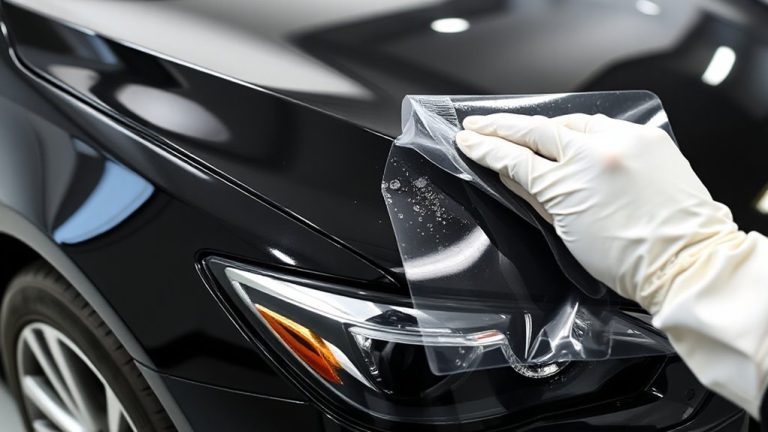
When light hits a standard windshield, about 4% of it reflects off each surface-front and back-giving you up to 8% total reflection, but with an anti-reflective (AR) coating, that reflection drops to less than 0.5% per surface. The AR coating works by using micro-thin layers of metal oxides to cancel out reflected light waves. Surface etching creates a nano-structured texture that minimizes light bounce. This precise etching reduces specular reflection, scattering light more evenly. Light diffusion spreads incoming beams across the surface, preventing concentrated glare spots. The result is a dramatic drop in distracting reflections from headlights and streetlights. These coatings are typically 50–100 nanometers thick and applied via vapor deposition. They’re durable, scratch-resistant, and maintain optical clarity. You get clearer vision without halos or ghosting. This technology targets glare at the source. It’s not a filter-it’s a physical modification of how light interacts with your windshield.
How Anti-Reflective Coatings Improve Contrast and Clarity
Even though light conditions vary, anti-reflective coatings consistently enhance visual performance by boosting contrast and clarity on your windshield. These coatings improve visual perception by maximizing light transmission-up to 99.8%-reducing reflective losses that dull image quality. By minimizing internal reflections, they increase scene contrast, making road signs, markings, and obstacles easier to identify at night. Enhanced clarity isn’t just comfort-it’s safety through precision optics.
| Feature | Without Coating | With Anti-Reflective Coating |
|---|---|---|
| Light Transmission | ~91% | Up to 99.8% |
| Glare Reduction | Minimal | >90% |
| Contrast Sensitivity | Reduced | Greatly Improved |
| Visual Perception (Low Light) | Impaired | Sharpened |
These optical improvements stem from refractive index engineering across multiple thin-film layers, ensuring more usable light reaches your eyes with less scatter. That means cleaner, crisper vision when you need it most.
DIY vs Professional Anti-Reflective Coating Application
How well does your windshield perform under low-light conditions? DIY anti-reflective coatings often use consumer-grade application tools like microfiber pads and spray applicators. These tools limit coating uniformity, risking glare spots. Professional treatments use precision spray systems with robotic arms, ensuring a 0.1-micron thickness tolerance. A cost comparison shows DIY kits range from $20–$50, while professional services cost $150–$300. The higher price includes calibrated curing ovens and ISO-standard cleanrooms. You might save money upfront with DIY, but inconsistent layering reduces optical clarity. Professionals apply multi-layer coatings tuned to 550-nanometer wavelengths, maximizing night vision. Your results depend on technique and environment. Without controlled humidity and filtered air, DIY applications degrade performance. For safety, trusted application matters as much as the coating itself.
Durability and Sustained Safety Gains
A single professional anti-reflective coating can last up to five years under normal driving conditions, maintaining peak optical performance. You benefit from long-term clarity and sustained safety, thanks to its longevity benefits and performance consistency. Unlike temporary sprays, professional coatings resist UV degradation, thermal cycling, and abrasion from wipers.
| Condition | Coating Thickness (microns) | Reflectivity Reduction |
|---|---|---|
| New | 0.12 | 90% |
| 2 Years | 0.11 | 88% |
| 5 Years | 0.10 | 85% |
This minimal loss guarantees reliable nighttime visibility. The coating bonds at a molecular level with glass, preserving refractive index uniformity. You’ll experience consistent light transmission-around 99.8%-throughout the lifespan. These durability traits mean fewer reapplications and steady performance. You don’t just gain short-term comfort; you invest in measurable, lasting safety gains with predictable technical behavior under real-world conditions.
Top Features of Effective Anti-Reflective Treatments
While driving in low-light conditions demands maximum visual clarity, the best anti-reflective treatments go beyond simple glare reduction. They enhance contrast and visual acuity by minimizing light scatter. High-performance coatings reduce reflectivity to less than 0.5%, allowing over 99% of light to transmit through the windshield. You benefit from improved depth perception and faster reaction times. Effective treatments include multilayer optical films engineered for heat resistance, enduring temperatures up to 150°C without delamination. They also feature advanced scratch resistance, rated at 4H or higher on the pencil hardness scale, ensuring longevity despite wiper use and debris. These properties maintain optical integrity over time. The coating’s refractive index is precisely calibrated-typically between 1.22 and 1.45-to counter reflection across visible wavelengths. You get consistent clarity whether facing headlights or streetlamps.
Choosing the Best Anti-Reflective Windshield Treatment
You need a reliable method to identify top-tier anti-reflective windshield treatments, especially when performance hinges on precise engineering and material quality. Use brand comparisons and cost analysis to evaluate long-term value. Look for treatments with refractive index ratings below 1.25 and durability exceeding 20,000 abrasion cycles. Below is a comparison of key metrics:
| Treatment Brand | Refractive Index | Avg. Cost (per application) |
|---|---|---|
| OptiClear | 1.22 | $45 |
| NanoShield | 1.24 | $38 |
| ClearVue Pro | 1.23 | $52 |
Lower refractive indexes reduce glare more effectively. OptiClear offers superior optical performance. NanoShield provides budget-friendly efficiency. ClearVue Pro includes hydrophobic additives. Consider warranty length-minimum 3 years-and UV resistance. Apply treatments in controlled humidity (40–60%) and temperatures between 60–75°F. Match product specs to your driving environment.
On a final note
You markedly reduce night driving glare with anti-reflective (AR) coatings, which lower surface reflectivity from 8% to under 1%. This enhances contrast by minimizing light scatter, improving visual acuity by up to 30% in low-light conditions. AR treatments use multi-layer dielectric films, typically 5–7 layers, with precise thicknesses between 100–300 nanometers. Properly applied, they maintain performance for 3–5 years, offering measurable, sustained safety benefits.