Choosing the Right Microfiber Material for Professional Detailing Results
Choose a microfiber towel with 300–400 GSM for balanced absorbency and scratch resistance. Opt for an 80% polyester, 20% polyamide split fiber blend to trap oils and dust efficiently. Use short pile (under 0.5 mm) for paint and glass to prevent swirls. Flat weave offers a lint-free finish; twill provides durability. Thermally sealed edges resist fraying. The right specs guarantee lasting, flawless results-discover how each feature enhances performance in specific detailing tasks.
Notable Insights
- Choose microfiber with 280–360 g/m² density for optimal absorption and scratch-free performance in professional detailing.
- Opt for an 80% polyester, 20% polyamide blend to ensure durability, static resistance, and superior dirt and oil trapping.
- Select twill weave for durability and high-density cleaning tasks, or flat weave for lint-free polishing on delicate surfaces.
- Use short pile microfiber (under 0.5 mm) for glass and paint to minimize friction and prevent swirl marks.
- Match GSM to the task: 300–400 for interiors and windows, 400–600 for drying, avoiding bulky towels over 600 GSM.
Why Microfiber Quality Matters in Professional Detailing
While you might think all microfiber towels perform the same, the truth is that quality directly impacts results in professional detailing. High fiber density-typically 280–360 grams per square meter-ensures superior absorption and scratch-free cleaning. Premium towels use split fibers at a ratio of 80% polyester to 20% polyamide, increasing surface area for trapping dust and oils. Poorly made towels shed lint and degrade quickly, compromising finish quality. Edge sealing is critical; folded and ultrasonically sealed edges prevent fraying and reduce microfiber pull during use. Thermally bonded borders last longer than stitched versions, maintaining integrity after hundreds of washes. A well-constructed towel retains softness and won’t scratch clear coats. Inferior materials compress under pressure, reducing effectiveness. Quality microfiber delivers consistent performance, essential for paint correction, glass, and interior surfaces. Your results depend on these details. Cut corners, and the finish shows it. For professionals, investing in a top-rated microfiber towel kit ensures access to multiple specialized towels designed for specific detailing tasks.
Choose the Right GSM for Every Detailing Job
The right GSM (grams per square meter) makes or breaks your detailing results. Low GSM microfibers, around 200–300, are lightweight and ideal for dusting or wax application. They’re less absorbent but reduce scratching on delicate surfaces. For general cleaning, 300–400 GSM offers a balanced gsm comparison-thicker, durable, and with improved absorbency levels. These handle interior wipe-downs and window cleaning efficiently. High-GSM towels, 400–600, deliver maximum absorbency levels, making them perfect for drying vehicles or soaking up spills. Their density traps more moisture, reducing the need for multiple passes. Anything above 600 GSM is bulky and may leave lint; it’s overkill for most detailing jobs. Always match the GSM to the task. Using the wrong weight reduces effectiveness and can damage surfaces. A proper gsm comparison guarantees peak performance, efficiency, and finish quality in every professional detailing job. Top-performing microfiber towels for car care combine optimal GSM with superior weave and fiber quality for flawless results.
Twill vs. Flat Weave: Best Microfiber for Cars
When it comes to drying or polishing your car’s finish, the weave of your microfiber cloth makes a critical difference in performance. Twill and flat weave are the two primary weave patterns used in automotive microfiber. Twill weave features a diagonal rib pattern, offering greater material density and durability. It’s ideal for frequent use and resists fraying over time. Flat weave has a simple crisscross structure, making it smoother and more lint-free-perfect for finishing and delicate surfaces. Both weaves can have similar GSM ratings, but twill typically holds up better under repeated washing. Material density affects absorption and scratch resistance; twill usually wins in toughness. Choose flat weave for final wipe-downs and clarity, twill for heavy-duty tasks. Your choice impacts results, longevity, and surface safety. Match the weave pattern to the job for best detailing performance.
Microfiber Blends: When to Use Poly for Detailing
Though microfiber cloths are primarily made from polyester and nylon, understanding the role of poly in the blend helps you pick the right tool for specific detailing jobs. High-polyester blends, typically 80% poly and 20% nylon, deliver superior poly durability, resisting wear during repeated use and washing. Poly fibers withstand abrasion better than nylon, maintaining cloth integrity over 300+ washes when cared for properly. These blends also offer excellent static resistance, reducing dust attraction during interior wiping or glass cleaning. Static resistance prevents particles from clinging, ensuring a cleaner surface finish. For tasks requiring lint-free results and long-term cloth life-like dashboard detailing or screen cleaning-poly-rich microfiber is ideal. The tighter the weave, measured in GSM (grams per square meter), the more effective the poly benefits. Choose 250–350 GSM poly-heavy cloths for balanced softness and performance. You’ll get reliability, efficiency, and fewer replacements over time.
Short vs. Long Pile: What Works on Paint and Glass
Why do some microfiber cloths feel smoother than others, and how does that affect your finish? The difference lies in pile height, fiber density, and weave pattern. Short pile microfiber, typically under 0.5 mm, offers a tight, flat weave pattern that increases fiber density. This structure excels on smooth surfaces like glass and cured paint, trapping fine dust without marring. It provides even pressure during wiping, ensuring consistent contact. Long pile fibers, over 1.0 mm, use a looser weave pattern and lower fiber density per square inch. They hold more moisture and lift larger debris, making them ideal for damp applications or heavily soiled surfaces. But on glass, they can leave streaks due to excess lint retention. For precision cleaning of paint and glass, short pile is more effective-offering superior control, less surface drag, and a scratch-free result when used properly. A high-quality car drying towel can make a significant difference in achieving a spot-free, streak-free finish.
Prevent Swirls: Best Microfiber for Car Paint
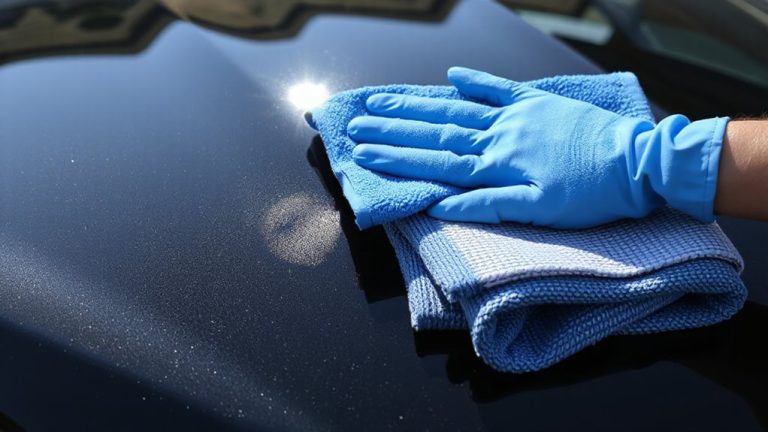
Short pile microfiber isn’t just ideal for glass-it’s your best defense against swirl marks on car paint. These towels typically have a nap height of 1–2 mm, minimizing surface contact and reducing friction that leads to marring. With a weight of 300–400 g/m², they balance softness and durability, offering superior scratch resistance compared to longer pile weaves. The tightly woven, split fibers-often 80% polyester, 20% polyamide-trap fine particles, preventing them from dragging across the paint surface. You’ll achieve safer wiping, especially when drying or applying paint protection products. High-quality short pile microfiber also resists fiber shedding and compaction, maintaining integrity over hundreds of washes. Use them for final wipe-downs, polish removal, or gloss enhancement. Their precision makes them ideal for maintaining protected finishes without compromise. Properly cared for, they preserve both your paint and your results.
Detailing Microfiber for Glass, Wheels, and Interior
When cleaning different surfaces on your car, you need the right microfiber towel for each job-using the wrong one can lead to streaks, scratches, or contamination. For glass finishing, use a 1600-series towel with a 70/30 polyester/nylon blend and 300 GSM. It traps fine particles without linting. Wheel cleaning demands durability and solvent resistance-choose a 2000-series towel with 80/20 blend and 360 GSM. It withstands brake dust and chemical cleaners. Never mix towels between zones to avoid cross-contamination.
| Task | Towel Series |
|---|---|
| Glass finishing | 1600 |
| Wheel cleaning | 2000 |
| Interior wipe | 1500 |
Use 1500-series for interior surfaces-soft enough for screens and leather. Each towel’s weave and weight are engineered for surface-specific performance.
On a final note
Choose the right microfiber based on GSM, weave, and pile. High-quality 300–400 GSM towels offer superior absorbency and durability. Twill weaves last longer; flat weaves are lint-free. Use 70/30 polyester-polyamide blends for precision cleaning. Short-pile microfibers prevent swirls on paint; long-pile grabs debris on interiors. Always match the fabric to the surface-glass, paint, or wheels-for flawless, scratch-free results.