How to Select Applicator Pads That Enhance Your Detailing Efforts
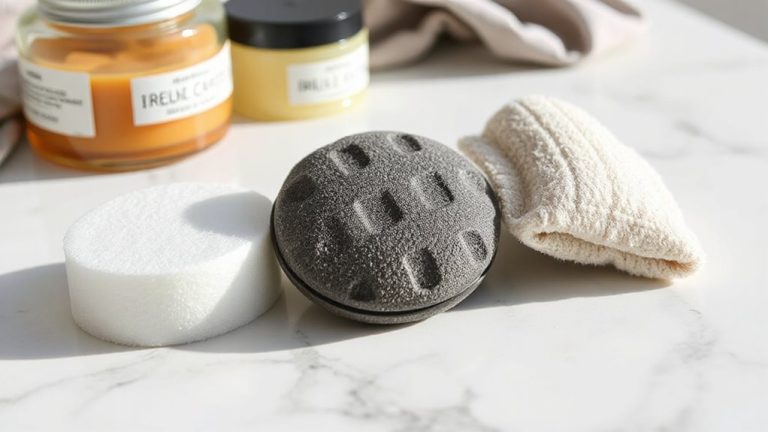
Choose foam pads for liquid waxes and ceramic coatings-they’re closed-cell, so they won’t absorb product. Use microfiber for thick compounds; its 50/50 polyester-polyamide blend delivers higher friction on smooth factory paint. Match density to task: soft (18–22 mm) for curves, firm (22–25 mm) for heavy correction. Pick 3-inch pads for trim, 6-inch for hoods. Seamless, laser-cut edges prevent marring. High-density foam and bonded backings boost pad life by up to 50%. There’s more to optimizing pad selection based on surface dynamics.
Notable Insights
- Match foam pads to liquids like waxes and coatings, and microfiber pads to thicker compounds for optimal friction and delivery.
- Choose microfiber with low denier count for smooth factory finishes, and open-cell foam for textured or hand-sanded surfaces.
- Select soft foam for delicate curves, medium density for sealants, and firm foam for aggressive polishing tasks.
- Use 3-inch pads for precision work in tight areas and 6-inch pads for faster coverage on large, flat panels.
- Opt for seamless, laser-cut pads with beveled edges to prevent marring and extend pad durability.
Start With the Right Applicator Pad for Your Product
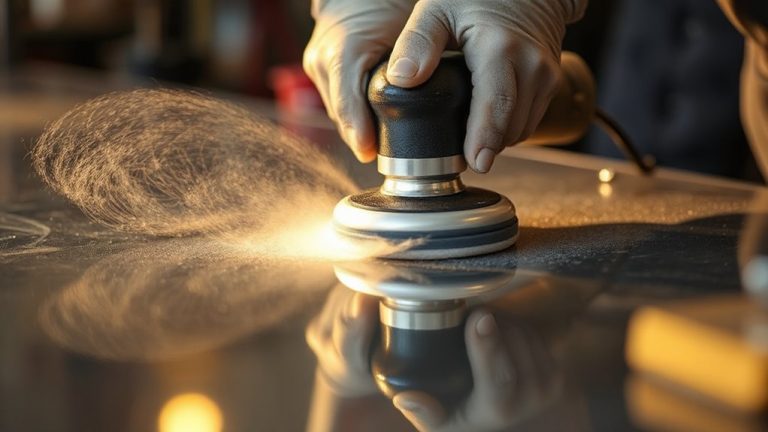
You’ll want to pick the right applicator pad based on the product you’re using-using the wrong type can lead to uneven coverage or product waste. Product compatibility directly affects performance. Foam pads work best with liquid waxes and ceramic coatings; their closed-cell structure holds viscosity-controlled formulas without absorption. Microfiber pads suit thicker compounds and polishes, offering higher friction for effective cutting. Your application technique must match both product and pad. Apply polish in 2-foot by 2-foot sections using overlapping, concentric circles at 1,200 to 1,800 orbital RPM. Too much pressure causes pad deformation and inconsistent spread. Pad thickness-typically 3/4 inch-guarantees even pressure distribution. Using the correct pad guarantees maximum product activation and minimum discard. Always clean used pads with a mild solvent solution to maintain cell integrity. Choosing correctly improves efficiency. For those on a tight budget, exploring best budget off-road vehicles can provide valuable insight into maximizing performance without overspending.
Match Applicator Pad Material to Your Car’s Surface
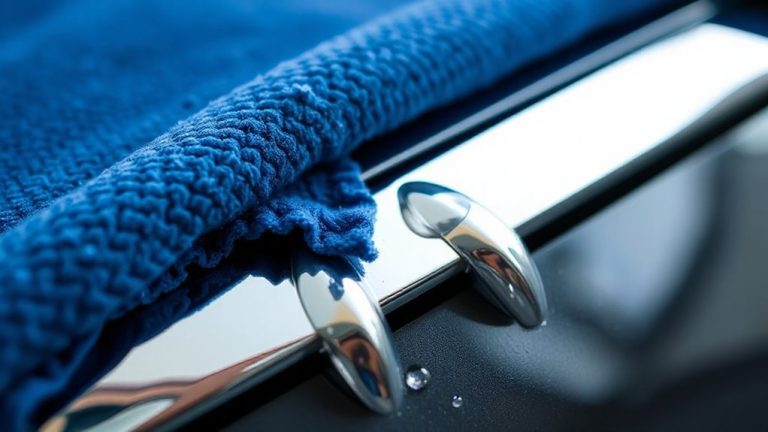
Choosing the correct applicator pad material isn’t just about the product you’re using-it’s also about your car’s surface. Surface texture directly affects material compatibility, so match the pad to your finish. For smooth, factory-level paint, microfiber pads with a 50/50 polyester-polyamide blend offer safe, even application. These 100% edge-dyed pads resist fraying and hold consistent shape under pressure. If dealing with hand-sanded or textured surfaces, use open-cell foam pads with a 1.8 lb/ft³ density rating-they conform better and prevent pooling. Avoid rough synthetics on soft clear coats; they can induce micro-marring. Instead, opt for low-abrasion, static-resistant microfiber with a denier count under 0.9. Material compatibility guarantees no residue transfer or surface damage. Always verify pad specs with paint manufacturer guidelines. A correct match enhances adhesion and finish uniformity. For interior leather care, using a dedicated car leather cleaner ensures optimal cleaning without compromising the material’s integrity.
Choose Applicator Pad Foam Density for the Task
When precision matters, the foam density of your applicator pad determines how evenly the product lays down and how well it adheres to surface contours. Soft foam pads, typically 18–22 mm thick, compress easily under light application pressure, conforming to curves and allowing controlled release of wax or cleaner. Medium-density foams, 20–24 mm thick, balance firmness and flexibility, ideal for glazes and sealants requiring moderate pressure. Firm foam pads, 22–25 mm thick, resist compression, enabling aggressive product transfer with high application pressure-perfect for heavy-duty polishes. Pad thickness and foam density directly influence contact surface area and shear force. Match low-density foams to delicate finishes and high-density foams to robust correction tasks. Choosing the correct foam density guarantees maximum product activation, reduces waste, and improves finish uniformity across varied substrates.
Pick the Right Applicator Pad Size for Coverage
A 3-inch pad covers tight areas with surgical precision, while a 6-inch pad cuts application time on large, flat surfaces. Pad shape directly impacts reach and conformity to contours-oval pads fit panel edges, while round pads offer uniform rotation. For hoods or roofs, a 5- to 6-inch pad boosts application speed by covering up to 30% more area per pass. Smaller 3- to 4-inch pads suit fenders, door jambs, and trim. Larger pads require less hand movement, reducing fatigue and improving consistency. Choose pad size based on surface geometry and access. A mismatched size leads to uneven coverage or overspray into unwanted zones. Match pad diameter to work zone: large for broad panels, small for detail zones. Application speed increases with proper size selection, ensuring even product distribution and fewer overlaps. A well-chosen wax applicator kit ensures compatibility between pad size, foam density, and your preferred wax or sealant type.
Avoid Scratches With Seamless Edge Pads
Smooth edges matter more than you think-seamless edge pads eliminate the ridges and micro-gaps found in traditional stitched or bonded pads, which are common culprits behind surface marring. Your priority for scratch prevention starts with advanced edge design. Seamless pads use ultrasonic welding or precision die-cutting, creating a continuous foam or microfiber edge that glides without catching. Unlike stitched edges, which can fray or create raised seams over 1.5 mm high, seamless versions stay flush and consistent. This reduces the chance of microscopic scratches during application. A clean, rounded edge profile-typically beveled at 30 to 45 degrees-ensures smooth contact across curved surfaces. High-quality seamless pads maintain structural integrity after 50+ uses, minimizing debris shedding. Edge design isn’t just cosmetic; it’s functional engineering that protects your finish. Choose seamless for reliable scratch prevention every time.
Choose Microfiber or Foam for Best Applicator Pad Performance
Most top-tier applicator pads rely on either microfiber or foam-your choice directly impacts performance, finish quality, and chemical compatibility. Microfiber pads offer superior pad absorbency, holding liquid polishes and sealants evenly for consistent spreadability. Their tightly woven fibers provide excellent material softness, minimizing swirl risk on delicate clear coats. These pads typically measure 7–9mm thick, with densities around 240–320 g/m² for balanced firmness and cushion. Foam pads, conversely, range from medium to high firmness (18–25 PSI) and suit heavier cutting jobs. Their open-cell structure enhances pad absorbency for water-based products but may require more frequent reloading with oils or waxes. Foam delivers reliable material softness too, especially polyurethane blends rated at 1.5–2.0 N/mm compression force. Choose microfiber for finesse work and high-slickness finishes; pick foam for aggressive leveling where precision control matters.
Pick Durable Applicator Pads That Last Longer
Durability in applicator pads hinges on material integrity and construction quality-choosing the right one saves money and boosts performance over time. Pad longevity depends on high-density foam or tightly woven microfiber that resists fraying and compression. Look for pads with edge sealing or bonded backings; these prevent delamination during repeated use and washing. Material resilience guarantees the pad maintains shape after exposure to waxes, sealants, and claying agents. High-quality foam pads typically measure 18–22mm thick with a Shore 00 hardness of 25–30, balancing firmness and flexibility. Microfiber variants should have a pile height of 3–5mm and a weight of at least 300g/m² for maximum durability. These specs support consistent product distribution and reduce shedding. Pads built with industrial-grade adhesives and laser-cut edges last up to 50% longer. Prioritize construction details-you’ll extend service life and maintain finish quality across multiple detailing jobs.
On a final note
Choose the right applicator pad to maximize product efficiency and surface safety. Foam density-typically 80–120 PPI-determines aggressiveness; use medium-density (100 PPI) for balanced spread and absorption. Seamless-edge pads prevent micro-scratches during gliding passes. Microfiber pads offer superior liquid retention (0.5–0.7 mL/cm²) for sealants, while open-cell foam suits waxes. Select 3”–5” diameters for control on contours. Durable pads with bonded backing last 15+ uses, reducing long-term cost.