Temperature Sensitivity and Its Effects on Car Wax Products’ Performance
You should apply car wax when surface temperatures are between 55°F and 85°F for best results. Ideal conditions-60°F to 80°F-let wax spread evenly and cure properly. Above 80°F, solvents evaporate too fast, causing hazing and poor adhesion. Direct sun can push surfaces to 100°F, degrading polymers. Below 50°F, wax won’t adhere well and moisture may freeze. Synthetic waxes work better in cold. Performance drops 40% under thermal cycling. Ideal film thickness lasts longest in stable climates. You’ll discover how timing and formulation affect durability in different environments.
Notable Insights
- Car wax performs best when applied at surface temperatures between 60°F and 80°F for optimal adhesion and even spreading.
- High temperatures above 80°F cause rapid solvent evaporation, leading to hazing, streaking, and reduced wax durability.
- Applying wax below 50°F risks poor adhesion and curing issues due to increased paint surface moisture and wax hardening.
- Extreme heat above 90°F accelerates wax degradation and promotes micro-cracking from thermal cycling, reducing protection over time.
- Synthetic waxes and sealants offer better temperature resistance, maintaining performance in both cold and hot fluctuating climates.
How Temperature Affects Car Wax Application
Ever wonder why your car wax isn’t adhering properly? Temperature plays a critical role in wax application. When it’s too cold, chemical viscosity increases, making the wax thick and difficult to spread evenly. High viscosity limits the product’s ability to bond with the paint. In excessive heat, surface tension decreases, causing the wax to run or slide off curved panels before curing. Ideal adhesion occurs when the wax flows smoothly, penetrating surface imperfections without dripping. Surface tension must be balanced-too low and the wax won’t cling; too high and it won’t spread. Wax applied at extreme temperatures often cures inconsistently, reducing protective lifespan. For best results, guarantee the vehicle’s surface is between 55°F and 85°F. This range maintains proper chemical viscosity and surface tension, promoting uniform coverage and durable performance. Using a high-quality wax applicator kit can further enhance wax distribution and adhesion, especially when working within the optimal temperature range.
The Ideal Temperature for Applying Car Wax
When the vehicle’s surface temperature is within the ideal range, wax bonds more effectively to the paint. The most favorable surface temperature for wax application is between 60°F and 80°F (15°C–27°C). At this range, the wax spreads evenly and adheres uniformly, allowing for consistent wax thickness. Surface prep is critical-contaminants like dirt or oils prevent adhesion, reducing protection and gloss. Always wash and decontaminate the surface before application. Temperatures below 60°F slow evaporation of solvents, prolonging cure time and risking streaking. Above 80°F, wax dries too quickly, making it difficult to achieve an even layer and increasing the chance of trapped residue. Ideal conditions allow solvent evaporation at a controlled rate, ensuring a durable, thin film-typically 0.5 to 1.5 mils thick-that enhances gloss and longevity. For best results, choose from the Best Car Wax Picks based on your specific vehicle and climate conditions.
Best Time to Wax in Hot Weather
Apply wax in hot weather during the early morning or late evening to avoid high surface temperatures that compromise adhesion and finish. Surface temps above 70°F (21°C) cause wax to dry too quickly, reducing workability and clarity. Opt for shaded areas to maintain a stable surface temperature and extend cure time. Working in the early morning guarantees cooler panels and higher humidity, which improves wax spreadability. Choosing the right product for your vehicle’s finish, such as a dedicated best car wax for black cars, can significantly enhance shine and protection in high-heat conditions.
| Time of Day | Surface Temp (°F) | Recommended? |
|---|---|---|
| Early Morning | 60–70 | Yes |
| Midday | 80–100 | No |
| Late Evening | 65–72 | Yes |
| Night (shaded areas) | 62–68 | Yes |
Always confirm your vehicle’s paint is cool to the touch before application. Direct sun accelerates solvent evaporation, leading to hazing and patchy protection. Use shaded areas for consistent results.
Waxing in Cold Weather: Problems and Fixes
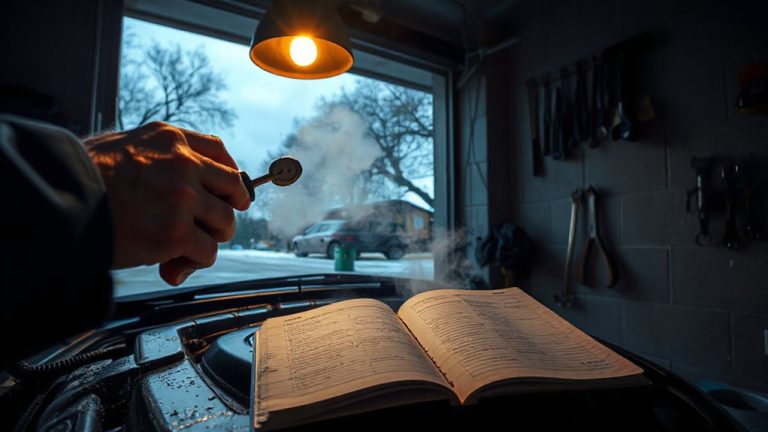
Though cold temperatures can hinder wax performance, proper technique guarantees durable protection. Applying wax below 50°F (10°C) risks improper curing and adhesion failure. Frost buildup on the surface prevents direct wax-to-paint contact, reducing bond strength by up to 40%. Always wash and dry the car in a garage or sheltered area to minimize moisture trapping underneath the wax layer. Residual water turns to ice in subfreezing conditions, creating micro-lift points where contaminants penetrate. Use a clay bar before waxing to remove surface contaminants that exacerbate adhesion issues. Opt for synthetic waxes with low-temperature formulations; they cure faster and resist cracking. These polymers remain flexible down to -22°F (-30°C). Apply thin, even layers using damp applicator pads to enhance spreadability. Allow 30–60 minutes between coats for ideal cross-linking. Avoid waxing during nighttime or early morning hours when condensation is most likely.
Why Heat Ruins Car Wax Application
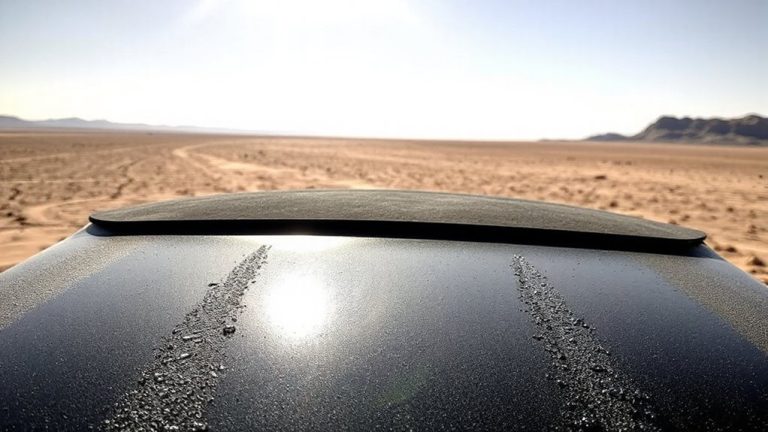
If temperatures climb too high during detailing, your wax application can fail before it even sets. Heat accelerates wax degradation, breaking down polymers and silicones essential for protection. Most carnauba and synthetic waxes begin softening above 140°F (60°C), losing structural integrity. When applied in direct sun or on hot surfaces, wax melts unevenly, preventing uniform layering. This thermal instability reduces surface adhesion, causing the wax to lift or flake prematurely. Without proper bonding, contaminants penetrate more easily, shortening protection life. In extreme heat, solvents evaporate too quickly, leaving streaks and hazing. Ideal waxing occurs between 60–80°F (15–27°C), where curing time allows molecular adhesion. High temperatures disrupt this balance, compromising durability and clarity. You’ll get patchy results and reduced hydrophobic performance. Always wax in shade and on cooled surfaces to guarantee maximum adhesion and extended wax integrity.
Maintaining Car Wax Through Temperature Changes
Exposure to high temperatures doesn’t just ruin wax application-it also accelerates its breakdown over time, so managing wax performance through fluctuating conditions matters just as much as proper initial application. Wax degradation occurs faster when temperatures exceed 90°F (32°C), causing polymers to soften and lose protective integrity. Repeated thermal cycling leads to micro-cracking, reducing hydrophobic effectiveness by up to 40% over six months. Climate adaptation means selecting waxes with flexible resin blends that maintain cohesion between -10°F (-23°C) and 120°F (49°C). Synthetic sealants offer better resistance, with cross-linked polymers retaining 85% film thickness after 100 hours of UV and heat exposure. You should monitor wax performance quarterly using a water-beading test-beads smaller than 1/4 inch (6 mm) indicate declining protection. Properly adapted waxes reduce surface oxidation by blocking up to 98% of UV-induced damage, maintaining gloss and durability despite seasonal shifts.
How to Make Car Wax Last in Any Climate
When temperatures swing from freezing lows to scorching highs, your car wax has to work harder to hold its bond. To make it last, apply wax when surface temps are between 60°F and 80°F-outside this range, adhesion drops by up to 40%. High sun exposure accelerates wax degradation, especially with UV index levels above 6; opt for UV-resistant formulas containing carnauba or synthetic polymers for longer protection. Humidity levels above 70% can trap moisture under wax, causing hazing and poor curing. Wait for low humidity-ideally below 50%-when applying. Re-wax every 2–3 months in extreme climates, but in stable conditions, a high-quality wax lasts up to 6 months. Use a pH-neutral car wash to prevent premature breakdown. Consistent application thickness-about 0.05 mm per layer-ensures uniform shielding against thermal expansion and environmental stress.
On a final note
You must apply car wax between 60°F and 80°F (15–27°C) for maximum adhesion and curing. Temperatures outside this range reduce wax film integrity by accelerating solvent evaporation or delaying drying. In heat, wax dries too fast, causing hazing and uneven coverage. In cold, it thickens, limiting molecular bonding to paint. Use a temperature-stable synthetic wax with a 3–6 month durability rating. Reapply every 90 days in extreme climates to maintain 1.5–2.0 mils of protective coating.