A Guide to Selecting Solvents Based on Their Application Requirements
Choose a solvent that matches your solute’s polarity-use nonpolar solvents like hexane (dielectric constant ~2) for nonpolar compounds, and polar solvents like water (~80) for ionic or polar substances. Prioritize low-toxicity options like ethanol or isopropanol (OSHA PEL 200 ppm) to reduce health risks. Guarantee the boiling point exceeds your application temperature-toluene (110.6°C) works for heat, but diethyl ether (34.6°C) doesn’t. Match evaporation rates to your process speed and confirm compatibility with materials like PTFE or stainless steel. Environmental and lifecycle costs matter just as much as performance-especially when scaling up.
Notable Insights
- Match solvent polarity to solute polarity using the “like dissolves like” principle for effective dissolution.
- Ensure solvent boiling point exceeds process temperature to prevent premature evaporation.
- Select low-toxicity, low-VOC solvents like water or ethanol to enhance safety and regulatory compliance.
- Align solvent evaporation rate with process conditions to avoid defects in coating or drying steps.
- Verify compatibility with system materials such as seals, tubing, and tanks to prevent degradation or failure.
Pick the Right Solvent for Your Application
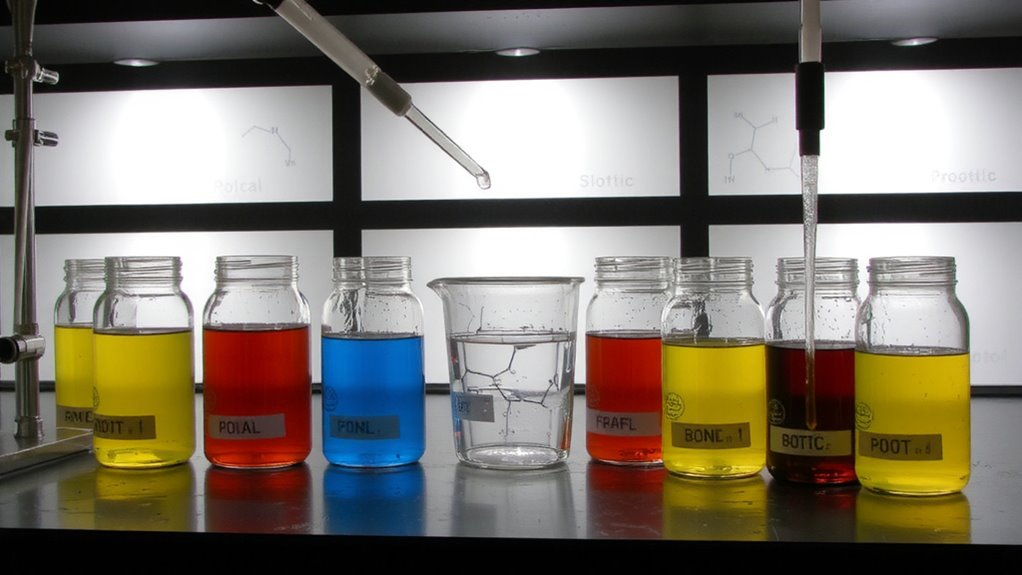
What makes one solvent better than another for your specific task? It boils down to matching solvent purity and application temperature to your process requirements. You need high solvent purity-typically 99.9% or greater-when working with sensitive reactions or analytical instruments. Impurities can interfere with results or degrade materials. Application temperature is equally critical. For instance, if your process runs at 80°C, the solvent must remain stable and not evaporate prematurely. Diethyl ether, with a boiling point of 34.6°C, would fail here, while toluene, boiling at 110.6°C, might be ideal. Always check thermal stability data. A solvent that performs well at room temperature may decompose or react undesirably at elevated temperatures. Selecting based on these two factors guarantees efficiency, safety, and reproducibility in any industrial or lab setting.
Use Polarity to Match Solvent and Solute
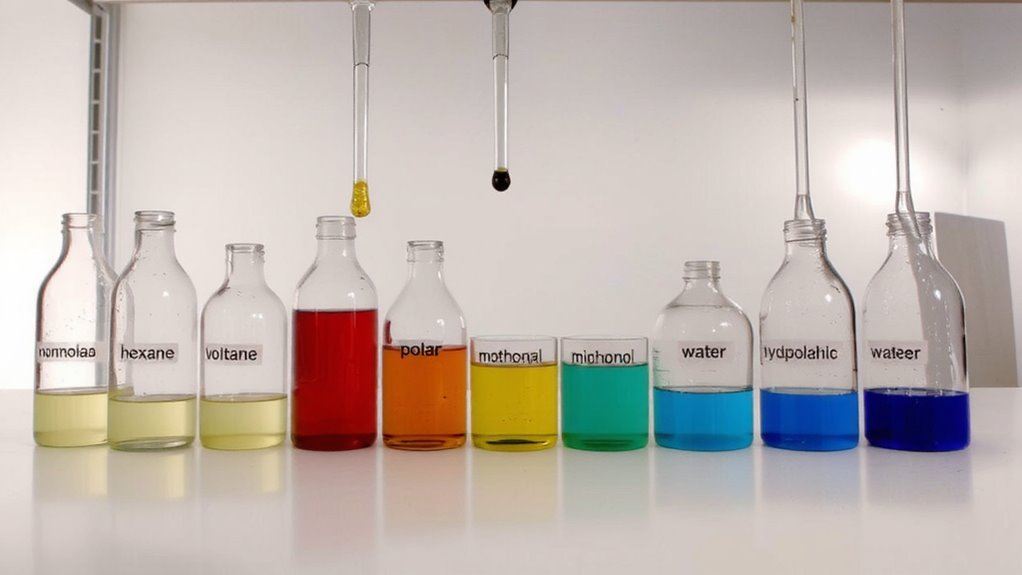
When choosing a solvent, aligning polarity between the solvent and solute is key to achieving effective dissolution. You need solvent polarity to closely match the polarity of your solute for ideal solute compatibility. Nonpolar solutes, like hydrocarbons, dissolve best in nonpolar solvents such as hexane or toluene. Conversely, polar solutes-like sugars or ionic salts-require polar solvents such as water or methanol. This “like dissolves like” principle guarantees strong intermolecular interactions. Dielectric constant values help quantify solvent polarity; water has a high dielectric constant of ~80, making it ideal for charged species, while hexane’s value of ~2 makes it suitable for nonpolar systems. Mismatched polarity leads to incomplete dissolution and inefficient processing. You’ll achieve better reaction yields, extraction efficiency, and product purity by matching solvent polarity with your solute’s chemical nature.
Choose Safer Solvents First
Though safety shouldn’t take a backseat to performance, you’re better off starting with safer solvents whenever possible. Prioritizing low solvent toxicity reduces health risks and simplifies ventilation needs. Solvents like water, ethanol, or isopropanol have favorable safety profiles compared to chlorinated or benzene-based alternatives. You’ll also improve regulatory compliance, avoiding strict handling requirements tied to carcinogens or volatile organic compounds (VOCs). Agencies like OSHA and EPA set exposure limits-such as a PEL of 200 ppm for isopropanol-meant to minimize respiratory and dermal hazards. Choosing solvents with high LD50 values, low vapor pressure, and minimal environmental persistence supports both worker safety and legal adherence. Even if a solvent performs slightly slower, its operational safety and reduced monitoring burden often justify selection. Safer solvents lower insurance costs, reduce training complexity, and minimize incident response needs-all critical in industrial settings where risk mitigation is essential.
Match Evaporation Rate to Your Process
You’ve already made smart choices by selecting safer solvents like water, ethanol, or isopropanol-now fine-tune your selection by aligning evaporation rate with your process needs. Evaporation speed directly affects drying time, impacting efficiency and finish quality. Water has a low evaporation speed-0.3 (diethyl ether = 1.0)-resulting in longer drying time, ideal for applications needing extended workability. Ethanol evaporates faster (relative rate: 1.8), reducing drying time for high-throughput operations. Isopropanol sits at 1.5, offering a balance between control and speed. Fast evaporation can cause issues like bubbling or uneven drying if your process isn’t automated and enclosed. Match solvent volatility to line speed and ambient conditions. For instance, use isopropanol for wipe-downs requiring rapid drying. Choose water-based systems when slower drying time improves coverage. Always validate evaporation speed under real-world conditions to optimize performance.
Avoid Damage to Materials and Equipment
A solvent’s compatibility with materials and equipment is critical to maintaining performance and longevity. You must assess material compatibility before selecting a solvent, as aggressive chemicals can degrade seals, gaskets, and hoses. For instance, chlorinated solvents may attack polycarbonate or acrylic components, leading to cracks or failure. Non-polar solvents like toluene can swell certain elastomers, compromising equipment safety. Always check solvent resistance charts for common engineering materials-nitrile rubber resists aliphatic hydrocarbons but not strong acids, while PTFE handles most solvents. Stainless steel and glass are generally safe, but aluminum may corrode with caustic solvents. Confirm exposure limits and temperature ranges; prolonged contact increases risk. A solvent that’s chemically unsuitable can cause leaks, contamination, or breakdowns. Prioritizing material compatibility isn’t optional-it protects your systems. Proper selection prevents costly repairs and downtime.
Weigh Environmental and Cost Tradeoffs
Selecting a solvent isn’t just about performance-it’s about balancing environmental impact and cost. You must consider solvent toxicity, as highly toxic options pose health risks and increase disposal costs. Solvents with low volatile organic compound (VOC) content, like water-based solutions, reduce air pollution and improve regulatory compliance. Non-halogenated solvents often meet EPA and REACH standards more easily than chlorinated alternatives. You’ll also face cost tradeoffs: while ethanol is biodegradable and low-toxicity, it may require special handling due to flammability. In contrast, acetone is affordable and effective but has higher VOC emissions. Always assess lifecycle costs, including storage, safety controls, and waste treatment. Regulatory compliance isn’t optional-violations lead to fines and shutdowns. Choose solvents that align with your facility’s environmental goals and operational budget without compromising safety or performance.
On a final note
You now know how to select the right solvent. Match polarity to solute for effective dissolution-nonpolar solvents like hexane dissolve oils; polar solvents like water dissolve salts. Choose low-toxicity options like isopropanol when possible. Control evaporation with boiling points: diethyl ether (34.6°C) dries fast; ethylene glycol (197°C) remains stable. Avoid solvents that degrade seals or plastics. Always balance environmental impact, cost, and performance.