Understanding Plastic and Rubber Deterioration Factors and Their Mitigation Techniques
You’re seeing plastic and rubber degrade because UV light breaks C–C bonds, heat accelerates chain scission, and oxygen or ozone causes cracking-especially in unsaturated rubbers. Nitrile loses 40% strength from chemical exposure; polypropylene drops 50% in impact resistance after 1,000 UV hours. Stabilizers like hindered phenols slow breakdown. EPDM resists ozone; proper material selection based on environment extends life markedly. There’s a systematic way to predict and prevent these failures.
Notable Insights
- Chemical exposure degrades polymers by weakening molecular chains, reducing tensile strength and accelerating material failure in plastics like nitrile and polypropylene.
- UV radiation causes bond breakage in plastics through photolysis, leading to chain scission, embrittlement, and significant loss of impact strength over time.
- Thermal aging accelerates rubber degradation by increasing molecular motion, with every 10°C rise doubling degradation rates beyond service temperature limits.
- Oxidative and ozone exposure causes rubber hardening, microcracking, and loss of elasticity, especially in unsaturated rubbers under strain.
- Hydrolysis breaks down polymers like nylon and PET in moist environments, reducing mechanical properties, while stabilizers help mitigate degradation.
What Causes Plastic and Rubber to Degrade?
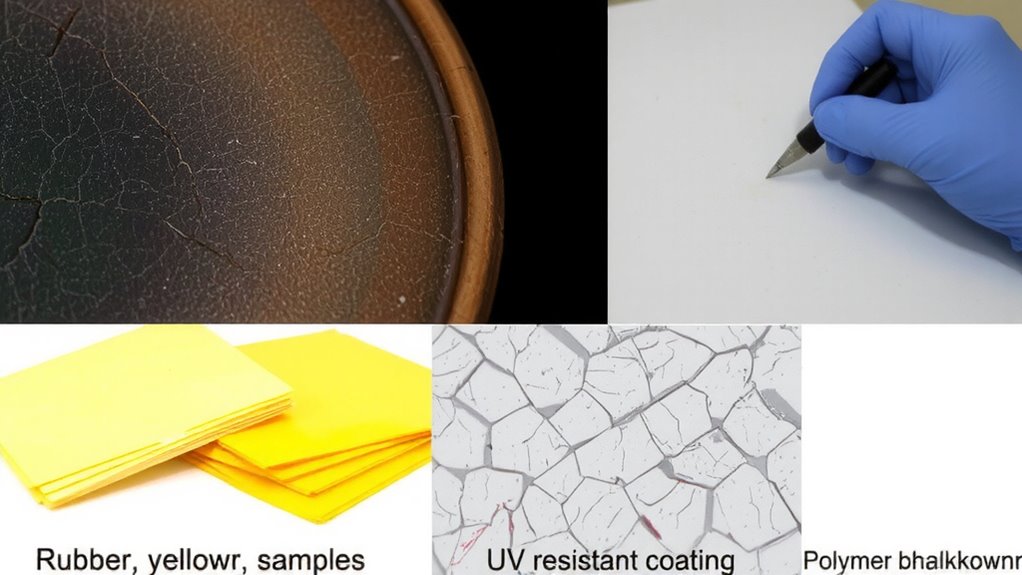
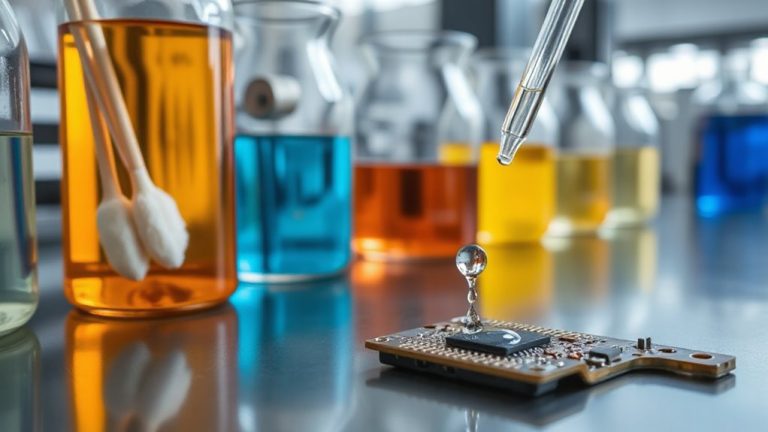
While you might expect plastic and rubber to last indefinitely, they actually break down over time due to environmental and chemical factors. Chemical exposure weakens polymer chains, especially in materials like nitrile or polypropylene, which degrade when in contact with oils, solvents, or acids. These reactions reduce tensile strength by up to 40% over six months under continuous exposure. Mechanical stress accelerates this breakdown. Repeated flexing, compression, or vibration causes microcracks, particularly in rubber seals or plastic housings. A seal subjected to 10,000 compression cycles at 5 MPa can lose 25% elasticity. Temperature fluctuations exacerbate both factors, increasing molecular mobility and reaction rates. Combined, chemical exposure and mechanical stress lead to embrittlement, swelling, or cracking. Material selection, protective coatings, and stress-relief designs mitigate these effects. Understanding degradation mechanisms helps extend product life in demanding environments.
Why UV Light Breaks Down Plastics
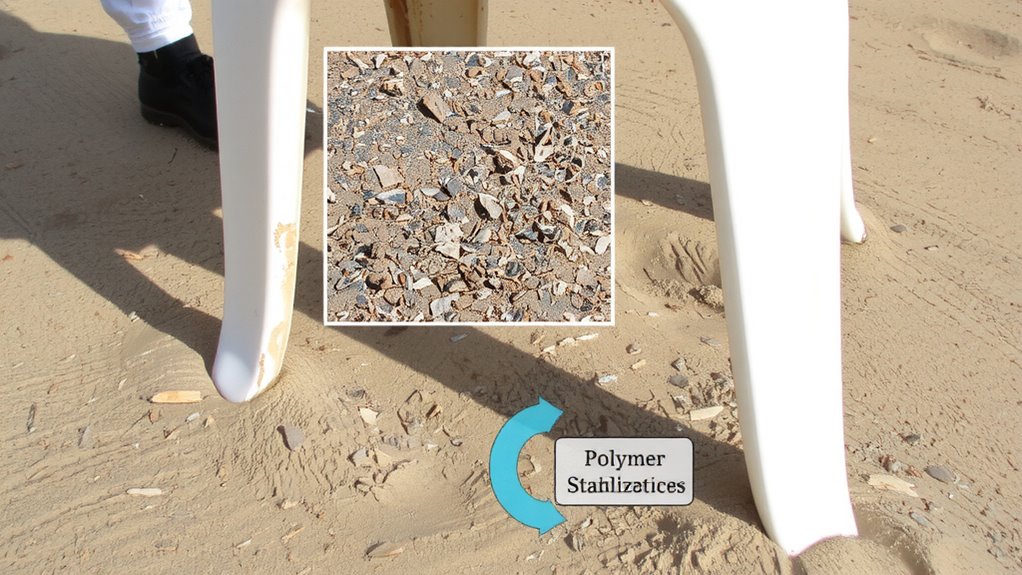
What makes sunlight so destructive to plastic over time? It’s UV absorption. When plastics absorb ultraviolet radiation, molecular bonds weaken and break. You see, most polymers aren’t designed to handle high-energy UV photons. These photons trigger photolysis effects-direct chemical bond cleavage-especially in bonds like C–H and C–C. That leads to chain scission, reducing tensile strength and embrittling the material. For instance, polypropylene loses up to 50% of its impact strength after 1,000 hours of UV exposure. UV absorption often starts at impurities or catalyst residues, accelerating degradation. The damage isn’t just surface deep; it penetrates microns into the material, propagating cracks. Without stabilizers like UV absorbers or hindered amine light stabilizers (HALS), photolysis effects progress unchecked. Even indirect sunlight through windows can cause measurable degradation over months. So, when you leave plastic outdoors, you’re effectively running a slow, invisible chemical attack on its structure.
How Heat Speeds Up Rubber Deterioration
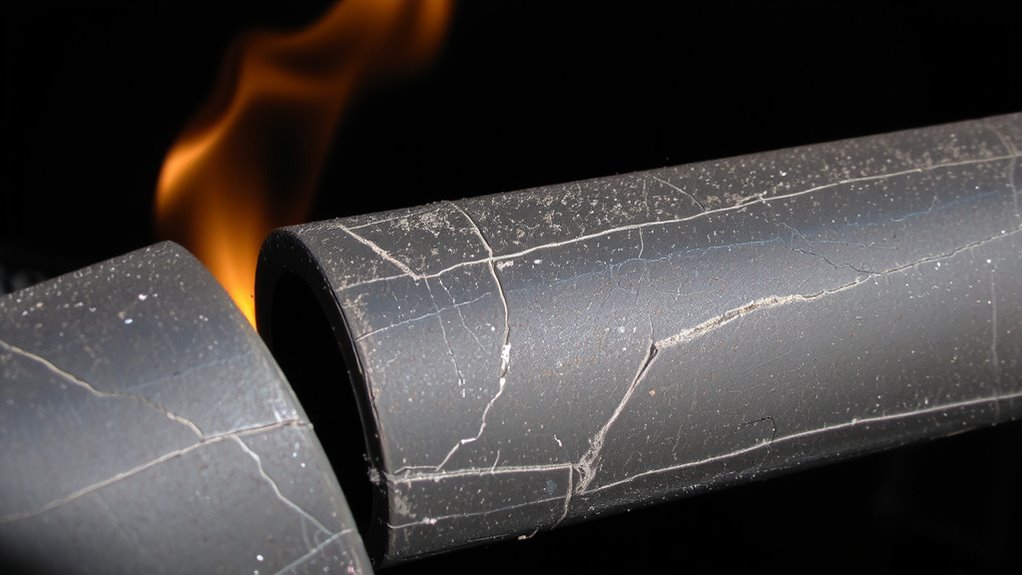
Heat acts as an accelerator for rubber deterioration in much the same way UV light degrades plastics, only through thermal energy instead of radiation. You’ll notice rubber parts lose elasticity and crack when exposed to elevated temperatures over time. This process, known as thermal aging, drives chemical changes within the polymer structure. As heat increases molecular motion, it promotes chain scission-the breaking of polymer chains-reducing molecular weight and weakening mechanical properties. For every 10°C rise above service limits, degradation rates nearly double. Standard elastomers like natural rubber or EPDM typically tolerate sustained use up to 70–100°C; beyond that, thermal aging accelerates rapidly. Chain scission disrupts cross-linking networks, leading to hardening or embrittlement. Operating at 120°C can shorten a rubber seal’s functional life by 50% compared to 80°C. Preventing overheating preserves material integrity.
What Oxygen and Ozone Do to Rubber
Oxygen and ozone silently attack rubber, degrading its structure over time. You’ll see this as oxidative aging, where rubber hardens and loses elasticity due to molecular chain scission. Prolonged exposure causes brittleness and microcracks, especially under stress. Ozone cracking is more aggressive-it targets double bonds in unsaturated rubbers like natural rubber, forming deep cracks perpendicular to applied strain, even at levels as low as 50 ppb.
Prevention relies on material selection and protective agents.
| Factor | Effect on Rubber | Prevention Method |
|---|---|---|
| Oxygen | Oxidative aging, hardening | Antioxidant additives |
| Ozone | Surface cracking (ozone cracking) | Antiozonants, waxes |
| Stress + Ozone | Accelerated crack growth | Reduce strain, use protective coatings |
Use saturated rubbers like EPDM where possible-they resist both oxygen and ozone far better.
Why Water Damages Plastics Over Time
While water may seem harmless, it can gradually compromise plastics through hydrolysis and physical swelling, especially in humid or submerged environments. You’ll notice that moisture absorption disrupts polymer chains, particularly in materials like nylon, PET, and polycarbonate. Hydrolysis reactions break down these chains when water molecules split amide or ester bonds, reducing tensile strength and impact resistance. For example, nylon 6 can absorb up to 2.5% of its weight in water at 50% relative humidity, causing dimensional instability. Over time, this swelling creates microcracks and weakens structural integrity. Engineering plastics in outdoor or aquatic applications are especially vulnerable. Even short exposure cycles lead to cumulative damage, as absorbed moisture lowers the glass transformation temperature. This degradation is irreversible and accelerates at higher temperatures. You can measure it using gravimetric analysis or FTIR spectroscopy. Preventing excessive moisture absorption is key to maintaining long-term performance.
How Stabilizers Prevent Material Breakdown
Because polymers are inherently susceptible to chemical and environmental degradation, stabilizers are added during manufacturing to intercept destructive reactions before they compromise the material. You rely on these additives to stop molecular scission, where polymer chains break under heat, UV exposure, or oxidation. Without intervention, scission reduces tensile strength and leads to cracking. Stabilizers like hindered phenols neutralize free radicals, halting chain reactions early. Others, such as phosphites, decompose peroxides before they initiate further damage. In polyolefins, UV absorbers create a shield, converting harmful radiation into harmless heat. These mechanisms also limit chain branching, which can distort the polymer’s structure and impair performance. Properly stabilized materials maintain integrity for years, even in harsh conditions. For example, HDPE pipes with antioxidants last over 50 years underground. You’ll find that effective stabilization isn’t optional-it’s essential for durability. Every formulation balances additive type, concentration, and compatibility to guarantee longevity without sacrificing processability.
Choosing the Right Plastic or Rubber for Long Life
You’ve seen how stabilizers protect polymers from degradation, but selecting the right base material matters just as much for long-term performance. Choose plastics or rubbers with high chemical resistance when exposed to oils, acids, or solvents. For example, PTFE resists nearly all chemicals and operates from -200°C to 260°C. Nitrile rubber handles petroleum-based fluids well, maintaining integrity under prolonged exposure. Mechanical stress demands materials with high tensile strength and fatigue resistance. Polyoxymethylene (POM) offers 60–70 MPa tensile strength, ideal for load-bearing parts. Silicone rubber endures constant flexing, surviving over 1 million cycles in dynamic seals. Consider durometer ratings-80–90 Shore A suits most sealing applications. UV exposure? Pick UV-stable polymers like ASA over standard ABS. Match the material not just to current conditions, but worst-case scenarios. A wrong choice accelerates wear, even with stabilizers.
On a final note
You now understand the key factors degrading plastics and rubber. UV radiation breaks polymer chains, causing brittleness-measurable via ASTM D1670. Heat accelerates oxidation, reducing rubber’s tensile strength by up to 50% at 70°C over 1,000 hours. Ozone cracks elastomers; even 50 ppb causes visible damage. Hydrolysis weakens ester-based plastics like PET. Use stabilizers: HALS for UV, antioxidants like phenolics. Choose PTFE or EPDM for longevity. Material selection directly impacts lifespan.