Best 12V RV Air Conditioners for Cool Comfort on the Road
You get fast, efficient cooling with 10,000 BTU 12V inverter rooftop units that draw as little as 0.3 kWh/hour. These models run quietly at 45–55 dB and fit standard 14” x 14” roof openings. They use scroll or rotary compressors with R134A refrigerant for stable temperature control and up to 30% better efficiency. With 750W to 960W power use, they’re ideal for off-grid setups using lithium batteries and solar. There’s more to explore about performance across different climates and setups.
We are supported by our audience. When you purchase through links on our site, we may earn an affiliate commission, at no extra cost for you. Learn more. Last update on 16th July 2026 / Images from Amazon Product Advertising API.
Notable Insights
- 12V RV air conditioners with inverter technology offer up to 5x greater energy efficiency and quieter operation for extended off-grid comfort.
- Models with 10,000 to 11,000 BTU cooling capacity rapidly cool small to mid-sized RVs while maintaining stable interior temperatures.
- Ultra-quiet compressors and brushless motors keep noise under 45 dB, ideal for sleeping and low-disruption environments.
- Inverter units consume as little as 0.3 kWh/hour, enabling 8–10 hours of runtime on a 120Ah lithium battery.
- Most units fit standard 14” x 14” rooftop openings and feature durable, low-profile designs for easy, tool-free installation.
RV Air Conditioner 12V 10000 BTU Quiet

If you’re looking for reliable, quiet cooling in a compact 12V RV air conditioner, the OutEquipPro Summit 2 10,000 BTU unit is ideal for RVers, van lifers, and mobile professionals who need efficient climate control in small spaces. It delivers 10,000 BTU cooling-enough to chill most RVs in 15 minutes. The brushless copper motor fans and spring-supported mounts cut noise to just 40 decibels. A directional duct directs airflow efficiently. UV-stabilized ABS and EPDM foam seals guarantee rooftop durability. It draws 2,946 watts, runs on 12 volts, and includes eco, sleep, and turbo modes.
Best For: RVers, van lifers, and mobile professionals needing quiet, efficient 12V climate control in small mobile spaces.
Pros:
- Delivers fast, effective 10,000 BTU cooling, chilling most RVs in under 15 minutes
- Ultra-quiet operation at 40 decibels thanks to brushless copper motors and spring-mounted design
- Durable rooftop construction with UV-stabilized ABS, EPDM foam gasket, and corrosion-resistant zinc-coated condenser
Cons:
- High power consumption of 2,946 watts may strain smaller battery systems
- 4,500 BTU PTC heater is insufficient as a primary heat source in extreme cold
- Limited cooling capacity for larger RVs or extremely hot climates
RV Air Conditioner 12V 10000 BTU
The 12V RV Air Conditioner 10000 BTU is engineered for off-grid adventurers who demand reliable, energy-efficient cooling without sacrificing battery power. I run on 12 volts and draw 2843 watts, delivering 1 ton of cooling power. I cool your space fast-typically within 15 minutes. My Summit 2 model (OEP2500) measures 28.3 x 28.3 x 6.3 inches and weighs 45 pounds. I’m built with UV-stabilized ABS and a zinc-coated condenser for durability. I operate quietly at 40 dB. I work with deep-cycle batteries-8 hours on a 480Ah battery, 10 on a 600Ah.
Best For: Off-grid adventurers seeking a quiet, durable, and energy-efficient 12V rooftop air conditioner for reliable cooling in RVs, vans, and campers.
Pros:
- Delivers fast cooling within 15 minutes and operates quietly at 40 dB
- Runs on standard 12V deep-cycle batteries with up to 10 hours of runtime on a 600Ah battery
- Built with UV-stabilized ABS, zinc-coated condenser, and weather-resistant materials for long-term durability
Cons:
- High power consumption at 2843 watts may strain smaller battery systems
- Requires a large battery capacity (480–600Ah) for extended use, increasing overall system cost
- Limited to 12V DC power source, which may not be compatible with all vehicles without modifications
12V RV Air Conditioner Non-Ducted 8530 BTU

You’ll find the V RV Air Conditioner Non-Ducted 8530 BTU ideal if you need reliable, energy-efficient climate control for your caravan, camper, or mobile work vehicle. It delivers 8530 BTU of cooling and 3412 BTU of heating using a heat pump system. Powered by 12V DC, it draws 800 W at 30A–50A. The inverter scroll compressor guarantees quiet 45 dB operation. Measuring 66 cm × 72 cm × 16 cm, it fits most standard roof openings. Its ABS housing resists UV damage and impacts. IPX6K-rated, it withstands heavy rain and dust. Seven 7 cm vents offer 360° airflow. R134A refrigerant must be charged post-shipment. It weighs 25 kg and comes with an 18-month warranty.
Best For: RV and van owners seeking a quiet, energy-efficient 12V air conditioner with reliable cooling and heating performance for off-grid adventures or mobile work environments.
Pros:
- Offers 8530 BTU cooling and 3412 BTU heating with energy-efficient inverter scroll compressor for quiet 45 dB operation
- Durable ABS construction with IPX6K rating ensures resistance to UV rays, water, dust, and rough terrain
- Compact, low-profile design fits most standard roof openings and enables 360° airflow via seven adjustable vents
Cons:
- Requires post-shipment R134A refrigerant charging, adding setup complexity and cost
- High power draw (30A–50A) demands a robust 12V electrical system or large battery bank
- At 25 kg, the unit is heavy and may require assistance during rooftop installation
12V RV Air Conditioner with Heat (10000 BTU)

Since I demand both heating and cooling in extreme conditions without relying on shore power, the 12V RV Air Conditioner with Heat (10000 BTU) is my top choice for off-grid adventures. It delivers 10,000 BTU of cooling and 3,500 BTU of heating, stabilizing interior temperature in about 10 minutes. The high-efficiency compressor guarantees rapid, uniform airflow. Its low-profile design uses an impact-proof, UV-resistant ABS shell that withstands hail, rain, and sun. I appreciate the 45dB noise level-comparable to a whisper-thanks to silent compressor tech and aerodynamic fan blades. Built-in 12V DC protections prevent damage from overcurrent, short circuits, overvoltage, and undervoltage. It fits most RVs, vans, and boats with a plug-and-play setup-no professional install needed.
Best For: Off-grid adventurers who need reliable 12V heating and cooling in RVs, vans, or boats without shore power.
Pros:
- Delivers powerful 10,000 BTU cooling and 3,500 BTU heating with rapid temperature stabilization in 10 minutes
- Durable, low-profile design with impact-proof, UV-resistant ABS shell built for extreme weather conditions
- Quiet 45dB operation and comprehensive 12V electrical protections for safety and comfort during travel
Cons:
- Limited heating output (3,500 BTU) may struggle in extremely cold environments
- 10,000 BTU capacity may be insufficient for larger RVs or high-heat climates
- Plug-and-play installation may still require minor modifications depending on vehicle type
12V Rooftop Air Conditioner for RV

A 12V rooftop air conditioner suits RV owners needing reliable cooling and heating without relying on shore power. I use a 10,000 BTU unit that delivers 2,300W of cooling and 1,000W of heating, ideal for extreme weather. It runs on 12V DC, pulling 30–50A with 960W power consumption, compatible with most RV electrical systems and portable power sources. Built tough, it features high-strength ABS plastic housing resistant to UV rays and impacts. The weatherproof design survives heavy rain, storms, and intense sun. Installation requires a roof opening of at least 12.59″ x 9.45″. It fits standard skylight mounts-I’ve seen it work on campervans, trailers, trucks, and heavy equipment.
Best For: RV owners seeking reliable 12V cooling and heating performance without shore power dependency.
Pros:
- Delivers strong 10,000 BTU cooling and 1,000W heating, ideal for extreme weather conditions
- Runs efficiently on 12V DC power with compatibility across RVs, campervans, and heavy-duty vehicles
- Durable, weatherproof construction with UV-resistant, impact-resistant ABS housing
Cons:
- Requires a substantial 30–50A current draw, demanding a robust 12V power system
- Installation needs a minimum roof opening of 12.59″ x 9.45″, which may not suit all vehicles
- Limited heating output (1,000W) may be insufficient in very cold climates
12V DC RV Air Conditioner 11000 BTU
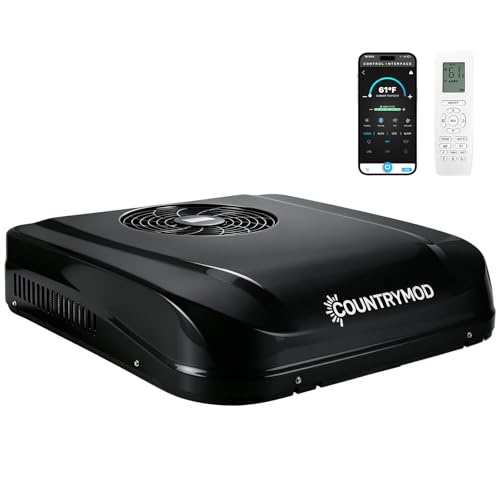
The 12V DC RV Air Conditioner with 11,000 BTU cooling capacity is ideal for travelers who demand reliable, energy-efficient climate control without sacrificing battery life. It uses inverter technology, drawing 300–900W, to cool quickly while consuming just 0.3 kWh per hour-five times less than standard units. A variable-frequency compressor adjusts output based on cabin temperature. It runs 10 hours on battery power alone. Noise ranges from 45–55 dB, quieter than normal conversation. Horizontal compressor design reduces vibration. It fits standard 14” x 14” rooftop openings without ductwork, works with most RVs and trailers, and installs easily.
Best For: Travelers seeking a quiet, energy-efficient rooftop air conditioner for RVs, trailers, or mobile spaces that operates reliably on battery power without major modifications.
Pros:
- Delivers 11,000 BTU cooling with inverter technology for rapid, variable-frequency cooling and 5x greater energy efficiency than standard units
- Runs up to 10 hours on battery power while consuming only 0.3 kWh per hour, ideal for off-grid use
- Quiet 45–55 dB operation and horizontal compressor design reduce noise and vibration for comfortable living
Cons:
- Not compatible with ducted RV HVAC systems, limiting installation options
- High initial power draw (up to 900W) may require robust battery and inverter setup
- Designed specifically for 14” x 14” rooftop openings, which may not suit all vehicle types
RV Air Conditioner 12V 8500 BTU

You’ll want this 12V RV air conditioner if you need reliable, energy-efficient climate control for a compact mobile space-think RVs, vans, or construction vehicles where power and room are limited. It delivers 8,500 BTU cooling and 3,400 BTU heating, running on 12V DC with a 40A draw. The vortex variable frequency compressor boosts efficiency over 30% versus traditional models. It adjusts output automatically based on cabin temperature. Noise ranges from 45–60 dB-about as loud as a fan. The thin 5.5-inch design fits standard 14×14 vents. Built with UV-resistant ABS, it withstands rough terrain and harsh weather.
Best For: RV, van, and mobile vehicle owners seeking efficient, quiet, and compact 12V climate control with reliable performance in tight spaces and rugged conditions.
Pros:
- Energy-saving vortex variable frequency compressor improves efficiency by over 30% compared to traditional models
- Ultra-thin 5.5-inch design fits standard 14×14 roof vents and reduces vibration for stable operation
- Quiet operation (45–60 dB) and automatic temperature adjustment for comfort and energy optimization
Cons:
- Heating capacity (3,400 BTU) is limited and not suitable as a primary heat source in cold climates
- 40A current draw may require electrical system upgrades in some vehicles
- Fahrenheit-only temperature display may be inconvenient for users preferring Celsius
12V RV Air Conditioner with Heating

When off-grid comfort depends on efficient climate control, this 12V RV air conditioner with heating delivers reliable performance for adventurers who demand both cooling and supplemental warmth. I rely on its 10,000 BTU cooling and 4,500 BTU PTC heating to maintain comfort in fluctuating conditions. The 960W inverter system uses a rotary compressor, cutting power draw for solar and battery setups. It fits standard 14 x 14-inch rooftops, runs under 40 dB, and includes remote control, overheat protection, and 6 AWG cables. Outequip’s OEP2500 weighs 45 lbs, offers a 1-year warranty, and operates efficiently year-round.
Best For: RV owners and off-grid adventurers seeking an energy-efficient, quiet, and compact 12V climate control solution with both cooling and supplemental heating capabilities.
Pros:
- 10,000 BTU cooling and 4,500 BTU PTC heating provide reliable temperature control in diverse conditions
- 12V DC inverter system with low power draw supports solar and battery-powered setups for extended off-grid use
- Ultra-quiet operation below 40 dB and compact design ideal for rooftop installation on standard RVs
Cons:
- Limited heating output makes it best suited for supplemental, not primary, heating in cold climates
- High upfront cost may be a barrier despite long-term energy savings
- Installation requires rooftop penetration, which could lead to leaks if not properly sealed
12V RV Rooftop Air Conditioner 8000BTU
No need to sacrifice comfort when living off-grid-this 12V RV rooftop air conditioner with 8000 BTU cooling power is built for adventurers who demand reliable climate control in remote conditions. It delivers 2300 W of cooling and draws just 750 W, running efficiently on 12V DC power. With a 3.26 energy efficiency rating, it cools faster than many comparable units-15% more output, to be exact. I appreciate its quiet 50 dB operation and ultra-thin 5.5-inch profile, which fits discreetly on my roof. It uses R134A refrigerant and requires a 350 x 250 mm roof cutout. Weighing 59 lbs, it’s made of durable ABS and fits motorhomes, vans, and even heavy machinery. I can control it from my seat with the included remote and LED panel. It works while driving or parked-even with the engine off. Installation is tool-free and straightforward. Model EAC002.32, ASIN B0CTLXV44S, backed by a manufacturer warranty and Amazon’s 30-day return policy.
Best For: Adventurers and off-grid travelers seeking reliable, quiet, and efficient 12V rooftop air conditioning for RVs, camper vans, or heavy machinery in remote conditions.
Pros:
- Delivers 15% higher cooling capacity than comparable units with fast, efficient performance
- Operates quietly at 50 dB and features a discreet ultra-thin profile for rooftop integration
- Simple tool-free installation and remote control capability for convenience while driving or parked
Cons:
- High current draw (30–62 A) may require robust electrical system upgrades
- Requires a large roof opening (350 x 250 mm), which may not suit all vehicle roofs
- Limited to 12V DC systems, reducing compatibility with standard household power setups
Aspligo 9000BTU 12V RV Air Conditioner

The Aspligo 9000BTU 12V RV Air Conditioner is ideal for users needing robust climate control in mobile or off-grid environments. It delivers 9000BTU cooling and 4500BTU heating, powered by a 12V system with 750W consumption. The scroll compressor enables fast, efficient cooling using R134A refrigerant. It draws 30–62A and includes low-voltage protection for safe operation. Cooling airflow reaches 2300W; heating hits 1000W. Weighing 27kg, it measures 666 × 720 × 160mm, requiring a roof opening between 310 × 165mm and 490 × 585mm. It works in RVs, trucks, boats, and heavy machinery. LED display and remote control allow easy adjustments.
Best For: RV, truck, boat, and off-grid vehicle owners needing reliable 12V-powered climate control with strong cooling and heating performance.
Pros:
- Delivers powerful 9000BTU cooling and 4500BTU heating with efficient scroll compressor technology
- Operates on 12V system with low voltage protection, ideal for mobile and off-grid use
- Includes LED display and remote control for convenient, user-friendly operation
Cons:
- High current draw (30–62A) may require robust electrical systems or supplemental power sources
- Heavy at 27kg, which could complicate installation on some vehicles
- Roof opening size requirements may limit compatibility with certain vehicle models
Factors to Consider When Choosing a 12V RV Air Conditioner
You need the right 12V RV air conditioner to stay comfortable without draining your battery. Consider cooling capacity first-units like the Aspligo 9000BTU can cool up to 350 sq ft but require at least 120Ah lithium battery support for 8+ hours runtime. Power efficiency, noise under 55 dB, low-profile mounting, and rugged construction all impact performance and convenience on the road.
Cooling Capacity
Most 12V RV air conditioners deliver cooling power between 8,000 and 11,000 BTU, with higher outputs cooling larger or hotter spaces more effectively. You’ll need about 20–30 BTU per square foot of interior space for reliable cooling. A 10,000 BTU unit typically cools an average RV in 10 to 15 minutes, depending on outdoor temps and insulation quality. Higher BTU models pull down temperatures faster but draw more power-between 750 and 2,950 watts-reducing your battery runtime off-grid. Look for inverter-equipped models; they adjust cooling output continuously, maintaining your set temperature without full on-off cycles. That means stable comfort and less strain on your electrical system. Match the unit’s capacity to your RV’s size to avoid underperformance or wasted energy. Oversized units cost more and drain power quickly, while undersized ones struggle in extreme heat. Choose wisely based on your typical conditions and usage.
Power Efficiency
A well-designed 12V RV air conditioner cuts power use without sacrificing cooling. You’ll save energy with inverter technology, which adjusts compressor speed to match demand-boosting efficiency up to five times over non-inverter models. Units with variable-frequency compressors cut energy use by over 30% compared to traditional rotor types. Look for lower wattage models: 750–960W units can run 8–10 hours on a 480–600Ah battery bank. Most 12V air conditioners draw between 750W and 2,946W, directly affecting how long your batteries last off-grid. High-efficiency units achieve energy efficiency ratios (EER) above 3.2, meaning they deliver more cooling per watt. Optimized airflow and reduced friction losses help reach these levels. Choosing a unit based on wattage and EER guarantees longer runtime and reliable performance without overloading your electrical system.
Noise Level
When selecting a 12V RV air conditioner, noise level plays a critical role in comfort, especially during rest or nighttime use. Most units operate between 40 and 60 decibels, but quieter models run at or below 40 dB-about as loud as a library. You’ll want a unit under 45 dB for undisturbed sleep. Brushless DC motors reduce electrical hum and wear, contributing to lower sound output. Spring-mounted compressors minimize vibration transfer, cutting mechanical noise drastically. Inverter-driven compressors run smoothly at variable speeds, eliminating the loud cycling common in traditional on/off models. Airflow design matters too-directional ducts reduce turbulence, lowering aerodynamic noise. Together, these features enable ultra-quiet performance without sacrificing cooling power. Prioritize units engineered for acoustics if silence is key. Noise isn’t just about comfort-it’s a measurable factor in how well your system integrates into daily RV life. Choose wisely based on dB ratings and component design.
Installation Requirements
Before you begin, make sure your RV’s roof cutout aligns with the air conditioner’s footprint-most units require an opening between 12.2 x 9.06 inches and 14 x 14 inches. Confirm your roof can handle the weight; these units typically weigh 45 to 60 pounds. Most 12V rooftop models are designed for non-ducted, direct installation, so verify your system type before buying. Check that the mounting area allows space above and below-low-profile units need just 5.5 to 7 inches of clearance. Use EPDM foam gaskets or equivalent weatherproofing to create a watertight seal and prevent leaks. Guarantee all fasteners and supports line up with your roof’s structure. Improper installation risks damage and reduces efficiency. Measure twice, cut once-accuracy prevents costly fixes later. Always follow the manufacturer’s template and specs exactly. Proper prep guarantees secure, leak-free performance in any weather.
Durability And Build
Choose a 12V RV air conditioner built to withstand extreme conditions, starting with a housing made from UV-stabilized ABS plastic. This material resists sun damage, preventing warping and cracking over time. Look for EPDM foam gaskets and zinc-coated condensers-they seal out moisture and resist rust from rain and humidity. Units with brushless copper motor fans deliver reliable operation while reducing mechanical wear. Spring-supported mounts minimize vibration, extending component life. An IPX6K or higher rating guarantees protection against high-pressure water jets and dust infiltration, critical for off-grid and all-weather use. A low-profile, aerodynamic design lowers wind resistance and improves stability on the road. The reduced center of gravity enhances roof mount security. These features combine to deliver long-term performance in harsh environments. Build quality directly impacts lifespan-don’t compromise when choosing your unit.
Heating Functionality
What if your 12V RV air conditioner could also take the chill off a cool evening? Some models do, offering supplemental heating with 3,400 to 4,500 BTU output. This warmth comes from efficient PTC electric elements or heat pump technology, both running directly on 12V DC power. Heating mode increases power draw, using 960W to 1,000W-something your battery bank must support. These systems aren’t designed for harsh winters or large spaces. They work best as a secondary heat source when temperatures dip slightly. Built-in sensors monitor interior temps, adjusting output to balance comfort and battery life. You control the settings manually, fine-tuning heat levels for efficiency. Think of it like a space heater-useful in mild conditions, but not a furnace replacement. Always size your batteries and charging system to handle the added load during colder hours.
Control Features
How easily can you adjust your comfort without leaving the couch? With most 12V RV air conditioners, you can use a remote control to change settings from anywhere inside the vehicle. Remote access lets you adjust temperature, fan speed, and mode without touching the unit. Many models offer multiple modes-eco, sleep, and turbo-to balance cooling power and battery use. LED or digital displays show real-time interior temperatures, usually in Fahrenheit, for precise monitoring. Temperature monitoring systems automatically modulate compressor output to maintain your set climate, improving efficiency. User-friendly interfaces feature intuitive buttons or remotes, allowing you to set timers, switch modes, or toggle between cooling and heating. These controls guarantee precise, hassle-free operation. Look for units with clear displays and responsive remotes for best results.
Frequently Asked Questions
Can I Run a 12V RV Air Conditioner All Night on Batteries?
Yes, you can run a 12V RV air conditioner all night on batteries, but only with a sufficiently large lithium battery bank. A typical 12V AC draws 30–50 amps per hour. Running it for 8 hours requires 240–400 amp-hours. A 400Ah lithium battery provides enough capacity, though you’ll still need to limit other loads. Solar charging helps extend runtime. Lead-acid batteries aren’t ideal due to slower recharge and shorter cycle life.
How Long Do 12V RV Air Conditioners Typically Last?
You can expect a 12V RV air conditioner to last 3–5 years with regular use. Build quality, operating cycles, and maintenance directly impact lifespan. Units run on DC power and typically draw 30–50 amps continuously. Lithium batteries help sustain load efficiency. Clean filters monthly. Avoid prolonged max-output operation. Heat exposure degrades components faster. Treat it like a compressor fridge-consistent care extends life. Replace seals and check connections yearly.
Are 12V RV Air Conditioners Suitable for Cold Weather Use?
No, you can’t rely on 12V RV air conditioners for cold weather heating. They’re designed for cooling, not heating. Some models include heat strips or reverse-cycle heat pumps, but these are inefficient in freezing temps. If you need warmth, pair your unit with a propane or diesel heater. Always check the operating range-most 12V AC units fail below 40°F. Don’t assume cooling capability equals heating performance.
Do 12V RV Air Conditioners Work With Solar Panels?
Yes, you can run a 12V RV air conditioner with solar panels if your system provides enough continuous power. Most 12V units draw 20–40 amps under load, requiring 400–800 watts of solar input, depending on efficiency. You’ll need a battery bank-typically 200–400Ah lithium-to handle startup surges. Pair panels with a charge controller and inverter/charger to maintain stable voltage. Properly sized, solar keeps your unit running day and night.
Can I Install a 12V RV Air Conditioner Myself?
You can install a 12V RV air conditioner yourself if you have basic electrical and mechanical skills. You’ll need to mount the unit securely using manufacturer-supplied brackets, typically requiring a roof cutout of 14” x 14”. Connect it to a 12V lithium battery bank with at least 200Ah capacity using 2/0 gauge copper wire. Integrate a 300A fuse within 18 inches of the battery. Use a digital thermostat to maintain efficiency.