Best Car Diagnostic Tool Kits Every Auto Enthusiast Needs
You need a diagnostic tool that delivers accurate, real-time insights across multiple systems. The ANCEL AD410 reads over 42,000 DTCs and supports CAN, ISO9141, and J1850 protocols, ideal for 1996+ vehicles. FIXD translates 39,000+ issues into plain English via smartphone. FOXWELL NT604 covers 60+ brands with ABS, SRS, and engine diagnostics. ZMOON ZM201 offers a 2.8-inch color screen and lifetime updates. Each balances depth, compatibility, and usability-discover which model aligns with your diagnostic demands.
We are supported by our audience. When you purchase through links on our site, we may earn an affiliate commission, at no extra cost for you. Learn more. Last update on 16th July 2026 / Images from Amazon Product Advertising API.
Notable Insights
- Choose OBD2 scanners with universal protocol support for compatibility across 1996+ gasoline and diesel vehicles.
- Prioritize tools with live data streaming, freeze frame, and I/M readiness for comprehensive diagnostics.
- Opt for devices with large color screens and intuitive navigation to simplify troubleshooting.
- Select scanners offering lifetime free updates to ensure long-term reliability and feature access.
- Consider wireless Bluetooth options with smartphone integration for real-time alerts and maintenance tracking.
ANCEL AD310 OBD2 Scanner for Cars

If you need a no-nonsense tool to quickly identify and clear emission-related trouble codes, the ANCEL AD310 OBD2 Scanner is your best choice. I use it to read live and freeze frame data, check I/M readiness, and retrieve vehicle information efficiently. It supports all OBDII protocols: CAN, KWP2000, J1850 VPW, ISO9141, and J1850 PWM. The device works on 1996+ US and 2000+ EU/Asian vehicles, including SUVs and light trucks. It draws power directly from the OBDII port-no batteries needed. Its 2.5-foot shielded cable resists damage. The display is large, the buttons are intuitive, and the 12-ounce design fits in any bag.
Best For: DIY car owners who need a reliable, easy-to-use scanner to quickly diagnose and clear emission-related check engine light issues without technical expertise.
Pros:
- Reads and clears emission-related trouble codes, displays live/freeze frame data, and checks I/M readiness with fast, accurate results
- Powered directly from the OBDII port-no batteries or charging required-and features a durable, portable design with a 2.5-foot shielded cable
- Supports all OBDII protocols and works with 1996+ US and 2000+ EU/Asian vehicles, including SUVs and light trucks, with a large display and intuitive buttons
Cons:
- Limited to emission-related fault codes only and cannot read non-emission engine trouble codes
- Not compatible with OBDI vehicles, even with an adapter
- Basic functionality may not satisfy users seeking advanced diagnostic features or bi-directional control
FOXWELL NT301 OBD2 Scanner Tool

The FOXWELL NT301 OBD2 Scanner Tool is my go-to choice when I need a no-nonsense, reliable way to diagnose engine trouble on 1996-and-newer gasoline vehicles or 2000-and-newer European and Asian models. It reads and clears DTCs, turns off the check engine light, and retrieves VIN and I/M readiness status. I use its live data graphing to monitor sensors in real time. It supports all OBDII protocols, including CAN, and works on 12V systems. The 2.8-inch color screen is clear; red-yellow-green LEDs give instant emissions status. No battery is needed-it powers from the OBD2 port.
Best For: DIYers and professional mechanics needing a reliable, easy-to-use OBD2 scanner for basic engine diagnostics on 1996-and-newer gasoline and 2000-and-newer European/Asian vehicles.
Pros:
- Reads and clears DTCs, turns off check engine light, and supports I/M readiness checks with color-coded LED indicators
- Plug-and-play design powered directly from OBD2 port-no built-in battery required
- Lifetime free updates, printer compatible, and features live data graphing for real-time sensor monitoring
Cons:
- Limited to powertrain diagnostics-does not support ABS, SRS, transmission, or advanced functions like bi-directional control
- Clearing codes only works after repairs; underlying issues will cause codes to reappear
- Not suitable for vehicles with damaged OBD2 ports or non-standard wiring configurations
OBD2 Scanner Diagnostic Tool with Reset

You’ll find this OBD2 Scanner Diagnostic Tool with Reset works best if you own a vehicle built after 1996 and want pro-level diagnostics without visiting a shop. It reads and clears trouble codes, turns off the check engine light, and accesses live data streams. With 35,901 built-in DTCs, it covers far more codes than older scanners. You can view freeze frame data, test battery voltage, and check I/M readiness. It supports Mode 6 and Mode 8 for advanced diagnostics. The device works on 98% of OBD2-compliant cars, trucks, and SUVs from the US, Europe, and Asia. It connects via Type-C cable to export data or print reports. You’ll avoid unnecessary repair bills. Firmware updates are free for life. It includes a storage bag and supports ten languages.
Best For: Vehicle owners with OBD2-compliant cars from 1996 onward who want professional-grade diagnostics and repair verification without relying on mechanics.
Pros:
- Offers an extensive library of 35,901 built-in DTCs for accurate and comprehensive fault diagnosis
- Supports advanced features like Mode 6 and Mode 8 diagnostics, live data streaming, and I/M readiness checks
- Provides lifetime free firmware updates and enables data export/printing for repair validation and long-term vehicle health tracking
Cons:
- Compatibility limited to 98% of OBD2 vehicles, potentially excluding some niche or older models
- Requires a Type-C to computer connection for data export, which may not be convenient for all users
- Lacks built-in Wi-Fi or Bluetooth, limiting wireless functionality compared to premium scanners
MOTOPOWER OBD2 Scanner Code Reader

I rely on the MOTOPOWER OBD2 Scanner Code Reader when I need a dependable, no-frills diagnostic tool that delivers accurate engine data without requiring extra power sources. It draws power directly from my vehicle’s OBDII port-no batteries or chargers needed. The scanner reads and erases engine fault codes, displays freeze frame data, I/M readiness, and real-time values like RPM, speed, coolant temp, and engine load. It supports all 9 OBD2 protocols, works with most gas-powered vehicles from 1996 onward, and features a 2.8-inch LCD with adjustable contrast. Six buttons offer quick access to VIN and DTCs. Live data appears in scrolling streams or graphical curves. It speaks English, German, Dutch, Spanish, French, and Italian. The 2.5-foot cable has thick insulation. A replaceable screen film guards against scratches. I plug it in, turn the key, and press OK. It doesn’t read ABS or airbag codes. For issues, MOTOPOWER’s support offers replacements if needed.
Best For: DIY car enthusiasts and mechanics seeking a reliable, easy-to-use OBD2 scanner for quick and accurate engine diagnostics without the need for external power.
Pros:
- Draws power directly from the vehicle’s OBD2 port-no batteries or chargers required
- Supports all 9 OBD2 protocols and works with most gas-powered vehicles from 1996 onward
- Clear 2.8-inch LCD with adjustable contrast and intuitive 6-button navigation for efficient diagnostics
Cons:
- Cannot read non-OBDII systems such as ABS, airbag, or oil service indicators
- Limited to six languages, which may exclude some regional users
- Screen protective film is replaceable but may wear over time with heavy use
ANCEL AD410 OBD2 Scanner for Check Engine Light

A reliable choice for DIYers and professional technicians alike, the ANCEL AD410 OBD2 Scanner delivers precise engine diagnostics for 1996+ U.S., 2000+ European, and Asian OBDII-compliant vehicles. It supports all 16PIN OBDII protocols, including CAN, ISO9141, and J1850. I use its 42,000+ built-in DTC definitions to instantly identify check engine codes. The 2.4-inch TFT color screen displays data clearly, even in sunlight. It performs I/M checks and EVAP leak tests, helping pass smog inspections. O2 sensor monitoring improves fuel efficiency. It clears codes only after fixes-no false resets. Powered via OBDII port, no batteries needed. Firmware updates are Windows-only. Trusted by Scotty Kilmer.
Best For: DIYers and professional technicians seeking an affordable, user-friendly OBD2 scanner for precise engine diagnostics on 1996+ U.S., 2000+ European, and Asian OBDII-compliant vehicles.
Pros:
- Supports all 16PIN OBDII protocols with over 42,000 built-in DTC definitions for accurate, instant code identification
- 2.4-inch TFT color display offers high visibility even in direct sunlight, ideal for quick diagnostics
- Performs advanced functions like I/M readiness checks, EVAP leak testing, and O2 sensor monitoring to improve fuel efficiency and emissions
Cons:
- Firmware updates are only supported on Windows (XP/7/8/10), not Mac
- Limited to engine diagnostics only-does not support ABS, SRS, or transmission systems
- USB port is for updates only, not for live data transfer or vehicle connection
FOXWELL NT604 Elite OBD2 Scanner

The FOXWELL NT604 Elite OBD2 Scanner is best suited for do-it-yourselfers and automotive technicians who demand reliable, no-cost diagnostics across a broad range of vehicle systems. It supports 60+ American, Asian, and European makes, covering engine, ABS, SRS, transmission, and check engine diagnostics. AUTOVIN captures vehicle data instantly, though manual entry is an option. I rely on its live data streaming, I/M readiness checks, and built-in DTC library. It lacks service functions like oil resets or battery registration. The rugged case adds durability. Preloaded software means no setup-I use it immediately with no update fees.
Best For: DIYers and automotive technicians needing reliable, no-cost diagnostics across a wide range of vehicle systems.
Pros:
- Supports 60+ American, Asian, and European vehicle makes with comprehensive diagnostics for engine, ABS, SRS, transmission, and check engine systems
- Features AUTOVIN for instant vehicle identification, live data streaming, I/M readiness checks, and a built-in DTC library
- Comes with preloaded software and a durable protective case, enabling immediate use without setup or update fees
Cons:
- Lacks advanced service functions such as oil resets, battery registration, ABS bleeding, and throttle relearn
- Cannot clear warning lights without performing physical repairs first
- Vehicle compatibility varies by make, model, and year, requiring verification before purchase
VDIAGTOOL VD10 OBD2 Scanner Diagnostic Tool
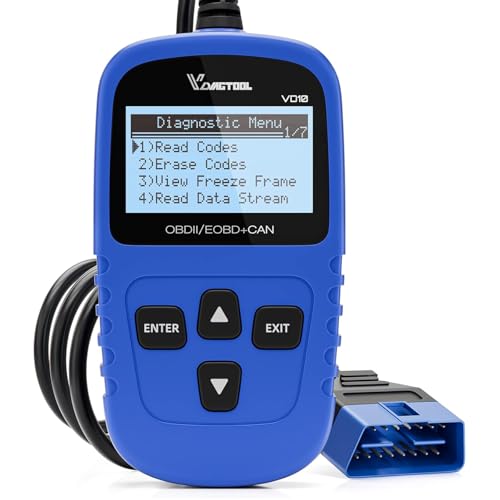
Built for DIYers and budget-conscious car owners who want professional-grade diagnostics without the complexity, the VDIAGTOOL VD10 OBD2 Scanner delivers essential functionality in a compact, no-frills package. It reads and clears generic and manufacturer-specific DTCs, with a built-in database of 3000+ codes. I get instant definitions, live sensor data, and freeze frame details for precise troubleshooting. It supports all OBDII protocols and works on 1996+ US, 2006+ EU, and 2009+ Asian vehicles. The VD10 pulls power directly from the OBD2 port-no batteries needed. Its 2-line LCD has adjustable contrast for clear viewing. I use it to check I/M readiness, verify ECUs via VIN and CVN, and reset the MIL after repairs. It includes lifetime free updates, a 3-year warranty, and supports six languages-making it a reliable, long-term tool for any garage.
Best For: DIY car owners and budget-conscious drivers seeking an easy-to-use, reliable OBD2 scanner for basic diagnostics and maintenance tasks.
Pros:
- Reads and clears both generic and manufacturer-specific DTCs with instant code definitions and freeze frame data
- Supports all OBDII protocols and works on a wide range of vehicles (1996+ US, 2006+ EU, 2009+ Asian)
- Plug-and-play operation with no batteries, lifetime free updates, 3-year warranty, and multilingual support
Cons:
- Limited to basic OBD2 functions without advanced bi-directional or module-specific controls
- Small 2-line LCD screen may be hard to read for some users, especially in bright sunlight
- No Bluetooth or smartphone connectivity for app-based diagnostics or data logging
STEELMAN PRO Wireless ChassisEAR 2 Auto Diagnostic Kit

You’ll find the STEELMAN PRO Wireless ChassisEAR 2 Auto Diagnostic Kit best suits technicians who regularly troubleshoot elusive chassis noises in cars and trucks. I rely on its four independent transmitters to isolate squeaks and rattles others miss. The 4.3-inch LCD touchscreen control unit delivers an intuitive interface for real-time monitoring. Transmitter jumpers let me separate clamps from sensors, so I can place them in tight or awkward spaces. Color-coded boots prevent mix-ups during setup. I name locations in the software, which speeds up diagnostics across the chassis. This system cuts guesswork-I pinpoint noise sources fast and accurately.
Best For: Technicians who frequently diagnose hard-to-locate squeaks, rattles, and noises in car or truck chassis systems.
Pros:
- Four independent transmitters with color-coded boots enable precise, organized noise detection
- Touchscreen control unit with location naming streamlines diagnostics and improves accuracy
- Transmitter jumpers allow flexible placement in tight or hard-to-reach areas
Cons:
- Limited to chassis noise diagnosis, not suitable for engine or electrical issues
- 4.3-inch screen may feel small for some users in complex diagnostic scenarios
- Higher cost compared to basic mechanical stethoscopes or analog tools
FIXD Bluetooth OBD2 Scanner for iPhone & Android

FIXD works best for DIYers who own multiple vehicles or want real-time engine diagnostics without visiting a mechanic. I use it to diagnose over 39,000 vehicle issues wirelessly through my smartphone via Bluetooth. The sensor plugs into the OBD2 port, compatible with gas and hybrid vehicles from 1996+ and diesel from 2006+. The free app translates complex codes into plain English, so I understand what’s wrong fast. It sends alerts for critical problems and tracks maintenance by mileage. I monitor multiple cars in one app, store scan history, and share results. A 14-day Premium trial includes repair estimates, live mechanic support, and vehicle value insights.
Best For: DIY car owners with multiple vehicles who want easy, real-time engine diagnostics and maintenance tracking via smartphone.
Pros:
- Translates complex OBD2 codes into simple, easy-to-understand explanations in plain English
- Monitors multiple vehicles in one app with unlimited free scans and scan history storage
- Provides real-time alerts for critical issues and includes a 14-day Premium trial with live mechanic support and repair cost estimates
Cons:
- Limited to OBD2-compliant vehicles (gas/hybrid 1996+, diesel 2006+) with no support for older models
- Bluetooth range is short, requiring phone to be near the sensor during use
- Premium features like live mechanic help and repair estimates require a subscription after trial
ZMOON ZM201 OBD2 Scanner Diagnostic Tool

If you’re a DIYer or occasional car owner who needs reliable engine diagnostics without maneuvering complex systems, the ZMOON ZM201 OBD2 Scanner is built for accuracy and ease. It works on all OBD2-compliant vehicles after 1996 (US), 2002 (EU), and 2008 (Asia) with a standard 16PIN port. It supports every OBDII protocol: CAN, ISO9141, KWP2000, J1850 VPW, and J1850 PWM. Powered directly from your car’s OBD2 port, it needs no batteries. I use it to read and clear engine codes, view live data with graphs, check freeze frame data, and run EVAP and O2 sensor tests. It displays I/M readiness and retrieves VIN-critical for smog tests. Its 2.8-inch color screen has adjustable brightness and intuitive menus. I access over 50,000 DTCs in its built-in database. It doesn’t support ABS, SRS, or transmission systems-engine-only. No app or setup is needed. I plug it in, turn the ignition to ON, and get results in seconds. It includes lifetime free updates. I connect it to my Windows PC to review and print data-compatible with XP through Windows 10, not Mac. Each unit is tested before shipping. I rely on 24/7 support when needed. It’s made with at least 50% recycled materials and safer chemicals-designed with sustainability in mind.
Best For: DIYers and occasional car owners who need straightforward, reliable engine diagnostics without the complexity of multi-system scanning tools.
Pros:
- Comprehensive engine diagnostics with live data, freeze frame, O2 sensor, and EVAP testing
- Plug-and-play operation with no batteries, apps, or setup required-works instantly on OBD2-compliant vehicles
- Lifetime free updates, 24/7 support, and eco-friendly design with 50%+ recycled materials
Cons:
- Engine-only diagnostics-does not support ABS, SRS, transmission, or other advanced vehicle systems
- PC connectivity and data printing limited to Windows (XP–10); not compatible with Mac
- Cannot permanently clear fault codes without fixing underlying issues, which may confuse novice users
Factors to Consider When Choosing Car Diagnostic Tool Kits
You need to check vehicle compatibility before buying a diagnostic tool-some kits only work with specific makes or model在玩家中, like OBD2 for vehicles post-1996. Look for tools that offer deep diagnostic depth, reading engine, transmission, ABS, and SRS systems, not just basic codes. A clear display, intuitive interface, and regular software updates guarantee long-term reliability and accurate troubleshooting.
Vehicle Compatibility
While selecting a car diagnostic tool kit, vehicle compatibility is the most critical factor to take into account. You must guarantee the tool supports your vehicle’s OBD2 protocols-CAN, ISO9141, KWP2000, J1850 VPW, and J1850 PWM-as all U.S. vehicles after 1996 use standardized OBD2 connectors. Confirm compatibility with your vehicle’s model year: EU models require OBD2 from 2000, while Asian models fall between 2000 and 2008, depending on manufacturer. The tool should read both generic (P0) and manufacturer-specific (P1, P3, etc.) codes for accurate diagnostics. Check that it supports 12V systems, standard for most gasoline and light-duty diesel vehicles. Also, verify it can retrieve VIN, calibration IDs, and CVNs to assess ECU integrity and enable advanced diagnostics.
Diagnostic Depth
Diagnostic capability defines what a tool can do beyond reading check engine lights. You need to assess diagnostic depth by the modes it supports-basic tools only read OBD2 codes, but advanced ones access Mode 6 for live system monitor data and Mode 8 for component testing. High-depth tools deliver real-time data streaming, freeze frame capture, and bidirectional controls, helping you trace intermittent faults. Look for models with over 50,000 built-in DTC definitions for instant, accurate problem identification. Some support EVAP leak testing, O2 sensor analysis, and I/M readiness checks, giving you full emissions system insight. Remember, OBD2 standards limit access to non-emissions systems like ABS or SRS unless the tool uses enhanced protocols. Choose accordingly if you need full-module coverage. Depth isn’t just about features-it’s about precise, actionable data when you need it.
Ease Of Use
A high level of diagnostic depth means little if the tool’s interface slows down your workflow. You need plug-and-play functionality-devices that power directly from the OBD2 port eliminate battery hassles. Choose models with intuitive menu layouts and dedicated hotkeys so you can navigate quickly under the hood. Clear visual indicators, like color-coded alerts, simplify status checks at a glance. Opt for scanners with automatic VIN retrieval to avoid manual entry errors and speed up setup. You’ll want a tool that delivers results in seconds, thanks to auto-scan functions and streamlined button designs. Built-in DTC libraries with at least 30,000 code definitions let you interpret issues instantly-no guesswork needed. These features reduce complexity, letting you focus on accurate, efficient diagnostics without technical overhead.
Display Quality
When you’re diagnosing a vehicle under harsh sunlight or in a dim garage, the screen you rely on must deliver clarity without strain. Choose a diagnostic tool with a color display of at least 240×320 pixels for sharp, readable data. Larger screens-2.8 inches or more-let you view trouble codes and live sensor values at a glance, reducing the need to scroll or zoom. You’ll benefit from adjustable brightness and contrast, which optimize visibility in bright daylight or dark engine bays. High-color-depth screens, supporting over 65,000 colors, clearly differentiate data trends in live graphs and system indicators. Backlit LCDs with anti-glare coatings minimize reflections and eye fatigue, especially in poorly lit spaces. These features guarantee you read data accurately, whether you’re tracing a misfire or checking O2 sensor response-no guesswork, just reliable visuals when you need them most.
Software Updates
Though older tools might still power on, they often can’t keep up with modern vehicles’ advanced systems without current software. You need regular updates to maintain compatibility with newer car models and access expanded diagnostic trouble code (DTC) libraries. Updated tools support modern OBD2 protocols like CAN, ISO9141, and J1850, guaranteeing reliable communication with your vehicle’s ECUs. Outdated scanners may miss critical codes or misdiagnose issues. Tools with lifetime free updates deliver long-term value, adding manufacturer-specific DTC definitions and advanced modes like Mode 6 for real-time sensor data and Mode 8 for component control. Some require manual updates via USB to a Windows PC, limiting convenience. Choose a tool that simplifies update delivery, guarantees ongoing protocol support, and enhances diagnostic precision as vehicle technology evolves-your accuracy depends on it.
Power Source
Your diagnostic tool’s reliability doesn’t end with software-it extends to how it gets power. Most OBD2 tools draw current directly from your vehicle’s 16-pin port, typically supplying 12V, eliminating the need for batteries. This guarantees uninterrupted operation during diagnostics. Some advanced scanners include built-in rechargeable lithium-ion batteries, enabling wireless use away from the port. These let you run live data streams without staying plugged in. USB-powered models add flexibility-just connect a power bank for field use. Avoid tools requiring AC adapters unless you work strictly in a shop. They limit mobility and aren’t practical for roadside troubleshooting. Power draw varies: full-featured tools need stable voltage to handle data-intensive tasks like real-time sensor streaming. Always verify voltage compatibility and current demands. A tool that sags under load can corrupt diagnostic sessions. Prioritize models with efficient power management for reliable performance.
Specialized Functions
While basic code readers only retrieve stored fault codes, advanced diagnostic tool kits offer specialized functions that greatly expand your troubleshooting capabilities. You can perform EVAP system leak tests and monitor O2 sensors to assess emissions and fuel efficiency. Advanced scanners support Mode 6 and Mode 8 diagnostics, giving you access to real-time component performance data and system readiness flags beyond standard OBD2. Some tools include I/M readiness checks with color-coded indicators or hotkeys, letting you quickly verify emissions status before smog tests. Freeze frame data capture records sensor values at the moment a fault occurs, helping you diagnose intermittent issues. High-end models offer graphing, data logging, and playback features so you can visualize live sensor trends over time. You’ll validate repairs with precision and track performance changes accurately. These capabilities turn guesswork into targeted diagnostics.
Frequently Asked Questions
Can These Tools Reset Oil Change Reminders?
Yes, these tools can reset oil change reminders. You connect the device to your car’s OBD2 port, usually under the dash. Through the menu, you select maintenance reset functions. Most scanners support protocol-specific resets, including CAN, ISO, and KWP2000. Compatibility varies by make and model. Always confirm the tool lists your vehicle’s brand. Resetting prevents false alerts and maintains accurate service tracking. Double-check post-reset to guarantee indicator lights disappear.
Do They Work With Diesel Engines?
Yes, they work with diesel engines. Most modern OBD2 scanners support CAN protocol, which diesel vehicles use. You can read DTCs, monitor live data like boost pressure and EGT, and access systems such as DEF and turbo controls. High-end tools like Autel MX808TS or Launch CRP129X support diesel-specific functions, including glow plug testing and fuel injector balancing. Always confirm vehicle compatibility, as some older diesels use manufacturer-specific protocols like VPW or PWM.
Are Software Updates Free for Life?
You don’t get free lifetime software updates with most diagnostic tools. Manufacturers like Autel and Launch offer limited free updates-typically 1–2 years. After that, you pay annual fees ranging from $50–$200. Tools with full system coverage, like MS908SE, require ongoing subscriptions. Free updates are rare and usually restricted to basic firmware patches, not full OBD2 or ECU software enhancements. Plan for long-term costs.
Can I Use Them on Motorcycles?
Yes, you can use them on motorcycles, but only if the tool supports your bike’s OBD2 or CAN bus protocol. Most modern kits read PIDs over OBD2, which many motorcycles use post-2010. Check compatibility with your bike’s make, model, and year. Tools like the Autel MS906BT support select Harley and BMW models. Always confirm ECU protocol-some Japanese or high-performance bikes use proprietary systems not universally supported.
Do They Require a Smartphone to Function?
No, they don’t require a smartphone to function. Most standalone scanners read OBD2 data directly and display results on their built-in screens. You’ll see live sensor values, trouble codes, and system status without any phone connection. Some advanced models offer Bluetooth or Wi-Fi to sync with apps, but that’s optional. The core diagnostics-like reading RPM, fuel trim, or freeze frame data-work independently. Think of the scanner as the brain; the phone is just a helper.