Top-Rated Oxidation Removers for Cars That Restore Shine Fast
You restore shine fast with top-rated oxidation removers like Meguiar’s Ultimate Compound (15.2 oz), which uses micro-abrasive technology to remove swirls, scratches, and oxidation safely on clear coats. For heavy oxidation, Meguiar’s M105 Ultra-Cut employs 8 oz of aluminum oxide micro-abrasives, best paired with M205 Polish. ABRO’s 10 oz rubbing compound cuts quickly without silicone residue. These formulas balance aggressive correction with surface protection, delivering professional results. Further details reveal ideal applications for your specific finish.
We are supported by our audience. When you purchase through links on our site, we may earn an affiliate commission, at no extra cost for you. Learn more. Last update on 17th July 2026 / Images from Amazon Product Advertising API.
Notable Insights
- Meguiar’s Ultimate Compound removes oxidation, swirls, and water spots quickly using micro-abrasive technology safe for clear coats.
- Meguiar’s M105 Ultra-Cut Compound eliminates heavy oxidation and deep scratches, ideal for fast results with a DA or rotary polisher.
- ABRO Rubbing Compound fast-cuts through oxidation and blemishes on cars, boats, and motorcycles with minimal effort and no residue.
- Meguiar’s Marine/RV One Step Compound restores faded, oxidized gel coat and fiberglass on RVs and boats with medium-grit abrasives.
- Oxide Reducing Emulsion dissolves oxidation on faded paint and headlights without abrasives, restoring shine with a wax-like application.
Meguiar’s Ultimate Compound 15.2 Oz

If you’re dealing with faded paint and surface oxidation, Meguiar’s Ultimate Compound 15.2 Oz is your best bet for restoring a deep, glossy finish. It removes scratches, swirls, oxidation, and water spots fast. The formula uses micro-abrasive technology to cut through defects without hazing. I’ve found it works safely on clear coats and all gloss finishes. You can apply it by hand or with a DA polisher-either way, it delivers professional results. Each container holds 15.2 ounces, ideal for multiple uses or gifting. Meguiar’s has made automotive care since 1901. In 2026, they’ll hit 125 years of innovation. This compound is proven, efficient, and trustworthy for serious paint correction.
Best For: Car enthusiasts and DIYers looking to restore faded, oxidized, or scratched paint to a showroom-quality finish.
Pros:
- Effectively removes scratches, swirls, oxidation, and water spots with micro-abrasive technology
- Safe for clear coats and all gloss finishes without causing hazing
- Can be applied by hand or with a DA polisher for professional-grade results
Cons:
- May require multiple applications for severe paint damage
- Slightly higher price point compared to basic compounds
- Strong chemical odor during application
Meguiar’s Mirror Glaze M105 Ultra-Cut Compound (8 Oz)

I rely on Meguiar’s Mirror Glaze M105 Ultra-Cut Compound when I need to remove heavy oxidation, deep swirls, or sanding marks up to 1200 grit without compromising paint integrity. It uses aluminum oxide micro-abrasives for fast, aggressive cutting. I’ve seen it eliminate moderate defects while leaving a high-gloss, mirror-like finish. It’s safe on clear coats and glossy paint systems. I use it with a rotary buffer or dual-action polisher-softer pads reduce cut, firm ones increase it. At 8 oz, the bottle is small but concentrated. For best results, I follow with Meguiar’s M205 Polish. Model M10508, UPC 070382002954, ASIN B003LMGDHI.
Best For: Professionals and DIY enthusiasts seeking aggressive paint correction to remove heavy defects like oxidation, deep scratches, and sanding marks while achieving a high-gloss, mirror-like finish on clear coats and glossy paint systems.
Pros:
- Utilizes aluminum oxide micro-abrasives for fast, effective removal of moderate to heavy paint defects
- Safe for use on clear coats and all glossy paint finishes without damaging paint integrity
- Compatible with rotary buffers, dual-action polishers, and hand application for versatile use
Cons:
- Aggressive formula may risk paint thinning if used improperly or excessively
- 8 oz bottle is small and concentrated, requiring careful application to avoid waste
- May leave holograms or hazing if not paired with the correct pad or followed by a finishing polish like M205
ABRO Rubbing Compound for Oxidized Finishes (10 oz)

The ABRO Rubbing Compound for Oxidized Finishes (10 oz) is ideal for car owners who need fast, reliable restoration of faded or dull paint without compromising finish integrity. I use it to remove oxidation, scratches, and surface blemishes on cars, boats, and motorcycles. Its fast-cutting formula delivers quick results by penetrating damaged clear coats efficiently. I’ve found it works as both a rubbing compound and polish, saving time and effort. It buffs cleanly, requires minimal elbow grease, and leaves no silicone residue. That means it’s safe on all paint types-modern clear coats, single-stage, or older finishes-without causing harm.
Best For: Car, boat, and motorcycle owners looking to quickly restore faded, oxidized, or scratched paint finishes without damaging the surface.
Pros:
- Effectively removes oxidation, scratches, and surface blemishes with a fast-cutting formula
- Doubles as both a rubbing compound and polish for a glossy, showroom-quality finish
- Safe on all paint types, including modern clear coats and older finishes, with no silicone residue
Cons:
- May require multiple applications for heavily oxidized surfaces
- Not ideal for deep scratches or paint damage beyond the clear coat
- Strong chemical smell during application may require use in well-ventilated areas
Meguiar’s Marine/RV One Step Compound (32 Oz)
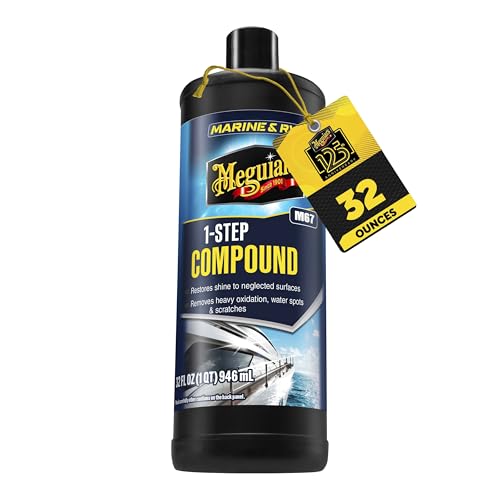
Meguiar’s Marine/RV One Step Compound (32 oz) is my go-to solution when restoring heavily oxidized fiberglass or gel coat surfaces on boats and RVs. This medium-grit formula uses 80-grit aluminum oxide abrasives to safely remove oxidation, scratches, and water spots. It’s 2.2 pounds, comes in a 3.74 x 2.56 x 8.86-inch container, and isn’t discontinued. I apply it with a rotary buffer, dual action polisher, or by hand-consistency stays strong across methods. Formulated for marine and RV use, it restores color depth and delivers a high-gloss finish. Meguiar’s, founded in 1901, backs this professional-grade product with over a century of surface care expertise.
Best For: Marine and RV owners seeking to restore heavily oxidized fiberglass or gel coat surfaces with professional-grade results.
Pros:
- Effectively removes moderate oxidation, scratches, stains, and water spots with 80-grit aluminum oxide abrasives
- Versatile application options using a rotary buffer, dual action polisher, or by hand
- Restores vibrant color depth and delivers a high-gloss, long-lasting finish on marine and RV surfaces
Cons:
- Medium-grit formula may be too aggressive for light surface defects or delicate finishes
- Requires careful application to avoid swirl marks, especially when used with a rotary buffer
- Slightly heavier weight and compact dimensions may limit ease of handling for some users
Meguiar’s Ultimate Compound 20 Oz
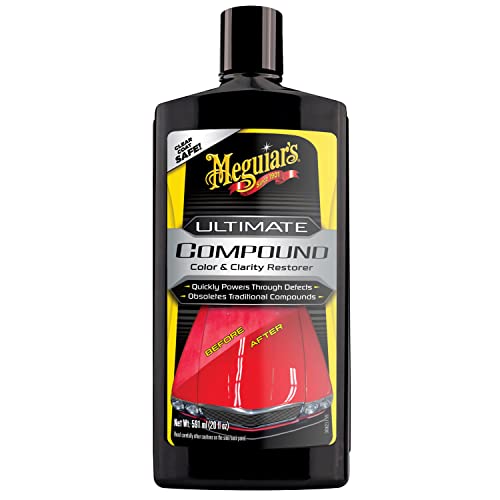
If you’re tackling moderate paint oxidation or swirl marks on a glossy finish, this compound delivers professional-grade correction without risking damage. I use Meguiar’s Ultimate Compound 20 oz (model G17220) on clear coats and single-stage paints daily. Its micro-abrasive formula contains aluminum oxide grit for medium-cut correction that removes defects fast. It eliminates light scratches, water spots, and blemishes in one step. I apply it with a dual action polisher like the MT300 or by hand, using circular motions on a cool, clean surface. Shake well. Wipe before drying. Results are visibly smoother, clearer, and glossier. Safe. Precise. Effective.
Best For: Enthusiasts and detailers seeking a medium-cut compound to correct moderate paint defects like swirls, oxidation, and light scratches on glossy clear coats.
Pros:
- Effectively removes swirl marks, oxidation, water spots, and light scratches with professional results
- Safe for all clear coat and single-stage paint finishes without causing damage
- Can be used by hand or with a dual action polisher for versatile application
Cons:
- May require multiple applications for severe paint defects
- Medium-cut abrasives may not be suitable for very light correction needs
- Requires a clean, cool surface for optimal performance, limiting use in direct sunlight
Upgraded Car Scratch Remover Kit 9.2oz
You get real results when you choose an oxidation remover that handles more than surface blemishes, and this 9.2oz Upgraded Car Scratch Remover Kit delivers exactly that for DIYers and car owners who want professional-level fixes without the shop cost. It repairs light to medium scratches, scrapes, and surface wear on paint. The formula works on most colors with minimal post-repair color shift. No sanding is needed-just apply the paste with the included applicator pad and wipe off. Repairs take 10 to 20 minutes. Polishing compounds boost shine and clarity. A protective, waterproof layer forms over treated areas. This layer blocks UV rays, resists rust, and prevents oxidation. It works on bumpers, wheels, mirrors, metal, and plastic. Compatible with most vehicles and paint finishes.
Best For: DIYers and car owners seeking quick, professional-level scratch repair without costly professional services.
Pros:
- Repairs light to medium scratches, scrapes, and surface wear without sanding or repainting
- Enhances shine and clarity with polishing compounds while forming a protective, waterproof layer
- Works on various surfaces including metal, plastic, bumpers, wheels, and mirrors for versatile use
Cons:
- Not effective for deep scratches that penetrate through the paint layer
- May cause slight color mismatch on certain paint types or finishes
- Limited to surface-level restoration; not a replacement for comprehensive paint repair
Rolite Pre-Polish Paste 4.5oz (1 Pack)

For professionals and detail-oriented enthusiasts who demand rapid, high-level metal restoration without compromising environmental responsibility, Rolite Pre-Polish Paste sets a strong benchmark. I rely on its 4.5-ounce, industrial-strength formula to dissolve heavy oxidation, rust, tarnish, and discoloration in seconds. It works on brass, bronze, chrome, copper, aluminum, nickel, stainless steel, and similar surfaces-including trophies, faucets, and sterling silver jewelry. I apply it with a microfiber cloth using circular motions; no buffers or power tools needed. It’s not for plated metals. The non-toxic, eco-friendly compound delivers professional results while staying safe for users and the environment.
Best For: Professionals and detail-oriented enthusiasts seeking an eco-friendly, industrial-strength metal restoration solution for removing heavy oxidation, tarnish, and discoloration on a variety of metal and coated surfaces.
Pros:
- Effectively removes heavy oxidation, rust, tarnish, and discoloration quickly with minimal effort
- Safe for user and environment with its non-toxic, eco-friendly formulation
- Requires no power tools-easy application using a microfiber cloth for professional-grade results
Cons:
- Not suitable for use on plated metals, limiting versatility
- Single 4.5oz pack may require repurchasing for larger or frequent restoration projects
- May require additional effort on severely corroded or pitted surfaces despite industrial strength
Meguiar’S M0416 Mirror Glaze Heavy-Cut Cleaner – 16 Oz Bottle

Meguiar’s M0416 Mirror Glaze Heavy-Cut Cleaner in the 16 oz bottle is the go-to solution for restorers and detailers facing heavily oxidized or damaged paint. I rely on its aggressive abrasive formula to remove deep swirls, scratches, and acid rain etching. It works fast, transforming into a buffing rouge that reduces heat and prevents new marring. I use it with a rotary buffer for maximum cutting power and flawless results. It’s safe on clear coats, enamel, and lacquer finishes. The buffered abrasives lubricate the surface, eliminating scouring. Body shops trust it. Meguiar’s has led auto care since 1901-125 years proves it works.
Best For: Detailers and restorers seeking to remove heavy paint defects like deep swirls, scratches, and oxidation on a wide range of glossy finishes.
Pros:
- Aggressive cutting action effectively removes severe paint imperfections including oxidation and etching
- Transforms into a buffing rouge to reduce heat and minimize the risk of new swirl marks
- Safe for use on clear coats, enamel, and lacquer finishes; trusted by professional body shops
Cons:
- Requires a rotary buffer for optimal results, limiting usability for casual users without proper equipment
- Heavy-cut formula may be too aggressive for minor defects or thin paint surfaces
- Higher skill level needed to avoid paint damage if not applied correctly
Oxide Reducing Emulsion for Car Paint & Headlights
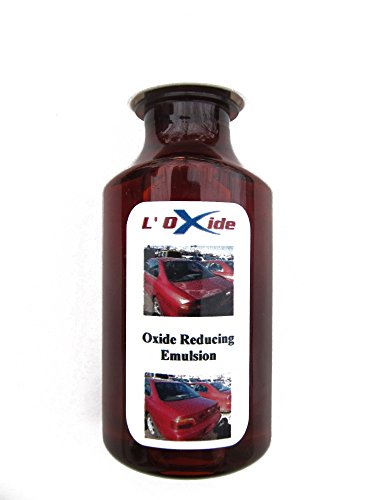
An oxide reducing emulsion delivers best results for vehicle owners dealing with surface oxidation on paint, clear coats, or polycarbonate headlights-especially when mechanical correction methods like wet sanding or buffing pose a risk of damage. I apply it like wax-no special tools needed. It penetrates sun-damaged clear coats, reversing faded paint to original color by dissolving oxidized layers. The formula revitalizes peeling clear coat and restores exterior trim without abrasives. On polycarbonate headlights, it removes yellowing, restoring up to 95% clarity. One coat lasts six months. Users confirm results in nearly one million YouTube views. It’s safe, effective, and requires zero buffing.
Best For: Vehicle owners looking to restore faded, oxidized, or sun-damaged paint and yellowed headlights without the need for polishing, sanding, or buffing.
Pros:
- Restores original color and clarity to oxidized paint and polycarbonate headlights without abrasives
- Easy wax-like application with no special tools or buffing required
- Revitalizes peeling clear coat and exterior trim while providing up to six months of protection
Cons:
- May not fully restore heavily damaged or deeply oxidized surfaces
- Results can vary depending on the severity of sun damage and age of clear coat
- Limited durability compared to professional paint correction and sealing methods
Collinite 415 Color Up Cleaner Compound (16 fl oz)

The Collinite 415 Color Up Cleaner Compound (16 fl oz) is built for detailers who demand controlled performance without aggressive cutting. It’s a light-duty pre-wax compound designed to remove surface film, light oxidation, brake dust, tar, and stains. I use it on clear coat and single-stage paint across all vehicle colors, plus metal and fiberglass. It won’t scratch or haze, making it ideal for routine paint prep. Apply it by hand or with a dual-action polisher-never use a rotary buffer. It won’t fix deep swirls or scratches but excels in surface decontamination. Think of it as a gentle cleanse, not a full paint correction.
Best For: Detailers and vehicle owners looking for a gentle, non-abrasive cleaner to remove light surface contaminants and prepare paint for waxing without causing scratches or hazing.
Pros:
- Effectively removes light oxidation, brake dust, tar, and surface stains without damaging clear coat
- Safe for use on painted surfaces, metal, and fiberglass with no hazing or marring
- Can be applied by hand or with a dual-action polisher for added convenience
Cons:
- Not suitable for removing deep scratches, swirl marks, or severe paint defects
- Should not be used on glass, rubber, or plastic trim surfaces
- Not recommended for use with rotary polishers, limiting machine compatibility
Factors to Consider When Choosing an Oxidation Remover for Cars
You need to match the remover to how bad the oxidation is-light haze needs mild abrasives, but heavy clouding requires compounds with stronger cutting power. Pick a product that works with your car’s surface, whether it’s clear coat, single-stage paint, or gelcoat on a boat, because using the wrong type can cause damage. Apply by hand or machine based on control and coverage: hand application is simpler, but a dual-action polisher with a foam pad gives faster, more consistent results.
Severity Of Oxidation
Most cases of paint oxidation fall into one of three categories-light, moderate, or severe-each requiring a specific type of oxidation remover for effective correction. Light oxidation shows as a chalky film and responds well to mild cleaning compounds with low-abrasive polymers, usually with particle sizes under 3 microns. You’ll restore clarity without risking paint thinning. Moderate oxidation creates a dull, hazy finish and demands medium-cut compounds with micro-abrasive technology, typically ranging from 3 to 6 microns. These safely strip the degraded layer while maintaining surface integrity. Severe oxidation leaves the paint rough and deeply faded, calling for heavy-cut compounds above 6 microns or multi-step polishing. These remove deeper flaws but require precision. Matching the remover’s abrasiveness to the oxidation level prevents over-correction, hazing, or unnecessary material loss. Always assess the damage first-your results depend on choosing the right cut level for your paint’s condition.
Surface Compatibility
Matching the abrasiveness of an oxidation remover to the severity of paint degradation sets the foundation for correction, but your success hinges just as much on surface compatibility. You must confirm the product is formulated for your paint type-clear coat or single-stage-since using the wrong compound risks irreversible damage. Aggressive formulas can haze or burn soft, aged finishes, leaving swirl marks that degrade shine. Always check if the remover is safe for gel coat, fiberglass, or metal when working on boats, RVs, or trim. Select a pH-balanced remover to preserve surface integrity and prevent chemical etching. Avoid products that aren’t heat-stable if you’re working in direct sun; rapid drying reduces dwell time and compromises oxidation removal. Your chosen formula should maintain effectiveness at surface temperatures up to 100°F.
Application Method
How you apply an oxidation remover can be just as critical as the product you choose. If you’re using a dual action polisher, pick a formula designed for it-these deliver swirl-free correction and are safer for DIYers. Rotary buffers remove defects faster but demand experience to prevent paint damage. For light oxidation or small areas, hand application works, though it takes more effort and repeat treatments. Some removers are versatile-safe for hand, dual action, or rotary use-giving you flexibility based on the job and skill level. Machine application cuts through oxidation quicker and more evenly than manual methods, saving time on larger surfaces. Always match the product’s recommended method to your tools and experience. Using the right application technique guarantees effective oxidation removal without compromising your paint’s integrity.
Cutting Strength
Cutting strength defines how well an oxidation remover attacks degraded paint layers, and choosing the right level is critical for safe, effective correction. You need stronger cutters for deep oxidation, moderate for hazy surfaces, and light for subtle dullness. Products with high abrasive grit-typically 2000–3000-remove thick oxidation fast but risk clear coat thinning if misused. Aluminum oxide abrasives deliver consistent, durable cutting with less smearing than silica-based alternatives. Match the product’s aggressiveness to your paint’s condition: too strong, and you’ll induce hazing or swirls; too mild, and results will be underwhelming. Some removers blend cutting efficiency with fine finishing, reducing the need for follow-up polishes. These dual-action formulas often use micro-abrasive technology to balance speed and surface protection. Always test on a small area first. You’ll get the best results when cutting power aligns precisely with paint wear.
Ease Of Use
You’ll save time and effort by choosing an oxidation remover that’s designed for straightforward application. Look for non-abrasive or micro-abrasive formulas you can apply by hand-no buffer or polisher required. These products reduce reliance on skill and equipment while still lifting surface oxidation. A simple circular rubbing motion is enough for effective results, eliminating the need for sanding or multi-step processes. Choose formulas that dry slowly-typically 2 to 5 minutes-giving ample working time without leaving heavy residue. The remover should wipe off cleanly with minimal effort, reducing dust and physical strain. Clear labeling and concise instructions guarantee correct use, even for beginners. Many top options require no ventilation or protective gear, simplifying safety precautions. Easy cleanup with a microfiber cloth enhances user convenience. These design features make oxidation removal accessible, repeatable, and efficient for routine car care.
Finish Quality
Smooth, reflective paint restoration starts with a product that prioritizes finish quality. You need an oxidation remover that eliminates dull, degraded clear coat while preserving underlying paint integrity. Finer abrasive particles-typically 3–5 microns-cut evenly, reducing the risk of swirl marks or hazing. As you buff, the formula should transform into a lubricating residue, enabling smooth pad movement and a clean wipe-off to minimize marring. A high-gloss finish depends on balanced cutting power and finishing capability. The best products achieve depth and clarity in one step, so you don’t need follow-up polishing. Look for formulations engineered to refine paint texture uniformly, matching the smoothness of healthy OEM finishes. This precision guarantees your car’s surface reflects light like new. Opt for removers that deliver both correction and shine without compromise.
Frequently Asked Questions
Can Oxidation Removers Be Used on Matte Paint Finishes?
No, you shouldn’t use oxidation removers on matte paint finishes. These products are formulated to abrade and polish clear coats, which disrupts the flat, non-reflective surface matte finishes require. Most contain micro-abrasives or solvents that increase gloss by flattening surface irregularities-counteracting the meticulously engineered texture of matte films. Using them risks creating shiny spots or uneven patches. Instead, you must use cleaners specifically designed for matte surfaces to preserve their low-sheen appearance without compromising protection.
Are These Products Safe for Ceramic-Coated Cars?
Yes, you can use oxidation removers on ceramic-coated cars, but only if they’re non-abrasive and pH-neutral. Harsh polishes strip the coating by breaking chemical bonds at the molecular level. Opt for products with <9 pH and no solvent carriers. Test on a small area first. Apply with a foam pad at 1200–1800 RPM to minimize heat. Overuse degrades hydrophobic properties. Always follow with a ceramic sealant to maintain protection and gloss long-term.
Do Oxidation Removers Work on Black Plastic Trim?
Yes, oxidation removers work on black plastic trim by breaking down degraded surface layers caused by UV exposure and environmental pollutants. They contain mild abrasives and solvents that dissolve chalky residues without stripping factory protectants. Use a soft microfiber applicator with circular motions to guarantee even dispersion. Most formulas are pH-neutral, preserving rubber seals and adjacent paint. Always follow with a UV protectant to prevent future fading and maintain long-term durability.
How Often Should I Use an Oxidation Remover?
You should use an oxidation remover only when oxidation is visible, typically every 3–6 months, depending on sun exposure and climate. Frequent use degrades clear coat over time. Most formulas contain abrasive compounds like aluminum oxide (1–5 microns) that remove a micro-thin layer of surface material. Apply with a foam pad at 1,200–1,800 RPM using a dual-action polisher for even results. Always follow with wax or sealant to protect restored surfaces.
Can I Apply These Compounds in Direct Sunlight?
You shouldn’t apply oxidation removers in direct sunlight. Heat from the sun speeds up solvent evaporation, reducing dwell time and effectiveness. Surface temperatures above 100°F can cause the product to dry too quickly, leading to residue and poor results. Work in shaded areas or during cooler hours. Maintain ambient temperatures between 50°F and 85°F for best performance. Always follow manufacturer guidelines to guarantee safe, effective application and maximum oxidation removal.