Best Trailer Hitch Balls for a Secure Tow Every Time
Choose a hitch ball that matches your trailer’s coupler size and weight demands. Use a 1-7/8-inch ball for loads up to 3,500 lbs, a 2-inch for up to 6,000 lbs, or a 2-5/16-inch for heavy-duty towing up to 10,000 lbs. Opt for hot-forged steel with chrome plating and a shank diameter that exactly fits your mount-3/4-inch or 1-inch-to prevent stress cracks. Torque fine-thread models to 160–250 lb-ft. Safety hinges on matching every component’s rating. The right setup guarantees stability, alignment, and long-term reliability in all conditions. More details follow on top models and their fitments.
We are supported by our audience. When you purchase through links on our site, we may earn an affiliate commission, at no extra cost for you. Learn more. Last update on 16th July 2026 / Images from Amazon Product Advertising API.
Notable Insights
- Match hitch ball size exactly to trailer coupler size to prevent instability or detachment during towing.
- Choose hot-forged steel balls with chrome or nickel-chrome plating for maximum strength and corrosion resistance.
- Ensure shank diameter and thread type match your ball mount to prevent movement and stress fractures.
- Install with proper torque-160 lb-ft for 2-inch balls and 250 lb-ft for 2-5/16-inch balls-for secure attachment.
- Confirm gross trailer weight and tongue weight ratings exceed your trailer’s requirements for safe towing.
Trailer Hitch Tri Ball Mount (2”)

If you need a versatile, heavy-duty solution for multiple trailer types, the Trailer Hitch Tri Ball Mount (2”) is your best choice. I rely on its triple ball design with 1-7/8″, 2″, and 2-5/16″ sizes, all in durable matte black plated steel. It fits any standard 2″ receiver. Each ball handles different loads: 3,500 lbs, 5,000 lbs, and 7,500 lbs GTW, respectively. The integrated hook supports up to 10,000 lbs GTW. Made from welded steel with powder-coated electroplating, it resists rust and corrosion. A self-locking latch and securing pin prevent disengagement. I use it daily on trucks, RVs, and farm trailers-it delivers.
Best For: Towing enthusiasts and professionals needing a durable, multi-purpose hitch solution for handling various trailer sizes and weights across RVs, trucks, and farm trailers.
Pros:
- Offers three hitch ball sizes (1-7/8″, 2″, and 2-5/16″) for maximum compatibility with different trailers
- Heavy-duty welded steel construction with rust-resistant powder-coated finish for long-term durability
- Integrated 10,000 lbs GTW hook and self-locking latch enhance safety and towing capacity
Cons:
- Heavier weight due to robust steel build may be cumbersome for some users
- Limited to 2” hitch receivers, reducing compatibility with smaller vehicles
- Higher price point compared to single-ball mounts may deter occasional users
CURT 40004 Chrome Trailer Hitch Ball

I rely on the CURT 40004 Chrome Trailer Hitch Ball when I need a durable, high-capacity towing solution for my heavy-duty trailer setups. It’s built from alloy steel and hot-forged for maximum strength. The 2-inch ball diameter fits standard couplers, with a 1-inch shank diameter and 2-1/8-inch shank length designed for Class 3 and 4 hitches. It handles up to 6,000 lbs gross trailer weight. Polished chrome plating resists rust, dirt, and scratches. Fine threads and a 250 lb.-ft. torque requirement guarantee a secure fit. It includes a zinc-plated hex nut and helical lock washer. Tested to U.S. VESC standards, it delivers reliable road safety.
Best For: Towing enthusiasts and professionals needing a reliable, high-capacity hitch ball for heavy-duty trailers with Class 3 or 4 hitches.
Pros:
- Durable alloy steel construction with hot-forged strength for long-lasting performance
- Polished chrome plating provides excellent resistance to rust, scratches, and environmental damage
- High 6,000 lb. towing capacity and includes locking hardware for secure attachment
Cons:
- 0-inch rise may not suit all hitch and trailer height configurations
- Requires precise torque (250 lb.-ft.) for safe installation, demanding a torque wrench
- Chrome finish, while corrosion-resistant, may show water spots or require polishing to maintain shine
CURT Fusion Trailer Hitch 7,500 lbs

The CURT Fusion Trailer Hitch 7,500 lbs is built for serious towing-ideal for truck and SUV owners who demand strength, compatibility, and corrosion resistance without compromise. It’s rated for 7,500 lbs gross trailer weight and 750 lbs tongue weight. Its welded one-piece design guarantees structural integrity under heavy loads. The 2-inch x 2-inch shank fits any standard receiver, offering universal compatibility. A 2-inch drop maintains level towing alignment. The rounded shank simplifies insertion. It comes with a 2-inch tow ball and hitch pin-ready to use out of the box. A black powder coat prevents rust, while the chrome-plated ball resists wear.
Best For: Truck and SUV owners who need a durable, high-capacity trailer hitch for heavy-duty towing with universal fit and corrosion resistance.
Pros:
- High 7,500 lbs towing capacity with a rugged, welded one-piece construction for superior strength
- Universal fit with a 2-inch shank that works with any standard receiver and includes a 2-inch drop for level towing
- Ready-to-use out of the box with a chrome-plated tow ball and hitch pin, featuring a black powder coat for long-lasting corrosion protection
Cons:
- Heavy and bulky, which may be excessive for light towing needs
- Chrome-plated ball may require periodic maintenance to prevent tarnishing in harsh environments
- No built-in lock included, requiring an additional purchase for theft prevention
CURT 40001 Chrome Trailer Hitch Ball 2000 lbs

This hitch ball suits light-duty towing needs, especially for small trailers like compact utility or camper models. I rely on its 2,000-lb gross trailer weight rating for secure, stable pulls. It’s built from hot-forged steel, so it handles stress without bending. The 1-7/8-inch ball diameter matches standard couplers on small trailers. Its 3/4-inch shank measures 1-5/8 inches long, ensuring a snug fit in compatible hitch receivers. Chrome plating resists rust, rain, and dirt. I tighten it with the included zinc-plated hex nut and lock washer to 160 lb.-ft. Fine threads prevent loosening. It meets U.S. VESC safety standards for trustworthy performance.
Best For: Those who need a reliable, rust-resistant hitch ball for light-duty towing of small trailers like compact utility or camper models.
Pros:
- Durable hot-forged steel construction handles stress without bending
- Chrome plating provides excellent resistance to rust, rain, and dirt
- Includes necessary hardware and meets U.S. VESC safety standards for secure towing
Cons:
- Limited to 2,000 lbs towing capacity, not suitable for heavy loads
- 1-7/8-inch ball size may not match larger trailer couplers
- Requires precise 160 lb.-ft. torque for proper installation
DEEAGLE 2″ Ball Hitch 6000lbs

Perfect for hauling heavy loads like campers, boats, or utility trailers, the DEEAGLE 2″ Ball Hitch handles up to 6,000 lbs gross trailer weight and 600 lbs tongue weight. I rely on its fully welded steel construction for maximum strength. It fits standard 2-inch receiver hitches with a 2-inch drop and 0.75-inch rise. The black powder-coated mount resists rust, while the chrome-plated 2″ ball adds durability. I include a hitch pin and ball-no tools needed for basic setup. A slight gap may occur due to manufacturing tolerances. I recommend an anti-rattle insert to minimize movement during towing.
Best For: Heavy-duty towing enthusiasts needing a durable, high-capacity ball hitch for campers, boats, or utility trailers.
Pros:
- Supports up to 6,000 lbs gross trailer weight and 600 lbs tongue weight for reliable heavy-load towing
- Constructed from fully welded steel with a black powder-coated finish and chrome-plated ball for strength and corrosion resistance
- Easy, tool-free setup with included hitch pin and ball, compatible with standard 2-inch receiver hitches
Cons:
- Slight gap may occur between hitch and receiver due to manufacturing tolerances
- Does not include an anti-rattle device, which may be needed to reduce movement during towing
- Limited to 2-inch drop and 0.75-inch rise, offering less adjustability for vehicles requiring different hitch heights
Nilight Chrome Trailer Hitch Ball (2,000 lbs)

You’re getting serious strength with a 2,000-pound gross trailer weight rating, making the Nilight Chrome Trailer Hitch Ball ideal for drivers hauling utility trailers, campers, or ATVs. I rely on its hot-forged steel core for durable performance under stress. The 1-7/8-inch ball diameter fits standard couplers securely. Its 1-inch diameter shank, 1-5/8 inches long, mounts firmly into hitch ball bases. Chrome plating resists rust, corrosion, and wear from weather. I include a zinc-plated hex nut and helical lock washer to prevent loosening. It meets U.S. VESC safety standards, ensuring trustworthy towing. Installation is quick with included hardware. I recommend it for boats, ATVs, and small trailers.
Best For: Drivers hauling utility trailers, campers, ATVs, or boat trailers needing a durable, 2,000-pound-rated hitch ball with reliable corrosion resistance.
Pros:
- Hot-forged steel construction ensures strength and durability under heavy loads
- Chrome plating provides excellent protection against rust, corrosion, and wear
- Includes zinc-plated hex nut and helical lock washer for secure, vibration-resistant installation
Cons:
- 2,000-pound capacity limits use to lighter trailers, unsuitable for heavy loads
- 1-7/8-inch ball size may not match larger trailer couplers requiring 2-inch balls
- Short 1-5/8-inch shank may not fit thicker or custom hitch mounts
CURT Trailer Hitch Ball 2-Inch Diameter
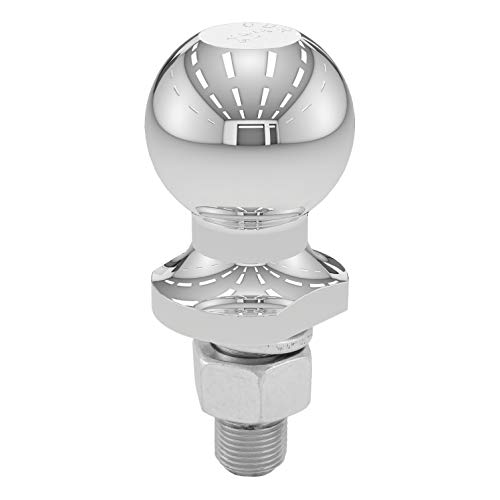
The CURT Trailer Hitch Ball with a 2-inch diameter delivers reliable performance for mid-weight trailers like small campers, utility trailers, and boat trailers. It’s rated for 3,500 pounds gross trailer weight-double the capacity of lighter models. Built from hot-forged steel, it handles stress without deforming. The 2-inch ball fits standard couplers universally. Its shank is 3/4 inch in diameter and 1-3/4 inches long, designed for secure receiver mounting. Chrome plating resists rust, dirt, and rain. A zinc-plated hex nut and helical lock washer guarantee tight fastening. Fine threads require 160 lb.-ft. of torque. It meets U.S. VESC safety standards for trustworthy towing reliability.
Best For: Towing mid-weight trailers like small campers, utility trailers, and boat trailers requiring a durable 2-inch hitch ball with 3,500-pound capacity.
Pros:
- Built from hot-forged steel for superior strength and resistance to deformation under stress
- Chrome-plated finish provides excellent corrosion resistance against rust, rain, and dirt
- Includes zinc-plated hex nut and helical lock washer for secure, vibration-resistant fastening
Cons:
- Requires 160 lb.-ft. of torque for installation, necessitating heavy-duty tools and precise tightening
- Fine-thread shank may be less compatible with certain hitch receivers or require thread care
- 3,500-pound limit may not suffice for heavy-duty towing applications
Reese Trailer Hitch Ball Mount Kit

I rely on the Reese Trailer Hitch Ball Mount Kit when I need a durable, ready-to-use towing solution for medium-duty trailers. It’s built with solid all-welded steel for reliable strength and safety. The kit handles up to 6,000 lbs. gross trailer weight and 600 lbs. of tongue weight. It fits 2-inch hitch receivers and includes a ball mount with a 2-inch drop for proper trailer leveling. A 2-inch trailer ball comes pre-attached. You also get a hitch pin with clip. It’s ideal for boat trailers, utility trailers, and campers. Each unit is tested to exceed SAE J684 standards. I trust its limited lifetime warranty and Reese’s legacy since 1952.
Best For: DIY enthusiasts and recreational vehicle owners who need a reliable, ready-to-use towing solution for medium-duty trailers like boats, campers, and utility trailers.
Pros:
- Solid all-welded steel construction provides dependable strength and safety for heavy loads
- Complete kit includes pre-attached 2-inch trailer ball, hitch pin with clip, and 2-inch drop ball mount for immediate use
- Fits standard 2-inch hitch receivers and tested to exceed SAE J684 standards with a limited lifetime warranty
Cons:
- Limited to 2-inch hitch receivers, not compatible with 1-1/4-inch receivers
- 2-inch drop may not suit all vehicle and trailer height combinations
- Weighs more than lightweight aluminum alternatives, which could matter for smaller vehicles
ORCISH Trailer Hitch Tri-Ball Mount
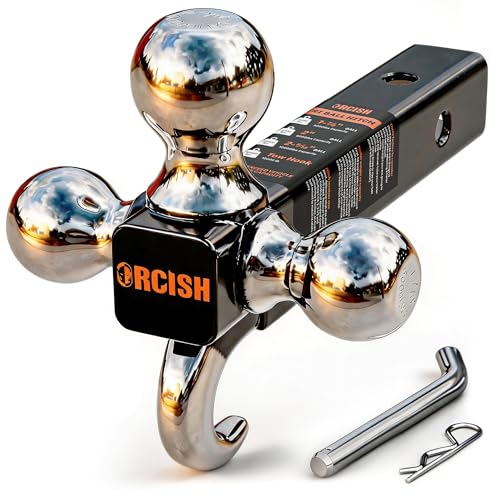
While some trailer hitch balls serve a single purpose, the ORCISH Trailer Hitch Tri-Ball Mount is built for people who demand versatility without sacrificing strength. It fits Class III/IV 2-inch receivers only-no 2.5-inch compatibility. I get three chrome-plated balls: 1-7/8 inch (5,000 lb), 2 inch (6,000 lb), and 2-5/16 inch (10,000 lb max). I rotate or remove the mount to switch sizes-no extra hardware needed. Its integrated tow hook handles up to 10,000 lb for recovery. Chrome plating resists scratches and wear. I use the included 5/8-inch hitch pin for stability. It’s ideal for boats, trailers, SUVs, and heavy-duty hauling.
Best For: Truck, SUV, and off-road vehicle owners who need a durable, multi-capacity hitch solution for towing a variety of trailers without switching mounts.
Pros:
- Features three trailer ball sizes (1-7/8″, 2″, and 2-5/16″) with up to 10,000 lb capacity for versatile towing needs
- Includes an integrated 10,000 lb-rated tow hook and a 5/8-inch hitch pin for enhanced stability and recovery use
- Chrome-plated components provide improved scratch resistance and durability in tough outdoor conditions
Cons:
- Compatible only with 2-inch receiver hitches; not suitable for 2.5-inch receivers
- Chrome plating may degrade over time with prolonged exposure to moisture or harsh weather
- Rotating or removing the mount to switch ball sizes may be less convenient than quick-swap systems
CURT 40007 Trailer Hitch Ball
Need a heavy-duty trailer hitch ball that won’t quit under pressure? I rely on the CURT 40007 for loads up to 10,000 lbs. It’s built from hot-forged steel, delivering unmatched strength. The 2-5/16-inch ball fits most standard couplers. Its 1-inch diameter shank is 2-1/4 inches long, ensuring deep, stable receiver engagement. Chrome plating resists rust, rain, and grime. I torque it to 250 lb-ft using the included zinc-plated hex nut and helical lock washer. Fine-thread design enhances clamp force. It meets strict U.S. VESC safety standards-no guesswork, just proven performance. This ball stays solid mile after mile.
Best For: Towing enthusiasts and professionals needing a reliable, high-capacity hitch ball for heavy loads up to 10,000 lbs.
Pros:
- Constructed from hot-forged steel for superior strength and durability
- Chrome-plated finish provides excellent resistance to rust, rain, and dirt
- Includes necessary hardware and meets U.S. VESC safety standards for secure, code-compliant towing
Cons:
- Requires a torque of 250 lb-ft, necessitating specialized tools for proper installation
- Fine-thread shank may not be compatible with all hitch receivers
- Chrome finish, while durable, can show scratches over time with heavy use
Factors to Consider When Choosing a Trailer Hitch Ball
You need to match the ball size to your trailer coupler-common sizes are 1-7/8″, 2″, or 2-5/16″, and using the wrong one risks a dangerous disconnect. Your hitch ball must support the trailer’s gross weight, so check both gross trailer weight (GTW) and tongue weight (TW) ratings to avoid overloading. Shank diameter, length, and thread size must fit your receiver and drawbar, while a corrosion-resistant finish like chrome or zinc plating keeps performance reliable in wet conditions.
Ball Size Compatibility
Choosing the right trailer hitch ball starts with matching the ball diameter to your trailer’s coupler size-a critical step that guarantees safe and secure towing. You must verify the coupler size stamped on your trailer-it’s usually 1-7/8 inches, 2 inches, or 2-5/16 inches. A 1-7/8-inch ball fits small trailers and handles up to 3,500 pounds gross trailer weight. The 2-inch ball is a common choice for utility and boat trailers, supporting up to 6,000 pounds. For heavy-duty towing, use a 2-5/16-inch ball-rated from 7,500 to 10,000 pounds-ideal for large trailers and heavy loads. A mismatched ball and coupler can cause trailer instability, excessive wear, or detachment. Always double-check the measurement. Using the correct size assures a snug, wobble-free connection and keeps your cargo and vehicle safe on the road.
Weight Capacity Match
Every ounce of towing safety hinges on proper weight capacity matching between your trailer hitch ball and the load it pulls. Always match the ball’s gross trailer weight (GTW) rating to your heaviest planned trailer-it must equal or exceed the trailer’s total weight. The lowest-rated part in your system-ball, hitch, or vehicle-sets your max safe capacity. Use a 1-7/8-inch ball for loads up to 3,500 lbs, a 2-inch ball for up to 6,000 lbs, and a 2-5/16-inch ball for 10,000 lbs or more. Don’t ignore tongue weight-your ball and mount must support 10–15% of the GTW. Exceeding capacity risks sudden failure, even if the ball looks fine. A trailer crash isn’t caused by weak trailers-it’s caused by overlooked limits. Choose right, stay within ratings, and tow with confidence.
Shank Dimensions Matter
A precise match between shank dimensions and ball mount specifications is non-negotiable for safe towing. You must guarantee the shank diameter exactly fits the ball mount hole-typically 3/4 inch or 1 inch-to prevent movement and stress fractures. A loose fit creates dangerous play, weakening the connection under load. The shank length is equally critical: it must fully engage the mounting hole and extend through the ball mount so the locking nut secures properly. You need at least 1/8 inch of thread visible past the nut for a reliable hold. A short shank risks thread stripping and sudden failure. Use fine-thread shanks when possible-they provide stronger clamping force and resist vibration loosening better than coarse threads. Always match the shank specs to your mount’s design for a secure, stable tow.
Corrosion Resistance Essential
While environmental exposure can rapidly degrade metal components, corrosion resistance in trailer hitch balls isn’t optional-it’s essential for safety and longevity. Chrome plating shields against rust, rain, and scratches, making it ideal for wet or salty conditions. You’ll benefit from its smooth finish, which resists pitting and maintains strength. Nickel-chrome plating goes further, forming a dense barrier that protects underlying steel even under heavy use. For added protection, powder-coated finishes withstand road salt and constant moisture without chipping. They’re perfect for winter climates or coastal areas. Zinc-plated washers and nuts prevent galvanic corrosion, ensuring your assembly stays secure. Choose hot-forged steel cores with these coatings-they resist oxidation and hold up under stress. Together, these features extend service life and maintain structural integrity. Don’t risk failure; prioritize materials that fight corrosion at every level. Your trailer’s safety depends on it.
Hitch Type Alignment
You’ve secured a corrosion-resistant hitch ball built to last, but that protection means nothing if the ball doesn’t match your trailer’s setup. Match the hitch ball diameter-commonly 1-7/8”, 2”, or 2-5/16”-exactly to your trailer coupler size; even a 1/16” mismatch risks detachment. Confirm the shank diameter and length fit your ball mount perfectly to prevent play or instability under load. Use a ball with the correct rise or drop to keep your trailer level, typically requiring 0” to 6” adjustment based on vehicle and trailer heights. Never exceed the lowest GTW rating in your towing system-your hitch ball must meet or exceed it. Always pair fine-thread shanks with matching fine-thread mounts for secure torque application and vibration resistance. Proper alignment guarantees control, safety, and longevity in every tow.
Frequently Asked Questions
Can Trailer Hitch Balls Be Used on Different Vehicles?
Yes, you can use trailer hitch balls on different vehicles as long as they match the receiver size, shank diameter, and rise or drop requirements. Most hitch balls use standard 1-1/4″, 1-7/8″, or 2″ diameters with 3/4″ or 1″ shanks. You must verify your vehicle’s class rating-Class I to V-supports the ball’s load capacity. Always match the ball’s rated capacity to the trailer’s GTWR for safe, compliant towing performance across various vehicles.
Are Trailer Hitch Balls Universal for All Trailers?
No, trailer hitch balls aren’t universal for all trailers. You must match the ball size to your trailer’s coupler-common sizes are 1-7/8”, 2”, and 2-5/16”. A 2” ball fits most light-duty trailers, while larger ones handle heavier loads. Always check tongue weight and gross trailer weight ratings. Using the wrong size risks detachment. Think of it like a key and lock-proper fit guarantees safety, stability, and control on every tow.
How Often Should I Replace My Trailer Hitch Ball?
You should replace your trailer hitch ball every 2–3 years or immediately if you spot wear. Cracks, rust, or threading damage compromise safety. Check the shank diameter-most are 3/4″ or 1″-and verify it matches your receiver. A worn ball reduces coupling efficiency, increasing sway. Inspect the spepære’s surface; deep grooves over 0.030″ demand replacement. Corrosion weakens structural integrity. Always torque the nut to manufacturer specs. Replace it after any overloading incident.
Do Trailer Hitch Balls Need Lubrication Before Use?
Yes, you should lubricate your trailer hitch ball before each use. Lubrication reduces friction between the ball and coupler, preventing wear and ensuring a smooth connection. Use a heavy-duty, weather-resistant grease like lithium-based or marine-grade grease. Apply a thin, even coat over the entire ball surface. Never use oil or dry lubricants-they don’t provide sufficient protection under heavy loads. Proper lubrication improves safety and extends equipment life.
Can a Rusted Trailer Hitch Ball Be Safely Repaired?
No, you can’t safely repair a rusted trailer hitch ball. Corrosion weakens the steel, reducing its tensile strength and load capacity. Surface rust might seem minor, but pitting compromises structural integrity. Even after grinding, the ball’s diameter-typically 1-7/8″, 2″, or 2-5/16″-may fall below spec, risking trailer detachment. Replacement is required. Use grade S or T balls with a minimum 2,000-pound safety margin. Rust means it’s already failed.